
n the scientific study of life, understanding how an organism responds to its environment is the key to mastering both sustainable pest control and advanced ecological conservation. By categorizing the various types of insect behavior, we can see that these creatures operate through a sophisticated mix of “hardwired” biological code and “soft” learned experiences that have been refined over millions of years. In 2026, researchers are increasingly using these behavioral classifications to build more efficient AI models and smarter agricultural traps, proving that even the most basic movement has a high-level computational purpose.
The fundamental architecture of these biological systems is divided between innate responses, which are genetically inherited, and learned behaviors that allow for individual adaptation. Innate types of insect behavior act as the “factory settings” of the insect mind, ensuring that life-critical tasks like spinning a web or performing a mating dance are executed perfectly from birth without prior training. However, the scope of these behaviors is not strictly rigid; many insects demonstrate an impressive capacity for habituation and conditioning, allowing them to modify their actions based on repeated environmental stimuli or successful foraging experiences.
Beyond internal programming, the way an insect navigates its surroundings through orientation specifically via kinesis and taxis reveals a high degree of directional intelligence. These types of insect behavior allow a species to move toward beneficial resources like light and moisture or away from lethal threats like predators and toxic chemicals. By decoding these movement patterns along with biological rhythms like periodicity, we can gain a complete view of the “biological software” that allows insects to dominate almost every ecosystem on Earth, providing us with the tools to manage them with scientific precision.
The Hardwired Mind: Innate vs. Learned Foundations of Insect Behavior
In the scientific study of life, the fundamental architecture of the insect mind is built upon a dual-system approach. While many organisms rely on complex deliberation, the various types of insect behavior are largely divided between hardwired genetic instructions and the ability to modify those instructions based on environmental feedback. This balance ensures that an insect can perform life-critical tasks immediately upon hatching while still possessing the flexibility to adapt to the unique challenges of its specific habitat.
Genetic Programming: Why Certain Actions are Unstoppable
Innate behaviors represent the factory settings of the insect world. These are heritable and intrinsic actions performed perfectly the very first time without any prior training or observation. Because these types of insect behavior are hardwired into the nervous system, they often manifest as “Fixed Action Patterns” that are virtually unstoppable once triggered. A classic example is a silk-spinning caterpillar that will continue its rhythmic head movements even if the silk is removed because the biological program must run to its conclusion regardless of the external result.
The Experience Factor: How Learning Refines Instinct in 2026
Contrary to the myth that insects are merely tiny robots, many types of insect behavior are actually refined through trial and error. Bees, for instance, learn which specific flower shapes and colors in their local area yield the highest sugar content, significantly increasing their foraging efficiency over several days. In 2026, researchers are discovering that these learned associations allow insects to navigate changing landscapes, proving that experience acts as a sophisticated filter for their base instincts.
Habituation and Conditioning: Adapting to a Changing Environment
Habituation is one of the most practical types of insect behavior where an individual learns to ignore a repetitive stimulus that provides neither a threat nor a reward. A common example is a cockroach eventually ignoring the vibration of a nearby appliance once it realizes the movement does not signal a predator. Conversely, classical conditioning allows insects to associate a neutral stimulus with a positive outcome. This trait is currently being used in 2026 to train honeybees to detect specific chemical signatures by associating those scents with a reward of sugar water.
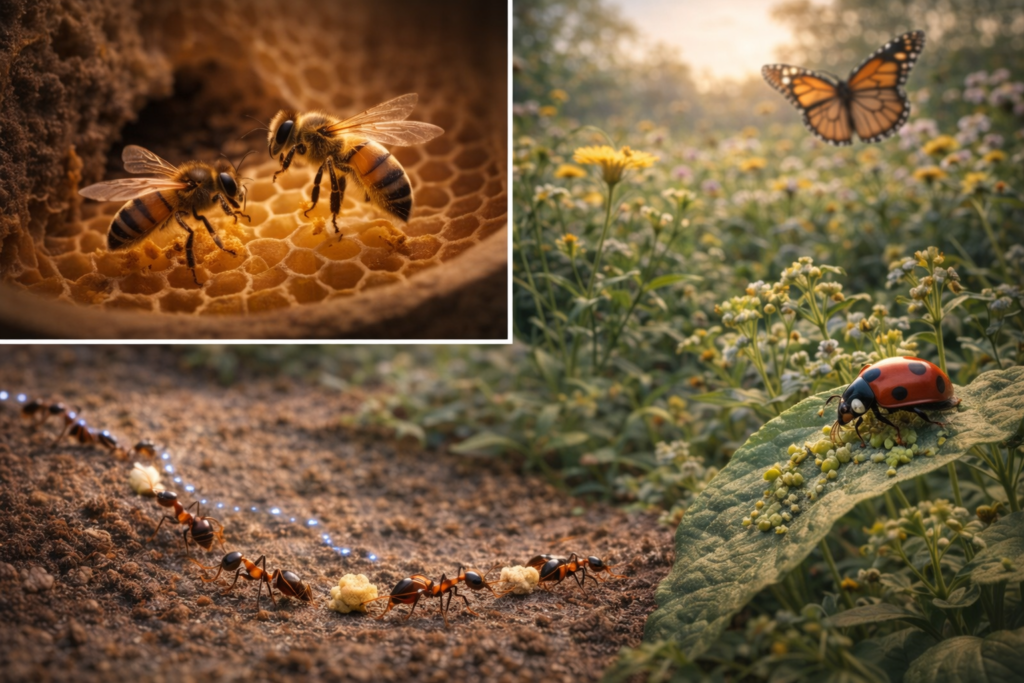
Rapid Responses: The Mechanics of Simple and Complex Reflexes
In the scientific study of life, the way an organism moves through its environment is a testament to its survival strategy. These specific types of insect behavior are categorized by how an individual reacts to a gradient of stimuli such as light, moisture, or chemical concentration. By understanding these navigational rules, we can predict where a population will congregate and how they will seek out the resources necessary for their growth.
Kinesis: Random Walks and Undirected Speed Adjustments
Kinesis is a non-directional response where the intensity of a stimulus affects the speed or the rate of turning but not the actual direction of travel. In this mode, an insect might move faster in an unfavorable environment to increase its chances of stumbling upon a better location. A woodlouse, for example, will increase its activity in dry air and slow down significantly once it reaches a moist area. This ensures it spends the majority of its time in the damp conditions it needs to survive without ever intentionally “steering” toward them.
Taxis: Precision Movement Toward Light, Chemicals, and Gravity
Unlike random movement, taxis is a directed response where an insect moves specifically toward or away from a source. This is a highly calculated action that relies on the insect’s ability to compare the strength of a signal between its two antennae or eyes. Whether it is a moth flying toward a flame or an ant following a pheromone trail, these actions allow for high precision in locating mates, food, and nesting sites.
Phototaxis and Chemotaxis: How Insects Locate “Hot Zones”
Phototaxis and chemotaxis are specialized forms of directed movement that govern how insects interact with light and chemical signals. Positive phototaxis draws many nocturnal species toward artificial light sources, while negative phototaxis drives soil dwelling insects into the dark safety of the earth. Chemotaxis is perhaps the most advanced of these mechanisms, allowing a predator to track the minute chemical signature of its prey across vast distances by constantly adjusting its path to follow the strongest scent gradient.
Directional Intelligence: Navigating the World Through Kinesis and Taxis
In the scientific study of life, the way an organism moves through its environment is a testament to its survival strategy. These specific types of insect behavior are categorized by how an individual reacts to a gradient of stimuli such as light, moisture, or chemical concentration. By understanding these navigational rules, we can predict where a population will congregate and how they will seek out the resources necessary for their growth.
Kinesis: Random Walks and Undirected Speed Adjustments
Kinesis is a non-directional response where the intensity of a stimulus affects the speed or the rate of turning but not the actual direction of travel. In this mode, an insect might move faster in an unfavorable environment to increase its chances of stumbling upon a better location. A woodlouse, for example, will increase its activity in dry air and slow down significantly once it reaches a moist area. This ensures it spends the majority of its time in the damp conditions it needs to survive without ever intentionally steering toward them.
Taxis: Precision Movement Toward Light, Chemicals, and Gravity
Unlike random movement, taxis is a directed response where an insect moves specifically toward or away from a source. This is a highly calculated action that relies on the insect’s ability to compare the strength of a signal between its two antennae or eyes. Whether it is a moth flying toward a flame or an ant following a pheromone trail, these actions allow for high precision in locating mates, food, and nesting sites.
Phototaxis and Chemotaxis: How Insects Locate “Hot Zones”
Phototaxis and chemotaxis are specialized forms of directed movement that govern how insects interact with light and chemical signals. Positive phototaxis draws many nocturnal species toward artificial light sources, while negative phototaxis drives soil dwelling insects into the dark safety of the earth. Chemotaxis is perhaps the most advanced of these mechanisms, allowing a predator to track the minute chemical signature of its prey across vast distances by constantly adjusting its path to follow the strongest scent gradient.
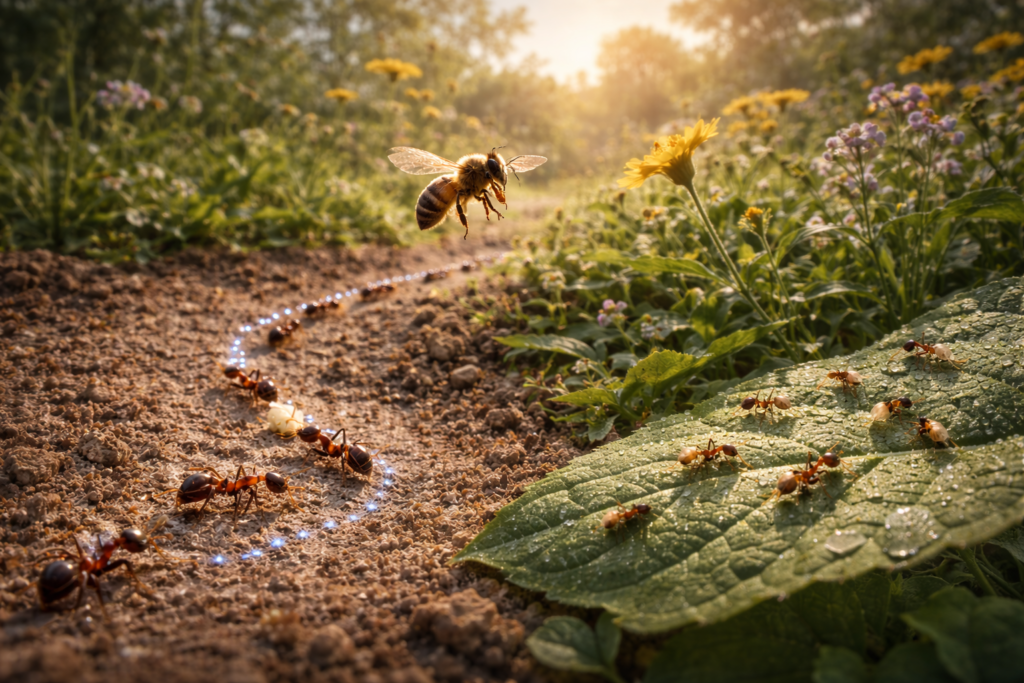
Biological Clocks: Periodicity and the Rhythms of the Insect World
In the scientific study of life, the ability to tell time is just as critical as the ability to find food. These rhythmic types of insect behavior are governed by internal biological clocks that allow an organism to anticipate environmental changes before they occur. By synchronizing their activities with the rotation of the Earth and the changing of the seasons, insects ensure they are active only when conditions are most favorable for their survival and reproduction.
Circadian Rhythms: The 24-Hour Cycle of Sleep and Foraging
Circadian rhythms are the most common internal timers, regulating activities over a roughly 24-hour period. These cycles determine whether an insect is diurnal, nocturnal, or crepuscular. For example, honeybees use their internal clock to remember the exact time of day specific flowers secrete the most nectar, allowing them to optimize their foraging trips. Even in total darkness, these rhythms persist, proving that the behavior is driven by an internal genetic mechanism rather than just a simple reaction to sunlight.
Seasonal and Lunar Periodicity: Timing Migrations and Mating
Beyond the daily cycle, many insects follow longer-term rhythms tied to the moon or the shifting seasons. Lunar periodicity is often seen in aquatic insects that swarm and mate in massive numbers during specific moon phases to overwhelm predators. Seasonal rhythms are even more dramatic, triggering long-distance migrations like those of the Monarch butterfly. These movements are precisely timed to ensure the insects arrive in warmer climates or find fresh host plants exactly when they are needed for the next generation. All of these cyclical types of insect behavior are essential for maintaining population levels and ensuring that life cycles remain synchronized with the ever-changing global environment.
Diapause: The Behavioral Strategy of Environmental “Hibernation”
Diapause is a sophisticated state of suspended animation that allows insects to survive extreme conditions like the freezing winters or intense summer heat of Punjab. Unlike simple sleep, diapause is a hormonal shift that stops development and drastically lowers the metabolic rate. This is a proactive survival strategy where the insect “shuts down” in response to shortening day lengths or falling temperatures, ensuring it remains dormant until the environment is safe enough for it to resume its life cycle.
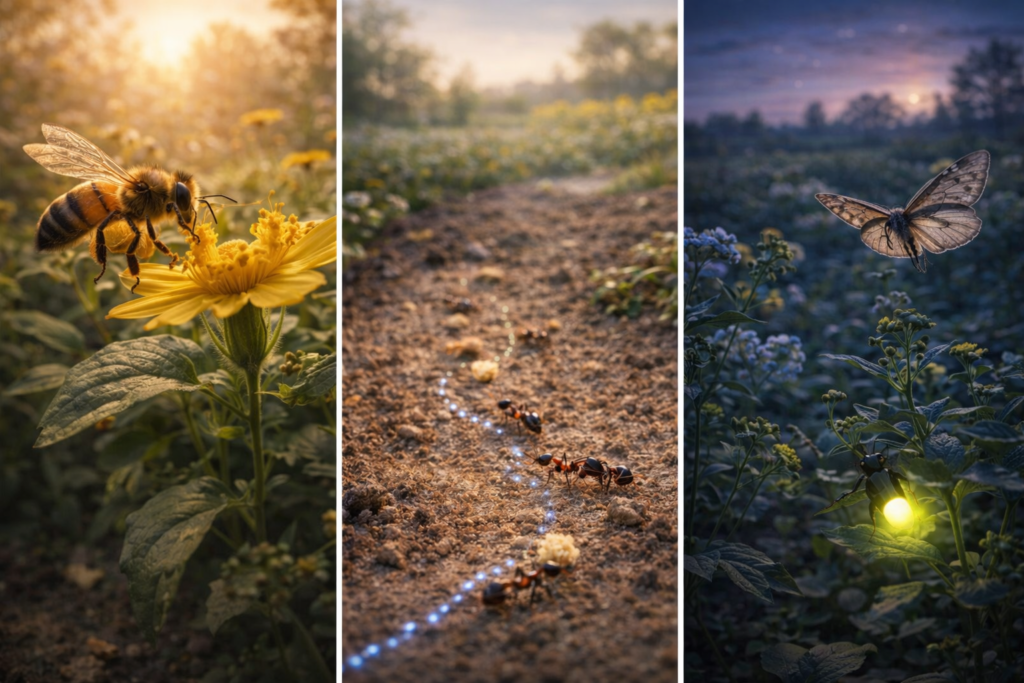
Comparative Analysis: Key Differences in Behavioral Modalities
In the scientific study of life, distinguishing between various biological responses is essential for understanding how a species thrives or fails in a changing environment. This comparative analysis clarifies the different types of insect behavior by highlighting the unique advantages and limitations of each. By mapping these modalities, researchers and designers can better simulate or manage the complex interactions between insects and their ecological niches.
Innate vs. Learned: Evolution vs. Experience
The primary difference between these two states lies in the source of the information. Innate behaviors are the result of millions of years of natural selection and are encoded directly into the DNA, making them uniform across an entire species. These actions are perfect from birth but lack flexibility. In contrast, learned behaviors are the result of an individual’s unique life history and are acquired through trial and error. While innate patterns ensure a baseline for survival, learning allows an insect to adapt to specific, local changes that evolution could not have predicted. These contrasting types of insect behavior demonstrate how a species balances hardwired survival instincts with the cognitive flexibility needed to thrive in a fluctuating environment.
Kinesis vs. Taxis: Random Search vs. Targeted Navigation
When observing movement, the distinction between kinesis and taxis is defined by the presence or absence of a specific direction. Kinesis is an undirected response where an insect simply changes its speed or rate of turning based on the intensity of a stimulus, essentially wandering until it hits a favorable zone. Taxis is a highly directed response where the insect uses its sensory organs to orient its body specifically toward or away from a source. While kinesis is an efficient way to find a general habitat, taxis provides the precision needed for complex tasks like tracking a mate or locating a specific host plant. Both navigation methods represent essential types of insect behavior that allow a species to optimize its position within an ecosystem for maximum survival.
Conclusion: Mastering Behavioral Types for Advanced Pest Management
In the scientific study of life, the ability to categorize and influence the various types of insect behavior represents the most significant shift from traditional chemical reliance to high-precision ecological management. By mastering the distinction between innate instincts and learned adaptations, we can design environments that disrupt life-critical cycles or exploit natural reflexes to lead pests away from our crops and homes. This behavioral literacy allows for the development of “smart” interventions such as pheromone-based taxis disruption or the manipulation of circadian rhythms to ensure that our agricultural and urban spaces remain protected. Ultimately, understanding these biological rules transforms our approach to pest control into a sophisticated strategy of informed co-existence, where we use the insects’ own hardwired logic to maintain the delicate balance of our global ecosystems.
FAQs: Common Questions on Instinct, Learning, and Navigation
Can an insect really learn, or is everything just instinct? While most actions are innate, many species show a high capacity for learning through experience. Honeybees can learn to associate specific colors with food rewards, and some insects even demonstrate habituation by learning to ignore non-threatening shadows or sounds. This proves that while their factory settings are instinctual, their biological software can be updated by their environment through different types of insect behavior.
What is the main difference between kinesis and taxis? The simplest way to distinguish these types of insect behavior is by direction. Kinesis is an undirected movement where an insect simply changes its speed or turning rate based on a stimulus, like a woodlouse speeding up in dry air to find moisture. Taxis is a directed movement where the insect orients its body specifically toward or away from a source, such as a moth flying directly toward a light.
How do insects know when to sleep or migrate? Insects rely on internal biological clocks known as circadian rhythms to manage their 24 hour cycles of sleep and foraging. For longer-term activities like migration or mating, they use seasonal periodicity, which is triggered by changes in day length and temperature. These rhythmic types of insect behavior ensure they are active only when their specific environmental window is open.
Why do some insects stop moving entirely during winter? This is a specialized state called diapause. It is a hormonal shutdown that is far more advanced than simple sleep, allowing the insect to survive extreme cold or drought by halting its development and lowering its metabolism. It is a proactive survival strategy that ensures the population survives until favorable conditions return.
How does a reflex differ from a fixed action pattern? A reflex is a near-instantaneous, simple response to a single stimulus, such as a cockroach’s leg jerking away from a touch. A fixed action pattern is a more complex sequence of innate movements that, once triggered, must be performed to completion, such as a wasp building a specific cell in its nest even if the initial conditions change.


