
In the scientific study of life, we have discovered that the natural world is far from silent; it is filled with a constant stream of biological data. The various forms of communication in insects represent a complex “language of survival” that allows these organisms to coordinate everything from mass migrations to the defense of a single hive. In 2026, researchers are decoding these signals to better understand how millions of individuals can act as a single, intelligent unit, providing us with a blueprint for advanced robotics and more sustainable agricultural management.
The fundamental success of any insect colony or species depends on its ability to send and receive clear, actionable information. Unlike human language, communication in insects utilizes a multi-sensory approach that combines chemical markers, physical vibrations, and visual displays to bridge the gap between individuals. These behavioral patterns are not merely random actions but are highly refined signaling systems that have evolved over millions of years to ensure that critical messages—such as the location of a food source or the approach of a predator—are transmitted with near-perfect accuracy.
As global environments continue to shift, the importance of understanding these signaling methods has never been higher. By mastering the science behind communication in insects, we gain the ability to protect essential pollinators and develop non-toxic pest management strategies that utilize the insects’ own “data streams” against them. This master guide explores the intricate networks of the insect world, revealing how the smallest wonders of nature use the power of communication to dominate nearly every ecosystem on our planet.
Decoding the Signal: The Fundamentals of Insect Behavioral Patterns
In the scientific study of life, the transition from basic survival to complex interaction is driven by the reliability of the signals sent between individuals. To understand the various forms of communication in insects, we must first look at the behavioral foundations that allow a solitary organism to evolve into a member of a high-functioning society. These behavioral patterns act as the hardware upon which the software of social communication is built, enabling insects to navigate a world filled with competing sensory data.
From Solitary to Social: The Evolution of Interaction
The evolution of sociality in the insect world is a journey from independent survival to total interdependence. Most primitive communication in insects began as simple “cues,” such as the scent a beetle leaves behind, which others might unintentionally follow. Over millions of years, these accidental cues were refined into intentional signals. This shift allowed solitary hunters to evolve into “eusocial” colonies, like those of ants and termites, where individual behavior is entirely sacrificed for the collective good of the hive through constant, real-time data sharing.
Signal vs. Noise: How Insects Filter Critical Information
In a crowded ecosystem, the air and ground are saturated with “noise,” including irrelevant scents, wind vibrations, and light reflections. Effective communication in insects requires a high degree of signal filtering to ensure that a vital message is not lost. Insects achieve this through specialized sensory tuning, where their receptors are “locked” to a specific frequency or chemical structure. For instance, a male moth’s antennae are so finely tuned to the specific pheromone of a female that they can detect a single molecule amidst millions of other scent particles, demonstrating an incredible biological ability to isolate a signal from the noise of the environment.

The Four Pillars of Communication in Insects
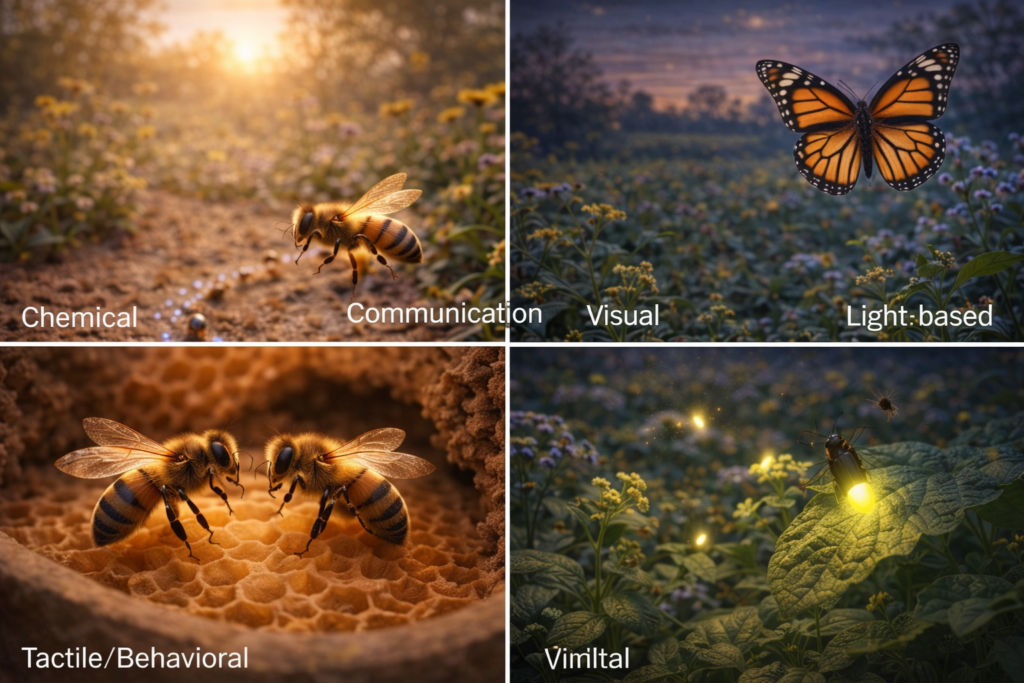
In the scientific study of life, the complexity of an insect’s world is managed through four primary sensory channels. These “pillars” represent the diverse methods of communication in insects, each serving a specific environmental or social purpose. By utilizing these distinct streams of data, insects can coordinate complex tasks across large distances or within the crowded, dark tunnels of a subterranean nest.
Chemical Networks: The Invisible World of Pheromones
Chemical signaling is the most widespread and ancient form of communication in insects. Pheromones are specialized chemical secretions that trigger a specific behavioral response in other members of the same species. These can range from “alarm pheromones” that call a colony to battle, to “trail pheromones” used by foragers to map a path to food. Because chemicals linger in the air or on surfaces, they act as a persistent messaging system that functions perfectly even in total darkness.
Acoustic Engineering: Using Vibration and Sound as Data
Many insects use sound and mechanical vibrations to transmit information through the air, water, or solid substrates. This form of communication in insects is often used for long-range attraction, such as the loud “songs” of crickets and cicadas produced by stridulation. However, it also includes “substrate-borne” vibrations, where insects tap or drum their bodies against leaves or wood to send private alerts to nearby colony members, bypassing the ears of flying predators.
Visual Displays: Color, Light, and Motion-Based Signaling
Visual signals are rapid and highly effective in well-lit environments or through specialized biological light. This pillar of communication in insects includes everything from the bright, warning colors of a toxic butterfly to the rhythmic flashes of a firefly’s abdomen. Motion also plays a key role, where specific flight patterns or body “posturing” tell a competitor to back off or a mate to approach, providing an immediate “read” of the sender’s intent.
The Power of Touch: Tactile Feedback in Colony Logistics
Tactile or physical communication is the backbone of short-range social interaction. In the dense population of a hive, communication in insects often involves “antennation,” where individuals touch antennae to exchange chemical and mechanical data. This “physical handshake” allows social insects to recognize nestmates, assess the health of the queen, and even gauge the hunger levels of other workers, ensuring the colony’s logistics remain balanced and efficient.
Advanced Data Sharing: Communication in Social “Superorganisms”
In the scientific study of life, the most impressive display of collective intelligence is found in social “superorganisms.” These colonies operate as a single unit where the biological exchange of data reaches a level of sophistication comparable to human logistics networks. By sharing high-fidelity information across the group, these organisms can solve complex problems—such as navigating to distant resources or defending massive territories—that would be impossible for a solitary individual to manage.
The Waggle Dance: Precise Spatial Data in Honeybees
The honeybee waggle dance is perhaps the most famous example of symbolic communication in insects. When a forager finds a rich patch of flowers, she returns to the hive and performs a figure-eight dance on the vertical honeycomb. The angle of her run relative to “up” (gravity) tells other bees the direction of the food relative to the sun, while the duration of the “waggle” phase indicates the exact distance. This allows the colony to deploy its workforce with surgical precision to the most profitable locations.
Pheromone Highways: The Logistics of Ant Trail Management
Ants manage their foraging efforts through dynamic chemical networks known as pheromone highways. This form of interaction utilizes a positive feedback loop where a successful forager lays a scent trail from the food back to the nest. As more ants follow the trail and find food, they add their own pheromones, making the signal stronger. Conversely, if the food source runs out, the pheromones naturally evaporate and the trail shuts down, allowing the colony to reallocate its workers to more productive areas without wasting energy.
Termite Vibrations: Rapid Emergency Response Systems
Because termites often live in total darkness, they rely heavily on mechanical signals for colony defense. This tactile method involves soldier termites head-banging against the tunnel walls when they detect a breach or a predator. These vibrations travel rapidly through the hard-packed soil or wood of the mound, acting as a colony-wide alarm system. In 2026, bio-acoustic research shows that these pulses are rhythmic and coded, allowing termites to distinguish between a minor structural disturbance and a full-scale invasion.
Ecological Interference: How the Environment Shapes the Signal
In the scientific study of life, we are discovering that external factors can significantly distort or even silence the natural flow of biological information. These challenges to communication in insects occur when environmental changes interfere with the physical or chemical properties of the message being sent. As we look at the state of biodiversity in 2026, understanding these signal breaks is essential for protecting the delicate balance of our global food systems and natural habitats.
Climate Shifts: The Impact of Heat on Pheromone Volatility
Temperature is a critical variable in chemical signaling because it controls how quickly molecules evaporate into the air. In hotter climates, pheromones can become too volatile, evaporating so quickly that a trail or an attraction signal disappears before it can be received. This can cause a breakdown in colony logistics where ants can no longer find their way back to the nest or where mates are unable to locate one another, leading to a sudden and dangerous decline in local populations.
Anthropogenic Noise: When Human Activity Disrupts Insect Data
Human activity introduces massive amounts of noise into the environment, from the low frequency hum of heavy machinery to the chemical pollution in our air. This interference is particularly damaging to species that rely on acoustic engineering for survival. For example, the vibrations from nearby construction can mask the emergency head banging signals of termites or the mating songs of crickets. Furthermore, chemical pollutants in the atmosphere can bind to insect pheromones, changing their molecular structure and effectively scrambling the message before it reaches its destination.

Applied Behavioral Science: Exploiting Signals for 2026 Pest Management
In the scientific study of life, the ability to “hack” biological operating systems has revolutionized modern pest control by shifting from toxic chemicals to targeted behavioral disruption. By leveraging the high-fidelity mechanics of communication in insects, experts in 2026 utilize synthetic pheromones to scramble mating signals and acoustic interference to mimic predator vibrations, safely driving pests away from crops and structures. This strategic exploitation of social data sharing—such as using an ant colony’s own tactile and chemical networks to distribute “smart” baits—allows for surgical precision in population management. Ultimately, understanding these natural languages enables us to protect global ecosystems and food supplies with minimal environmental impact, marking a new era of informed, scientific co-existence.
Conclusion: Why Behavioral Literacy is the Future of Entomology
In the scientific study of life, the shift toward behavioral literacy marks the end of an era defined by broad chemical use and the beginning of high-precision ecological management. By mastering the various forms of communication in insects, researchers in 2026 can now influence entire populations by disrupting their internal signaling rather than just their physical survival. This deep understanding of biological data sharing allows us to protect essential pollinators and manage agricultural pests by working with their natural instincts instead of against them. Ultimately, treating the insect world as a complex network of information enables a more sustainable, scientifically informed approach to biodiversity that ensures the stability of our global food systems.
FAQs: Understanding the Complex Signaling Systems of Insects
How do insects communicate in total darkness? Many social species rely on chemical networks and tactile feedback. By using pheromones and “antennation” (physically touching antennae), they can exchange complex logistics data without needing any visual light. This ensures the colony remains coordinated regardless of time or location.
Can human noise really stop insects from “talking”? Yes, this is known as “acoustic masking.” Anthropogenic noise from machinery or urban traffic can vibrate at the same frequency as insect signals, effectively drowning out mating calls or emergency alarms. This can lead to a dangerous breakdown in a species’ ability to reproduce or defend itself.
What is the most advanced form of communication in insects? The “Waggle Dance” of the honeybee is often cited because it uses symbolic movement to share precise mathematical data regarding the direction and distance of resources. It is one of the few known non-human communication systems that can describe things that are not currently visible.
Are pheromones the only way ants find food? While pheromones create the “highway,” ants also use tactile signals and visual landmarks to navigate. However, the chemical trail is the primary method for mass recruitment and colony-wide coordination, allowing thousands of individuals to act as a single unit.
Why is 2026 a turning point for studying these signals? With rising global temperatures affecting signal volatility and chemical persistence, understanding how the environment shapes the message is critical. This knowledge is essential for saving endangered pollinators and securing our food supply through behavioral-based pest management.


