
The scientific study of life reveals that the success of the 10 quintillion insects on Earth is driven by highly specialized insect behavior patterns that allow them to dominate almost every environment. From the individual survival instincts of the “Tilchatta” to the complex social structures of honeybees, these actions are governed by a mix of innate genetic programming and learned adaptations. By understanding the “why” behind their movement—such as how a forager identifies a food source or detects a predator through air vibrations—we gain a deeper insight into the biological blueprint that has allowed these creatures to thrive for over 400 million years.
Communication serves as the backbone of these interactions, utilizing a sophisticated array of chemical, visual, and acoustic signals to maintain order within the colony. This aspect of insects behavior relies heavily on pheromones—invisible chemical trails that coordinate everything from foraging paths to emergency defense alarms. In 2026, researchers are even uncovering how certain species use electroreception and changes in atmospheric pressure to predict weather patterns and locate mates. These signals ensure that a “superorganism,” like a termite mound or an ant hill, can make collective decisions that benefit the survival of the entire group rather than just the individual.
Applying these insights to Integrated Pest Management (IPM) is the modern frontier of sustainable agriculture and home protection. By exploiting specific insects behavior—such as using pheromone traps to disrupt mating cycles or leveraging a predator’s “ambush” instincts—we can manage populations without relying solely on heavy chemical interventions. Understanding behavioral ecology allows us to “harden” our environments against invaders by removing the triggers that invite them in, transforming our approach from reactive extermination to proactive, bio-inspired harmony. This guide serves as your roadmap to mastering the complex, hidden world of these fascinating organisms.
Communication serves as the backbone of these interactions, utilizing a sophisticated array of chemical, visual, and acoustic signals to maintain order within the colony. Insect communication behavior relies heavily on pheromones—invisible chemical trails that coordinate everything from foraging paths to emergency defense alarms. In 2026, researchers are even uncovering how certain species use electroreception and changes in atmospheric pressure to predict weather patterns and locate mates. These signals ensure that a “superorganism,” like a termite mound or an ant hill, can make collective decisions that benefit the survival of the entire group rather than just the individual.
Applying these insights to Integrated Pest Management (IPM) is the modern frontier of sustainable agriculture and home protection. By exploiting specific behaviors—such as using pheromone traps to disrupt mating cycles or leveraging a predator’s “ambush” instincts—we can manage populations without relying solely on heavy chemical interventions. Understanding behavioral ecology allows us to “harden” our environments against invaders by removing the triggers that invite them in, transforming our approach from reactive extermination to proactive, bio-inspired harmony. This guide serves as your roadmap to mastering the complex, hidden world of these fascinating organisms.
What is Insect Behavior? The Biological Blueprint of the “Tilchatta” and Beyond
In the scientific study of life, defining insects behavior involves analyzing the complex responses these organisms have to internal and external stimuli. Whether it is a cockroach (often called the Tilchatta) scurrying away from a sudden light or an ant following a scent trail, every action is a calculated biological move designed for survival. These behaviors are the result of millions of years of evolution, fine-tuning how an organism interacts with its environment to ensure resource acquisition and successful reproduction.
Innate vs. Learned: How Insects “Know” What to Do
Most insect behavior is innate, meaning it is genetically hardwired from birth and performed perfectly without prior experience. For example, a silk moth does not need to be taught how to spin a complex cocoon; the instructions are written into its DNA. However, many species also exhibit “learned” behaviors through trial and error; honeybees, for instance, can remember the specific location and color of flowers that provide the highest nectar yield. This blend of instinct and memory allows them to adapt quickly to changing conditions in the local environment.
The Scientific Study of Life: Why Behavioral Ecology Matters in 2026
Studying insect behavior through the lens of behavioral ecology is critical for modern technology and environmental management. In 2026, researchers are using these biological patterns to develop “swarm intelligence” for robotics and more effective Integrated Pest Management (IPM) systems. By understanding why a specific pest is attracted to a certain type of light or moisture level, we can design smarter, non-chemical traps that exploit their natural instincts rather than relying on toxic sprays.
Survival Adaptations: The “Fight or Flight” of the Insect World
The “fight or flight” response is a cornerstone of insects behavior that dictates how a species handles immediate threats from predators. While some utilize “flight” through rapid movement or camouflage to blend into their surroundings, others choose “fight” by using chemical sprays, venomous stingers, or intimidating visual displays. Understanding these defensive maneuvers is essential for anyone looking to manage populations without triggering aggressive colonial responses, especially when dealing with social species like wasps or termites.

Communication Beyond Words: How Insects Signal Each Other
In the scientific study of life, communication is the primary force that allows a colony to function as a single unit, making it the most complex aspect of insects behavior to observe. Because these organisms lack vocal cords, they have developed a sophisticated “hidden language” based on chemistry, vibrations, and light. These signals allow them to coordinate massive efforts—such as moving a nest or defending against a predator—with a level of precision that rivals modern human technology.
Chemical Mastery: Pheromones and the Invisible Trail
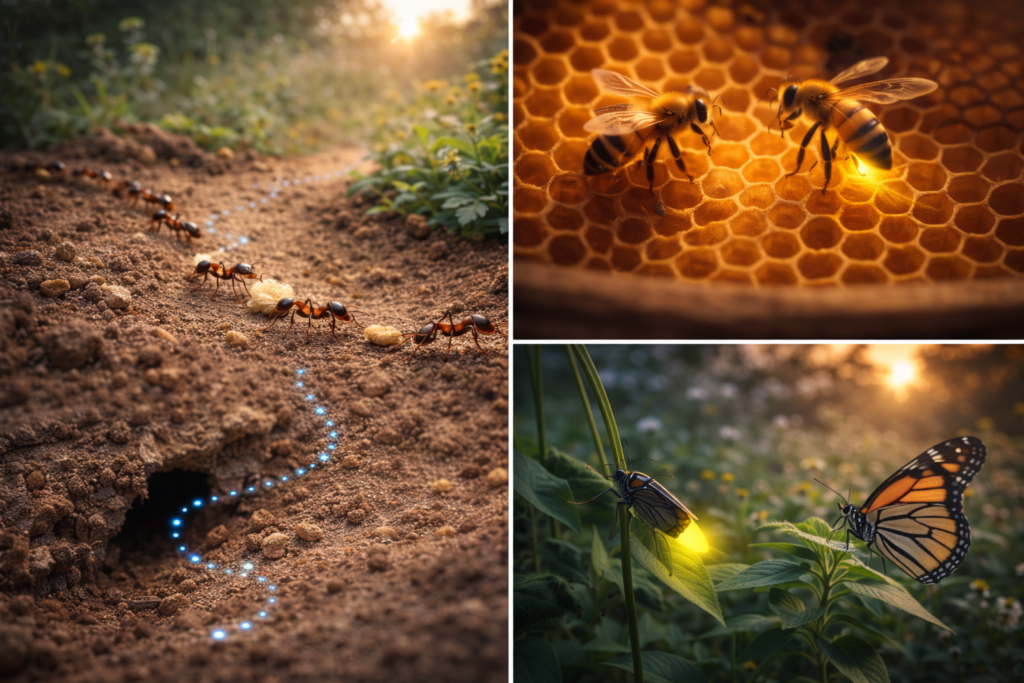
Pheromones are the most vital tools in the repertoire of insects behavior, acting as invisible chemical messages that linger in the air or on the ground. When a scout ant finds a sugar source, it leaves a “recruitment trail” for its sisters to follow; conversely, if the colony is attacked, “alarm pheromones” trigger an immediate, aggressive response. These chemical signals are so specific that they can even distinguish between a friend from the same nest and a stranger from a rival colony.
Visual and Acoustic Signals: The “Waggle Dance” and Stridulation
While chemicals are dominant, many species rely on sight and sound to relay information as a key part of insect behavior. The most famous example of visual signaling is the honeybee’s “waggle dance,” a series of figured movements that tell other bees the exact direction and distance of a flower patch relative to the sun. Meanwhile, crickets and grasshoppers use stridulation—rubbing body parts together—to create acoustic songs that serve as long-distance beacons for attracting mates or establishing territory.
New Frontiers: Atmospheric Pressure and Electroreception in Foraging
Cutting-edge research in 2026 has revealed that insects behavior is even more sensitive to the environment than previously thought. Scientists have discovered that some foragers can detect minute changes in atmospheric pressure, allowing them to seek shelter hours before a storm hits. Furthermore, bees have been shown to use electroreception to sense the electric fields of flowers, helping them identify which blooms have already been drained of nectar by other visitors.
The Feeding Game: Sophisticated Foraging and Predatory Tactics
In the scientific study of life, the quest for energy drives the most diverse and specialized forms of insects behavior. Whether an insect is a passive grazer or a highly calculated hunter, its feeding strategy is a result of millions of years of evolutionary pressure. These tactics are designed to maximize nutrient intake while minimizing the risk of becoming a meal for something else.
Herbivorous Strategies: Host Plant Selection and Defense Neutralization
Herbivorous insects behavior is a constant arms race between the grazer and the plant. Many insects have evolved specialized sensors to detect specific chemical signatures of “host plants,” ensuring their offspring hatch on a viable food source. To counter plant defenses like toxic sap or sticky hairs, some species have developed the ability to neutralize or even sequester these toxins, using the plant’s own poison as a chemical defense against their own predators.
Predatory Intelligence: Ambush, Trapping, and Venom Resistance
The predatory side of insect behavior showcases incredible tactical intelligence, ranging from the patient “sit-and-wait” ambush of the praying mantis to the sophisticated architectural traps of the antlion. Some hunters, like the assassin bug, use chemical mimicry to “disguise” themselves as part of the colony they are hunting. Additionally, many predators have developed specific resistances to the venom of their prey, allowing them to take down insects that would be lethal to any other attacker.
Scavenging Behavior: The Essential Role of Nature’s Decomposers
Scavenging is a vital but often overlooked aspect of insect behavior that keeps ecosystems balanced. Decomposers, such as dung beetles and carrion flies, perform the essential task of recycling organic matter back into the soil. By breaking down waste and decaying material, these foragers prevent the spread of disease and ensure that nutrients are redistributed throughout the insect environment, proving that even the most “unpleasant” behaviors are foundational to the health of the planet.
Mating and Reproduction: The Complex Art of the Nuptial Flight
In the scientific study of life, few events are as spectacular or high-stakes as the drive to create the next generation. This phase of insect behavior is characterized by extreme competition and elaborate displays designed to ensure genetic survival. From massive synchronized flights to intimate one-on-one rituals, the strategies used to locate and win a mate are among the most diverse in the animal kingdom, often involving high-energy maneuvers that test the physical limits of the species.
Courtship Rituals: From Gift-Giving to Bio-Luminescent Displays
Courtship is a highly specialized form of insect behavior that serves to identify a compatible mate and reduce the risk of predatory attack during the process. Some species, like the dance fly, engage in “gift-giving,” where the male presents a protein-rich silk-wrapped insect to the female to ensure her cooperation. Others utilize light and sound; fireflies use precise bio-luminescent “morse code” flashes to signal their location, while certain crickets produce complex acoustic songs. These rituals act as biological filters, ensuring that only the healthiest and most capable individuals successfully reproduce.
Reproductive Systems: Understanding Oothecae and Parental Care
Once mating is complete, the focus of insect behavior shifts to the survival of the offspring through various reproductive strategies. While many insects simply lay eggs and depart, others invest heavily in protection, such as the cockroach or mantis, which produces a leathery, protective ootheca to shield embryos from the elements and predators. In rare cases, such as with giant water bugs or certain earwigs, we observe advanced parental care, where the adults actively guard the eggs or carry them on their backs to ensure a high hatch rate in a dangerous environment.

Social Structures: The “Superorganism” of Ants, Bees, and Termites
In the scientific study of life, the most awe-inspiring display of insect behavior is found within eusocial societies. In these groups, individuals no longer act for themselves but function as integrated cells within a “superorganism.” This collective existence allows a colony of ants, bees, or termites to solve complex engineering and survival problems—such as climate-controlling a mound or harvesting vast amounts of food—that would be impossible for a solitary insect to achieve.
Division of Labor: The Caste System and Task Allocation
The backbone of social insect behavior is a highly organized “caste system” where roles are determined by age, size, or genetics. In a typical colony, the queen is responsible for reproduction, while the workers and soldiers handle everything from nursing larvae to defending the nest. This task allocation is incredibly fluid; for instance, a worker bee may start her life as a “nurse” inside the hive and transition into a “forager” as she matures. This specialization ensures that the colony’s energy is used with maximum efficiency, allowing the group to thrive even in harsh environments.
Collective Intelligence: How Thousand-Strong Colonies Make One Decision
Perhaps the most mysterious aspect of insect behavior is “swarm intelligence,” the process by which thousands of individuals make a single, unified decision without a central leader. Whether it is a swarm of bees choosing a new nesting site or ants finding the shortest path to a sugar source, the decision emerges from local interactions and feedback loops. By using simple rules—like following the strongest pheromone trail—the colony exhibits a form of collective wisdom that allows them to navigate and dominate the insect environment with startling accuracy.
Defense and Survival: The Master Mimics and Chemical Warriors
In the scientific study of life, the “arms race” between predator and prey has resulted in some of the most ingenious examples of insect behavior. Survival is never guaranteed, so species have evolved high-stakes tactics that range from complete invisibility to aggressive chemical warfare. These methods are not just about individual safety; they are a sophisticated biological investment in ensuring the species can survive long enough to reproduce in a hostile insect environment.
Camouflage and Aposematism: The Visual Art of Staying Alive
Visual insect behavior is often a choice between blending in or standing out. Many species utilize crypsis (camouflage) to become virtually invisible to predators, such as stick insects that mimic twigs or katydids that look like rotting leaves. On the opposite end of the spectrum is aposematism, where insects use bright “warning colors”—like the vibrant oranges of the monarch butterfly—to signal that they are toxic or unpalatable. This visual honesty saves the insect’s life by teaching predators to associate specific patterns with a painful or poisonous experience.
Colony Defense: Warning Scents and “Doomed Ant” Signals
For social species, defensive insect behavior is a coordinated effort that often requires individual sacrifice. When a nest is disturbed, workers release “alarm pheromones” that act as a chemical siren, instantly recruiting soldiers to the site of the breach. Some species have even evolved extreme altruism, such as certain ants that engage in autothysis—exploding their own bodies to coat an attacker in a sticky, toxic glue. These “doomed” individuals prioritize the survival of the queen and the collective over their own lives, ensuring the colony’s fortification remains intact.
Conclusion: Why Understanding Behavior is the Future of Pest Management
In the scientific study of life, shifting our focus from simple elimination to a deep understanding of insect behavior represents the most significant advancement in modern pest control, as it allows us to outsmart pests by targeting their biological “triggers” rather than relying solely on broad-spectrum chemicals. By decoding the specific ways a forager communicates, navigates, and reproduces, we can implement high-precision Integrated Pest Management (IPM) strategies that disrupt colonies at their source, utilizing pheromone disruption or environmental modification to make our homes inhospitable to invaders. As we move through 2026, this behavior-driven approach not only ensures more effective and sustainable protection but also fosters a science-based harmony that manages the insect environment with intelligence and environmental responsibility.
FAQs: Common Questions on Insect Intelligence and Behavior
- Do insects actually have intelligence or are they just tiny robots? While they don’t have human-like reasoning, insect behavior demonstrates a high level of “distributed intelligence.” For example, bees can solve complex mathematical problems like the “Traveling Salesman Problem” to find the shortest route between flowers, and ants use collective memory to navigate. They aren’t robots; they are biological computers programmed for extreme efficiency and environmental adaptation.
- Can insects learn and remember things? Absolutely. Research into insect behavior shows that many species, particularly pollinators like bees and wasps, have incredible spatial memory. They can remember landmarks, colors, and even time of day to return to a food source. Some studies have even shown that certain insects can be trained to associate a specific scent with a reward, much like Pavlov’s dogs.
- Do insects feel pain or emotions like we do? This is a hot topic in the scientific study of life. While insects have a nervous system and can detect harmful stimuli (nociception) to move away from danger, scientists generally believe they do not “process” pain emotionally like mammals. Their responses are primarily survival-based insect behavior, allowing them to continue functioning even when injured to ensure the survival of their genetics or colony.
- Why do some insects seem to “play dead” when touched? This is a defensive strategy known as thanatosis. It is a calculated piece of insect behavior designed to trick predators that only eat live prey. By becoming completely still, the insect removes the visual trigger of “movement” that many hunters rely on, often causing the predator to lose interest and move on.
- How do insects navigate so perfectly in the dark? Many nocturnal species use a mix of “celestial navigation” (using the moon or stars) and polarized light detection. Additionally, their antennae serve as high-tech sensors in the insect environment, detecting pheromone molecules and air currents that act as a map, allowing them to “see” their way through a room or forest without any light at all.


