
Introduction: Why Knowing The Anatomy of Bees Changes How You See Them
I’ve really found that most people look at a honey bee and just see a tiny, fuzzy insect that makes honey and occasionally stings. But once you start looking closer at The Anatomy of Bees, you realize they are more like high-tech biological machines than simple bugs. From my experience, understanding how they are built—from the hooks on their wings to the specialized baskets on their legs—completely changes how you view a colony’s efficiency. The Anatomy of Bees isn’t just a textbook topic; it’s the key to understanding how these creatures have survived and thrived for millions of years.
The funny thing is, real mastery in beekeeping or entomology starts with the basics that most people overlook, like their exoskeleton or how they “smell” with their antennae. When you dig into the “why” behind their body parts, you see that every hair and joint has a specific job to do. Honestly, I think it’s pretty incredible how a worker bee’s body is a walking toolkit specifically designed to solve the practical challenges of gathering nectar and defending the hive in a tough environment.
In this guide, I’m going to break down The Anatomy of Bees in a way that’s easy to follow, without the heavy academic jargon. We’ll look at the parts you can see, like the compound eyes that detect UV patterns on flowers, and the internal systems that most people forget about, like their “bee blood” and the specialized honey stomach. My goal is to help you see these insects not just as pests or pollinators, but as one of nature’s most perfectly engineered masterpieces.
The Anatomy of Bees: A Closer Look at the Outside
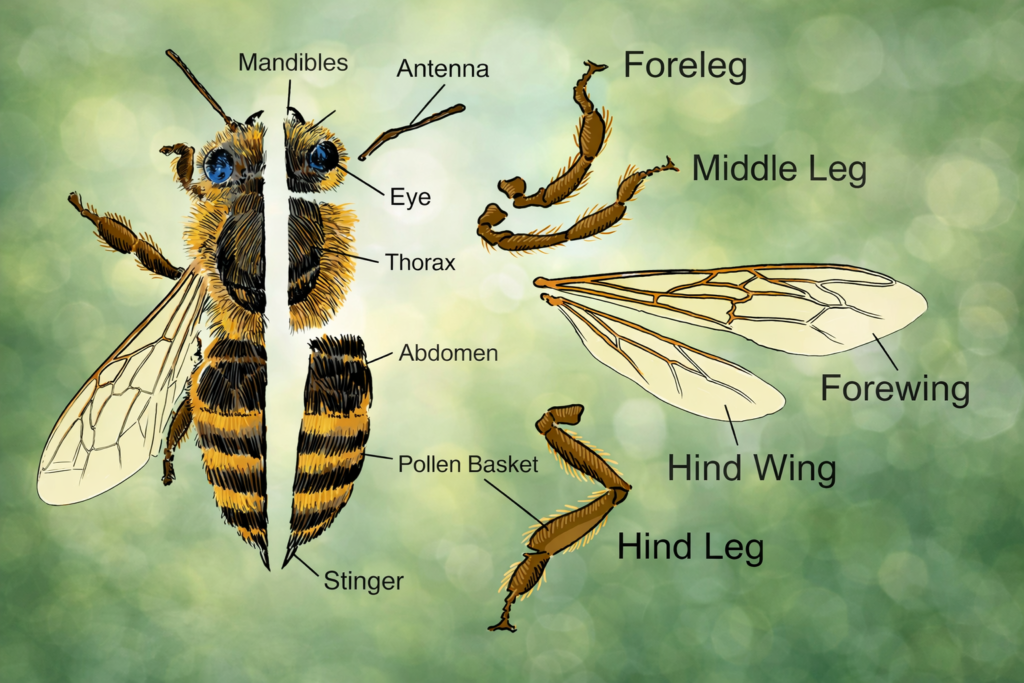
When you look at the outside of a honey bee, you’re essentially looking at a masterclass in functional design. The body is divided into three main segments—the head, thorax, and abdomen—each acting as a specialized department for the bee’s daily survival. I’ve always found it’s helpful to think of the head as the sensory center, the thorax as the muscular engine that drives flight, and the abdomen as the powerhouse for digestion and defense. This external structure is covered in a hard, protective layer that keeps the bee safe while providing the mechanical leverage needed to move its six legs and two pairs of wings with incredible precision.
Do Bees Have Bones? Understanding the Exoskeleton
Actually, bees don’t have an internal skeleton like we do; instead, they wear their “bones” on the outside in the form of an exoskeleton. This tough outer shell is a fundamental part of The Anatomy of Bees, made primarily of chitin—a remarkably strong yet flexible material that acts as a protective suit of armor against predators and physical injury. From my experience, what’s most interesting is that this shell doesn’t just protect them—it also prevents their tiny bodies from drying out by locking in moisture. Because it’s a rigid structure, bees can’t grow continuously like humans; instead, they have to go through a process of molting during their larval stages to reach their final, adult size.
The Head: Sensory Hub of the Hive
Think of the honey bee’s head as a high-tech control center that manages every piece of information the bee needs to navigate the world. Honestly, it’s where all the most important sensory equipment is packed into one tiny space, from the massive eyes that detect motion to the sensitive antennae that pick up pheromones from across a field. It isn’t just a face; it’s a sophisticated command hub that allows the bee to find flowers, communicate with sisters, and stay alert for danger. Without this complex setup, The Anatomy of Bees would be incomplete, and the bee would be unable to perform the precision tasks that keep the hive alive.
Antennae: More Than Just a Bee’s Nose
If you’ve ever watched a bee closely, you’ll notice its antennae are constantly moving, and there’s a good reason for that—they are the bee’s primary way of “feeling” and “smelling” the world. While we often call them a bee’s nose, they’re actually much more sophisticated than that. These two mobile appendages are covered in thousands of tiny sensory cells that can detect not only floral scents from long distances but also vibrations, humidity, and even carbon dioxide levels. From my experience, it’s incredible to think that these tiny stalks allow a bee to navigate in total darkness inside the hive just by touching surfaces and sensing the air around them.
Compound and Simple Eyes: How Bees See
Bees actually see the world through five different eyes, which is far more complex than our own vision. Most of their “seeing” happens through two large compound eyes that take up a huge portion of their head, allowing them to detect even the slightest movement and see ultraviolet patterns on flowers that are invisible to us. On top of that, they have three tiny, “simple” eyes called ocelli that don’t see shapes but act as light sensors, helping them navigate and keep their balance by tracking the sun’s position. It’s a fascinating setup because while their vision isn’t as sharp as ours, they can process images much faster—which is why it’s so hard to catch a bee mid-flight.
Proboscis and Mandibles: The Multi-Tool Mouth
I’ve always found it fascinating how a bee’s mouthparts essentially act as a biological multi-tool kit, allowing them to switch between physical labor and liquid feeding in seconds. The strong, plier-like mandibles (jaws) are built for the heavy lifting, like molding wax into honeycomb, cleaning the hive, or even defending the entrance from intruders. Meanwhile, the proboscis works like a high-powered, retractable straw that they dip into flowers to lap up nectar. When they aren’t feeding, they simply fold this long “tongue” away under their head, keeping it protected while they fly. It’s this clever combination of “chewing” and “lapping” tools that makes the honey bee so much more versatile than other insects that can only do one or the other.
The Thorax: The Engine Room of Flight
The thorax is what I like to call the “engine room” of the honey bee because it’s essentially a solid block of powerful muscle designed for one thing: movement. This middle segment of the body is where the real heavy lifting happens, as it anchors all six of the bee’s legs and both pairs of its wings. Inside this armored compartment, the flight muscles are so efficient that they can vibrate the wings over 200 times per second, which is exactly why we hear that distinctive “buzz” whenever they fly past. From my experience, it’s the most physically active part of The Anatomy of Bees, acting as the structural bridge that coordinates every takeoff, landing, and walk across the honeycomb.
Wings and Flight Mechanics
I’ve always found it amazing that honey bees actually fly with four wings, not two, using a clever trick of nature to stay aerodynamic. The secret lies in a row of microscopic hooks called hamuli that zip the front and hind wings together during flight, creating a single, powerful surface for lift. When they land, these wings unhook and slide over each other so the bee can move through the narrow gaps of the hive without getting stuck. Instead of a simple up-and-down flap, they move their wings in a rapid, rotating “sculling” motion that allows them to hover and carry heavy loads of nectar that can weigh almost as much as they do.
Legs and the Worker’s Pollen Basket
I honestly think the most impressive part of a worker bee’s toolkit is their legs, because they aren’t just for walking—they’re for grooming, cleaning, and heavy-duty transport. While all three pairs of legs have specialized brushes to clean their antennae and wipe pollen off their bodies, the hind legs are the real stars of the show. On these legs, you’ll find the pollen basket (or corbicula), which is a flattened, hair-fringed area where the bee packs moist pollen into a tight ball. It’s incredible to watch them mid-air as they use their other legs to “comb” the pollen from their fuzzy bodies and kick it into these baskets to carry back to the hive.

The Abdomen: Digestion and Defense
I’ve always thought of the abdomen as the honey bee’s “multitasking center” because it manages both the colony’s growth and its protection in one flexible package. Unlike the rigid thorax, the abdomen is made of overlapping segments that can expand like an accordion, allowing the bee to carry a massive load of nectar or take deep breaths during flight. Inside, it houses the vital digestive organs and the “honey stomach,” but it’s also the bee’s primary line of defense. From my experience, the real engineering marvel in The Anatomy of Bees is how this section can curve and pivot with incredible precision, allowing the bee to aim its stinger or reach its wax glands while building the hive.
Wax Glands: Building the Colony
I’ve always found it fascinating that honey bees literally grow their own building materials from their own bodies. On the underside of a worker bee’s abdomen, there are four pairs of specialized wax glands that convert the sugar from honey into tiny, clear flakes of beeswax. The process is actually quite a workout—bees have to consume a large amount of honey and hang together in “festoons” to raise their body temperature so the wax can flow. Once the wax scales harden, the bee uses its legs to pass them up to its mandibles, where it chews the wax to make it soft and pliable. It’s this incredible biological process that allows them to engineer the perfectly hexagonal combs that serve as both a nursery for larvae and a pantry for honey.
The Stinger: A One-Way Protection
I’ve always found it a bit tragic that the honey bee’s most famous tool, the stinger, is essentially a “one-way” weapon for the worker. Unlike wasps, a worker bee’s stinger is equipped with tiny, microscopic barbs that act like a fishhook, anchoring into the skin of mammals so firmly that it cannot be pulled back out. While this ensures the venom sac stays behind to keep pumping long after the bee is gone, the physical cost is fatal for her. From my experience, the most fascinating part of The Anatomy of Bees regarding defense is the alarm pheromone released during the sting; it smells remarkably like bananas and acts as a biological “red alert” to guide other bees to the same spot.
Looking Inside: Bee Blood and Internal Organs
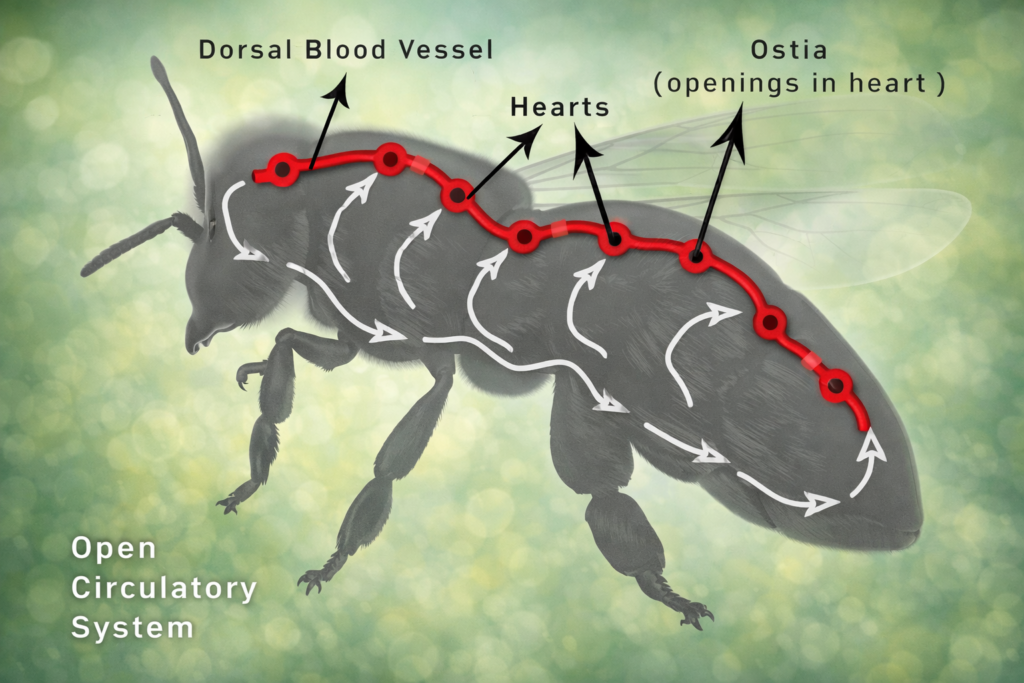
When you look inside a honey bee, you won’t find red blood or a complex network of veins like ours; instead, they have a clear, yellowish fluid called hemolymph. This “bee blood” doesn’t carry oxygen—that’s handled by a system of tiny breathing tubes called tracheae—but it is packed with nutrients, hormones, and immune cells that bathe the internal organs directly. The bee’s heart is actually a long, thin tube running along the top of the abdomen that pulses to keep this fluid moving in an open circulatory system. From my experience, seeing how these internal systems work together really makes you appreciate the biological engineering required for The Anatomy of Bees to function at such high speeds.
The Honey Stomach (Crop): Where the Magic Happens
I’ve always thought the honey stomach, or crop, is one of the most brilliant biological “inventions” because it allows a bee to act as a transporter without being a consumer. Unlike our own stomachs, the crop isn’t for digestion; it’s a specialized storage tank that a bee uses to carry nectar back to the hive while keeping it separate from her own digestive juices. A tiny valve called the proventriculus acts as a gatekeeper, staying shut so the nectar remains pure, only opening if the bee needs to “sip” a little for her own energy. From my experience, the real magic happens during the flight home, where the bee adds enzymes like invertase to the nectar, beginning the transformation into honey before she even reaches the hive.
Reproductive Organs: Differences in Queens and Drones
I’ve always found it remarkable how the anatomy of the Queen and the Drone is strictly specialized for their “royal” duties, leaving no room for the chores workers do. The Queen’s body is essentially a high-capacity egg factory, dominated by massive ovaries and a spermatheca—a specialized organ that keeps sperm viable for years so she can fertilize eggs throughout her entire life. In contrast, the Drone is built for a single, high-speed mission; his reproductive system is designed for a one-time mating event that, much like the worker’s stinger, is fatal upon completion. From my experience, seeing these two side-by-side proves that in The Anatomy of Bees, form always follows function: the Queen is engineered for long-term survival, while the Drone is built for a single, vital genetic contribution.
How Anatomy Changes Between Bee Castes
I’ve always found it fascinating that even though every bee starts from a similar egg, their final “caste”—Worker, Queen, or Drone—results in a completely different physical build that fits their specific job description. Workers are the “Swiss Army Knives” of the colony, equipped with pollen baskets, wax glands, and complex mouthparts, whereas the Queen is a specialized “egg-laying machine” with a much longer abdomen and no foraging tools. Drones, meanwhile, are built like the “tanks” of the bee world, featuring massive compound eyes that meet at the top of the head for 360-degree vision to spot a Queen mid-flight. From my experience, seeing these three side-by-side in The Anatomy of Bees proves that in a colony, your anatomy isn’t just about who you are; it’s about what you are designed to do for the survival of the group.
Why I Think Understanding Morphology Makes You a Better Beekeeper
I honestly believe that mastering The Anatomy of Bees is the “secret sauce” that separates a beginner from a truly skilled beekeeper. When you understand the physical structure of the bee, you stop just looking at a box of insects and start reading a living story. For me, knowing what a healthy pollen basket looks like or being able to spot the Queen’s elongated abdomen at a glance makes hive inspections faster and much less stressful for the bees. If you can see that a worker’s wings are frayed (a sign of age) or notice a Drone’s oversized eyes in the wrong season, you can predict the health and future of your colony before a problem even starts. From my experience, The Anatomy of Bees is the language the bees use to tell you exactly what they need; once you learn to speak it, you aren’t just keeping bees—you’re collaborating with them.
Conclusion: The Incredible Complexity of the Tiny Honey Bee
I’ve always felt that the true magic of the honey bee lies in the fact that such a tiny creature can hold so much biological complexity. When you step back and look at the whole picture—from the five eyes that process light at lightning speed to the microscopic hooks that zip their wings together—it becomes clear that The Anatomy of Bees isn’t just a simple insect; it’s a masterclass in evolutionary engineering. Every segment of its body, whether it’s the wax-producing glands in the abdomen or the specialized pollen baskets on the legs, is perfectly optimized to serve the greater good of the hive. From my experience, the more you zoom in on these individual “tools” within The Anatomy of Bees, the more you realize that their survival depends on a perfect balance of anatomy and teamwork. It’s a humbling reminder that even the smallest living things are capable of incredible feats when every part of their design has a purpose.
FAQs: Quick Answers to Common Bee Questions
How many eyes does a bee actually have? Bees have five eyes in total. They have two large compound eyes on the sides of their head for detecting movement and patterns, and three tiny simple eyes (ocelli) on top of their head to help with navigation and light sensing.
Why do bees die after they sting? Only worker honey bees typically die after stinging mammals. This is because The Anatomy of Bees includes a stinger with microscopic barbs that get stuck in the skin. When the bee tries to fly away, the stinger and attached internal organs are pulled out of her body.
Do bees have ears? Not in the traditional sense! They don’t have ears on their heads, but they “hear” by sensing vibrations through their antennae and specialized organs on their legs called chordotonal organs.
How many wings does a honey bee have? Within The Anatomy of Bees, they have four wings (two pairs). However, they can hook them together using tiny hooks called hamuli, making them function like two large, powerful wings during flight.
Can bees see all colors? Not exactly. Bees see a different spectrum than we do; they can’t see the color red (it looks like black to them), but they can see ultraviolet light, which helps them find “nectar guides” on flowers that are invisible to the human eye.


