
I’ve always felt that the first warm day of the year is the true starting gun for any serious beekeeper. I honestly believe that spring management of honeybee colony is the ultimate balancing act because you are managing a living system that is trying to explode in size while the weather is still potentially lethal. From my experience, the difference between a record-breaking honey year and a total hive failure comes down to how well you bridge the gap between the last frost and the first major nectar flow.
When you master the spring management of honeybee colony , you stop being a passive observer and start becoming a strategic partner to your bees. This season is about more than just checking for a queen; it’s about ensuring the hive has the protein and space it needs to fuel a massive population boom. If you don’t stay ahead of their growth, the colony’s natural instinct to swarm will take over, and you’ll watch half of your potential honey harvest fly away into the trees.
The goal of this guide is to provide you with a high-level roadmap for success. We will dive into the technical details of early inspections, stimulating feeding, and advanced swarm prevention to ensure your apiary is a powerhouse of productivity. By the time the summer sun hits the flowers, your colonies will be perfectly timed, healthy, and ready to bring in the “liquid gold” that every beekeeper dreams of.
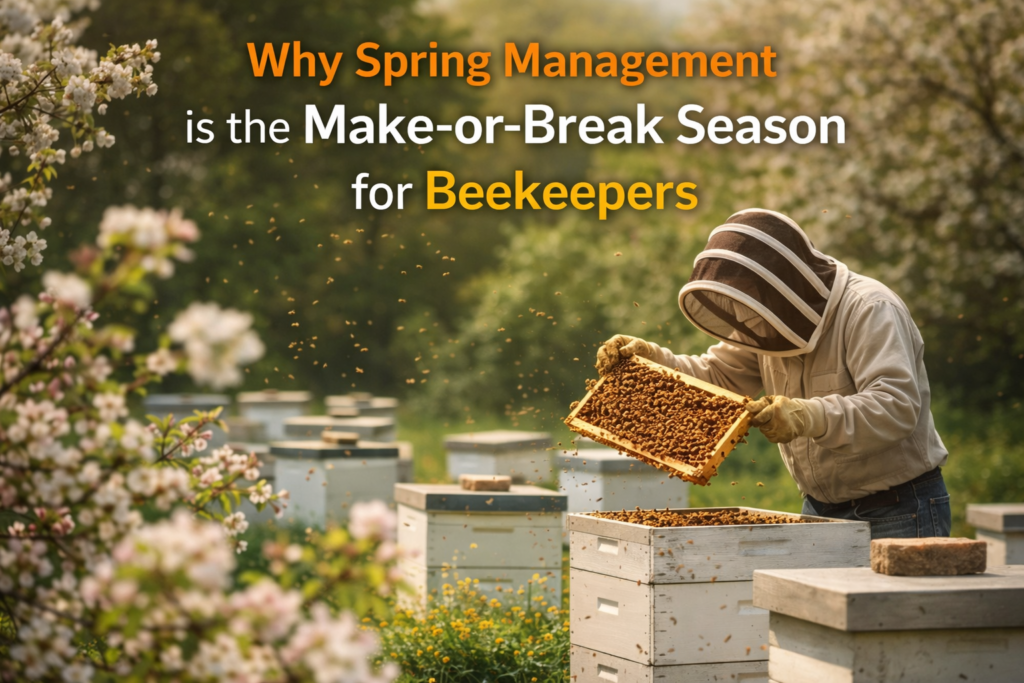
2. Why Spring Management is the Make-or-Break Season for Beekeepers
I honestly believe that spring is the “season of truth” because it’s the only time of year where the bees’ biological drive for expansion is in direct conflict with the lingering dangers of winter. From my experience, spring management of honeybee colony is the make-or-break period because this is when “spring dwindle” occurs—a precarious moment where the old winter bees are dying off faster than the new brood can hatch, potentially causing a colony collapse if they cannot keep the expanding brood nest warm during a sudden cold snap. Success during this window is entirely dependent on your ability to synchronize the colony’s peak population with the local nectar flow; if you aren’t proactive with stimulating feeding and space management, you risk losing your workforce to a swarm or a late-season stall, whereas effective care ensures you have a massive, healthy team ready to maximize the “liquid gold” the moment the flowers bloom.
3. The Post-Winter Assessment: Evaluating Honeybee Colony Spring Care Needs
I’ve always felt that the first real “opening” of the hive after winter is a high-stakes moment of truth that defines your entire strategy for the months ahead. I honestly believe that a thorough post-winter assessment is the foundation of effective spring management of honeybee colony , as it allows you to categorize your hives into those that need emergency help and those ready for rapid expansion. From my experience, you should perform this evaluation on a calm day when temperatures are at least 15°C (60°F) to avoid chilling the cluster; your goal is to quickly gauge the “Big Three”: queen viability, food stores, and colony strength. If you find a hive with plenty of bees but no eggs, or a colony that has eaten through its winter stores and is sitting on the brink of starvation, your strategy must pivot immediately to supplemental feeding or requeening to prevent a total loss. By accurately evaluating these spring care needs early, you ensure that every hive in your apiary has a customized plan for success, rather than applying a “one-size-fits-all” approach that might ignore the most vulnerable colonies.
4. Conducting the First Spring Inspection of Honeybee Colonies Like a Pro
I honestly believe that your first full inspection is the most important date on your beekeeping calendar, as it’s the moment you stop guessing and start knowing exactly what’s happening inside the cluster. From my experience, conducting this first spring inspection of honeybee colonies like a pro requires speed and surgical precision; you want to be in and out in less than five minutes to prevent the brood nest from losing critical heat. During this crucial phase of spring management of honeybee colony , I always look for “pearl-like” larvae and a solid, C-shaped brood pattern, which confirms that your queen is healthy and back in action. If you see “spotty” brood or only drone cells, it’s a sign that your queen is failing, and you’ll need to act fast to requeen or combine that hive with a stronger one. By focusing on food reserves, queen health, and hive hygiene during this initial deep-dive, you lay the groundwork for a successful season and ensure that your bees are set up for a record-breaking year.

5. Fueling the Spring Buildup of Honeybee Colonies: Advanced Feeding Strategies
I’ve always said that you can’t build a skyscraper on a weak foundation, and in beekeeping, that foundation is nutrition. I honestly believe that fueling the spring buildup of honeybee colonies is the secret weapon of high-production apiaries, as it mimics the natural nectar flow and “tricks” the queen into thinking the season has fully arrived. From my experience, effective spring management of honeybee colony during this phase requires a two-pronged approach: thin 1:1 sugar syrup to stimulate wax building and foraging energy, and high-protein pollen patties to support the massive demand for larval food. Without this protein boost, even a prolific queen will be forced to limit her egg-laying, which stalls your population growth right when you need it most. By implementing these advanced feeding strategies, you ensure that your efforts result in a massive, healthy workforce that is ready to hit the first major bloom at peak capacity.
6. Strategic Bee Colony Management in Spring: Managing Weak vs. Strong Hives
I honestly believe that a “one-size-fits-all” approach is the fastest way to lose half your apiary, which is why strategic bee colony management in spring requires you to play the role of a triage medic. From my experience, you must ruthlessly categorize your hives into “boomers” and “dwindlers” to ensure your spring management of honeybee colony is effective. For strong hives, the goal is to prevent them from outgrowing their space too quickly and swarming; however, for weak colonies, you have to decide if they are worth “nursing” with frames of capped brood from stronger hives or if it’s smarter to combine them to create one viable unit. By equalizing your apiary in this way, you ensure that every box is a productive asset rather than a drain on your resources, making your overall operation far more efficient and profitable.
7. Accelerating Colony Bees Development for Maximum Nectar Flow
I’ve always felt that the “Summer Rush” is won or lost in April, and accelerating colony bees development is the only way to ensure your workforce is large enough to capitalize on the year’s biggest nectar flows. From my experience, successful spring management of honeybee colony during this phase is all about maximizing the “brood nest temperature” and providing unlimited resources; bees can only raise as much brood as they can keep warm at 35°C (95°F), so keeping the hive insulated and compact is key. By ensuring a steady supply of thin syrup and high-quality protein, you push the queen to her maximum laying capacity, allowing the population to explode just as the honey flow begins. When you master this stage, you create a “tide” of bees that doesn’t just collect honey, but overflows the supers, turning a standard season into a record-breaking harvest.
8. Mastering Spring Swarm Prevention Techniques to Protect Your Harvest
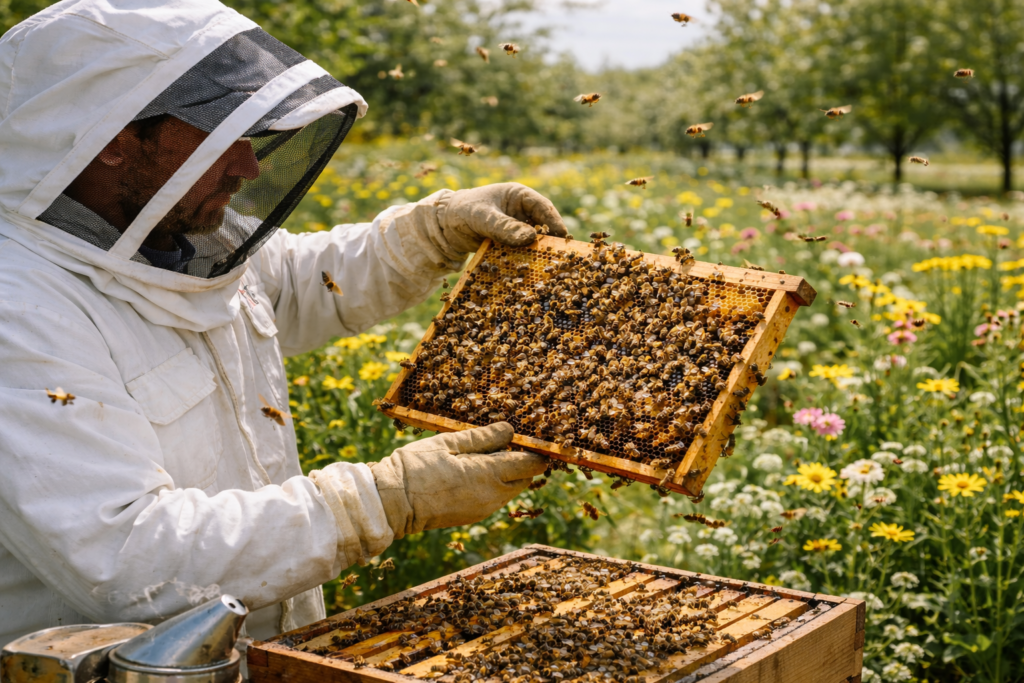
I honestly believe that the most frustrating part of beekeeping is watching your best, most productive queen fly away with half your workforce just as the honey flow begins. Mastering spring management of honeybee colony means staying one step ahead of the bees’ natural urge to reproduce by managing “congestion” before it starts. From my experience, the secret lies in techniques like reversing brood boxes—moving the bottom box to the top to give the queen fresh room to move upward—and checkerboarding, which breaks up the “honey cap” that often makes a hive feel cramped. By proactively splitting your strongest hives or adding extra space early, you satisfy the colony’s biological drive to expand while keeping your honey-making team intact. When you nail these swarm prevention methods, your workflow shifts from a rescue mission to a high-yield operation that protects your harvest and keeps your bees focused on the supers.
9. Making Room to Grow: Timing the Spring Supering for Your Bees Colony
I’ve always felt that “supering” is a lot like surfing—it’s all about the timing of the wave. I honestly believe that spring management of honeybee colony reaches its peak complexity when you have to decide exactly when to add those honey supers; add them too early, and you make the hive too large to keep warm during a cold spring night, but add them too late, and the bees will feel “honey-bound” and start preparing to swarm. From my experience, the gold standard is the 70% rule: once the bees have drawn out and started filling seven out of the ten frames in their top brood box, it’s time to expand. By staying ahead of the flow and providing this vertical space, you ensure your production remains the priority, giving your bees the room they need to store “liquid gold” without feeling the need to move out.
10. Early Defense: Pest and Disease Management for Spring Beekeeping
I honestly believe that a healthy-looking hive in April can be a “ghost town” by June if you ignore the microscopic threats hiding in the brood nest. Early defense is a non-negotiable pillar of spring management of honeybee colony, as this is the window where Varroa mite populations begin to climb alongside your bee numbers. From my experience, the most successful beekeepers use this time to perform an alcohol wash or powdered sugar roll to get an accurate mite count before the honey supers go on and treatment options become limited. Furthermore, during the damp, unpredictable days of early spring, you must stay vigilant for signs of Nosema or European Foulbrood (EFB), which can devastate a colony that is already stressed. By prioritizing these disease checks now, you ensure that your hives build a resilient workforce that is strong enough to resist pests and stay focused on the nectar flow.
11. Avoiding Common Pitfalls in Spring Honeybee Management
I honestly believe that even the most experienced beekeepers can fall into “spring traps” if they get too comfortable with a routine. From my experience, the most devastating pitfall in spring management of honeybee colony is the “starvation trap”—where beekeepers assume that because the flowers are blooming, the bees are fine, only to have a three-day rainstorm lead to a colony starving to death because they had no backup stores. Another common mistake is “over-inspections” during chilly weather; opening the hive too often or for too long can chill the brood, causing the colony to regress just when it needs to be accelerating. Finally, ignoring the “swarm signs” because you think it’s too early in the season is a classic error that costs beekeepers their best foragers. By staying disciplined and avoiding these common mistakes, you ensure your results remain on a professional, high-yield trajectory.
12. Conclusion: Setting the Stage for Summer Success
I honestly believe that the effort you put into the apiary during these critical months is exactly what separates a hobbyist from a master beekeeper. As we’ve seen, successful spring management of honeybee colony isn’t about a single event, but a series of timely, calculated interventions that align with the bees’ natural biology. From my experience, when you prioritize early nutrition, precise inspections, and proactive swarm control, you aren’t just keeping bees—you are engineering a high-performance superorganism. By setting the stage now and ensuring your colonies are healthy, queen-right, and properly spaced, you move into the summer months with total confidence. Ultimately, the “liquid gold” that fills your jars in the autumn is won through the discipline and care you provide today, securing a thriving future for your apiary and a record-breaking harvest for the year ahead.
13. FAQs: Master How to Manage Honeybee Colonies in Spring
1. When is it officially “safe” to start spring feeding? From my experience, you should start stimulating your bees as soon as they are flying consistently and daytime temperatures regularly hit 10°C (50°F). I honestly believe that in the context of spring management of honeybee colony, starting too late is a bigger risk than starting early; if they have no stores, they will starve during the “spring dwindle” regardless of the temperature.
2. How do I know if my queen is failing during the first inspection? During your spring management of honeybee colony, look closely at the brood pattern. A high-quality queen will lay in a tight, solid “C” shape with very few empty cells. If you see a “pepper-box” or spotty pattern, or if there are multiple eggs in a single cell, it’s a clear sign that your queen is failing or that you have laying workers, and you need to intervene immediately.
3. Should I really reverse my brood boxes every spring? I’ve found that reversing is one of the best ways to manage colony bees development. Bees naturally move upward, and by spring, the cluster is usually at the very top of the hive with an empty box below them. Reversing those boxes puts that empty space above them, which is a vital part of spring management of honeybee colony that significantly delays the urge to swarm.
4. What is the best way to help a weak colony in early spring? If you find a weak hive, I suggest “borrowing” a frame of capped brood (without the bees) from a booming hive. This provides an immediate population boost of young nurse bees. However, I honestly believe that if a colony is exceptionally small—less than two frames of bees—it’s often better to combine it with a stronger one rather than risking both hives’ productivity.
5. How can I tell the difference between a “supersedure” cell and a “swarm” cell? Location is everything! Swarm cells are almost always found hanging from the bottom of the frames, as the bees are looking for room to grow. Supersedure cells—which mean the bees are trying to replace a failing queen—are usually found in the middle of the frame face. Knowing the difference is a vital part of seasonal care and dictates whether you should add space or replace your queen.


