
Introduction to Honey Bee Morphology
When you look at a bee zipping around your garden, you might just see a fuzzy, yellow-and-black insect. But if you actually stop to look at the morphology of honey bee (Apis mellifera), you realize it is basically a tiny, perfect biological machine. I’ve always been amazed that something so small can be so complex. It isn’t just about having wings and legs; every single hair and segment is engineered for a specific purpose, whether that’s gathering food, building a home, or defending the family.
The way they are put together is surprisingly straightforward once you break it down. The bee’s body is divided into three main sections: the head, the thorax, and the abdomen. Think of it like a well-organized factory. The head is the control center where all the sensory decisions happen. The thorax is the engine room packed with muscles to drive the wings and legs. And the abdomen? That’s the cargo hold and the weaponry, housing everything from the honey stomach to the stinger.
What I find most interesting is that not all honey bees are built the same. Their physical form changes depending on their job description. You have the Queen, who is long and slender because she’s essentially an egg-laying athlete. Then you have the Drones, who are bulky with huge eyes just to spot the Queen. And finally, the Workers—the ones we see every day—who are equipped with specialized tools like pollen baskets that the others just don’t have. It’s a perfect example of how form follows function.
General Morphology and External Structure
Bees possess a protective exoskeleton that acts as a suit of armor, safeguarding internal organs and providing a rigid structure for muscle attachment while maintaining enough flexibility for agile movement. This Honey Bee Morphology is organized into three primary regions: the head for sensory input and feeding, the muscular thorax which serves as the locomotive engine for flight, and the abdomen for digestion and defense. These structural features are specifically adapted to the bee’s role, with the Queen possessing a large egg-laying abdomen, the Drone featuring a barrel-chested frame for mating flights, and the Worker being smaller but highly equipped with tools like wax glands and pollen baskets.
Worker Bee Diagram and Visual Anatomy
The worker bee is the biological Swiss Army knife of the hive, featuring an anatomy packed with specialized tools such as the corbicula, or pollen basket, on her hind legs and wax-secreting glands on her abdomen. Unlike the Queen or Drones, the worker’s Honey Bee Morphology is defined by these labor-centric details and a defensive barbed stinger designed for a one-time sacrificial act. These distinct physical traits confirm that workers are a specialized caste designed specifically for the heavy lifting, hive maintenance, and colony protection.
Head of Honey Bees
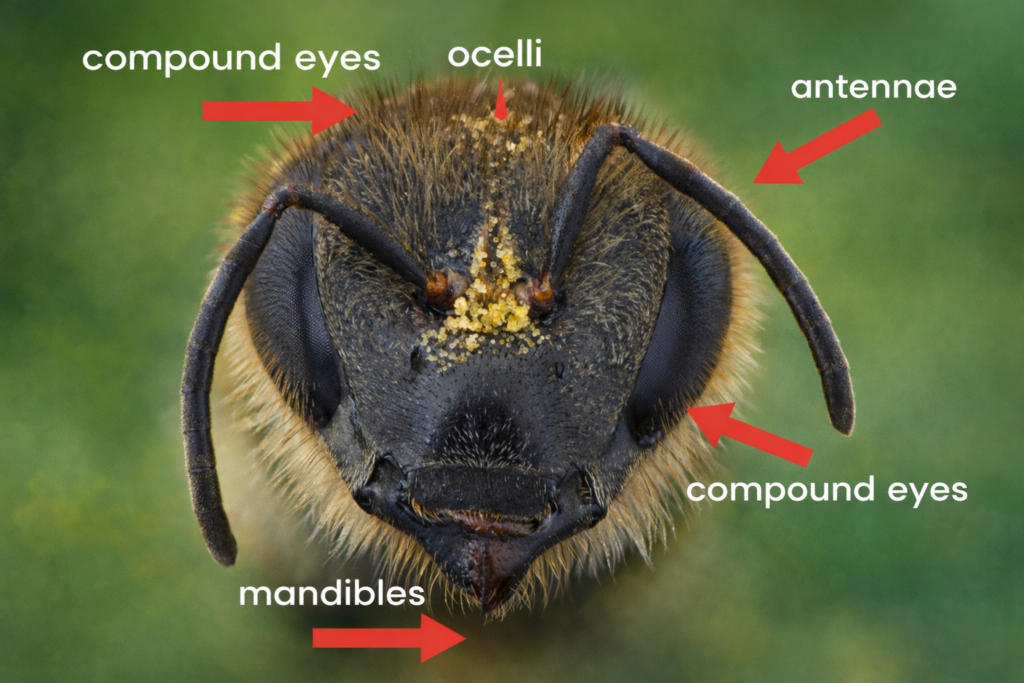
The head functions as a triangular sensory control room connected to the thorax by a flexible neck, allowing for the precise movements needed to clean the hive and feed larvae. Externally, it is dominated by two large compound eyes for motion detection and three small ocelli for light sensing, as well as highly sensitive antennae that act as the bee’s primary tools for smelling pheromones and measuring honeycomb cells. This concentrated arrangement of sensory organs ensures the bee can navigate the world and communicate effectively within the dark environment of the hive.
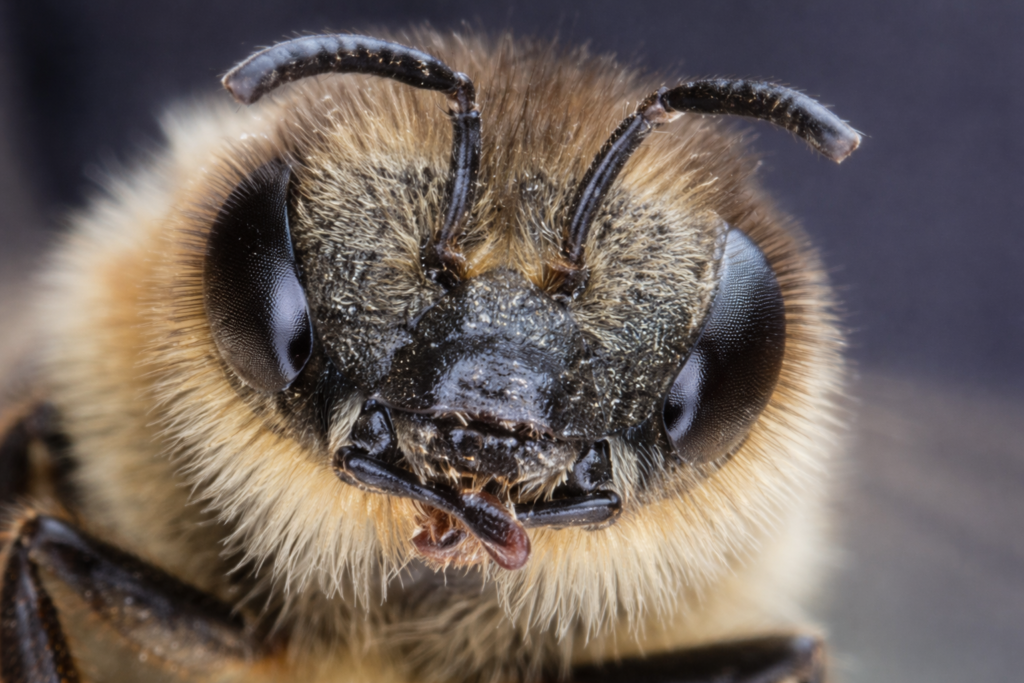
Eyes and Antennae of Honey Bees
With five eyes in total, the bee uses its compound eyes to track movement and the sun while the ocelli maintain flight stability by detecting light intensity changes. The antennae complement this by sensing vibrations and odors, and they are kept in peak condition by the antenna cleaner located on the foreleg of honey bee. This integrated sensory system is a vital component of Honey Bee Morphology, ensuring the insect remains “online” and responsive to its environment at all times.
Mouth Parts of Honey Bee
The mouth parts of honey bee utilize a unique “chewing-lapping” design that features strong mandibles for kneading wax or fighting and a tube-like proboscis for drinking nectar. This dual-purpose setup allows the bee to switch effortlessly between heavy construction work and delicate foraging. The proboscis conveniently folds back under the head during flight, demonstrating the extreme functional efficiency inherent in their anatomical design.
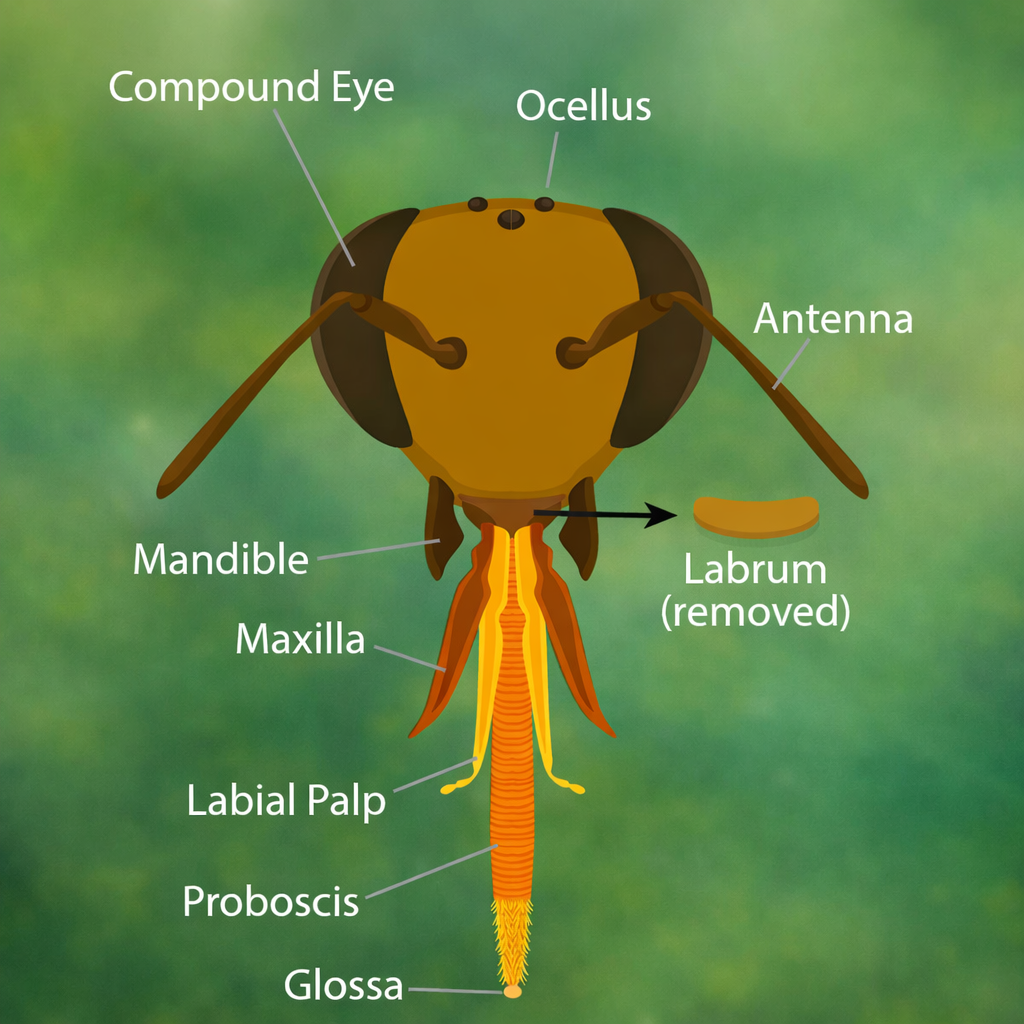
Mandibles and Hypopharyngeal Glands
In Honey Bee Morphology, the spoon-shaped mandibles serve as the bee’s hands for shaping honeycomb, while the hidden hypopharyngeal glands act as internal factories producing royal jelly. These glands are especially active in young nurse bees, allowing them to secrete the nutrient-rich “bee milk” necessary for raising larvae and sustaining the Queen. Without this combination of external tools and internal glands, the colony would be unable to produce the next generation of workers.
Thorax of Honey Bees
The thorax is the powerhouse of Honey Bee Morphology, a rigid, muscular box that supports three pairs of legs and two pairs of wings. Composed of three fused segments, it houses the massive muscles required to beat wings at over 200 times per second and can even generate heat during winter through muscle vibrations. This section of the body is purely dedicated to locomotion and temperature regulation, serving as the central link between the sensory head and the functional abdomen.
Foreleg of Honey Bee (Prothoracic Legs)
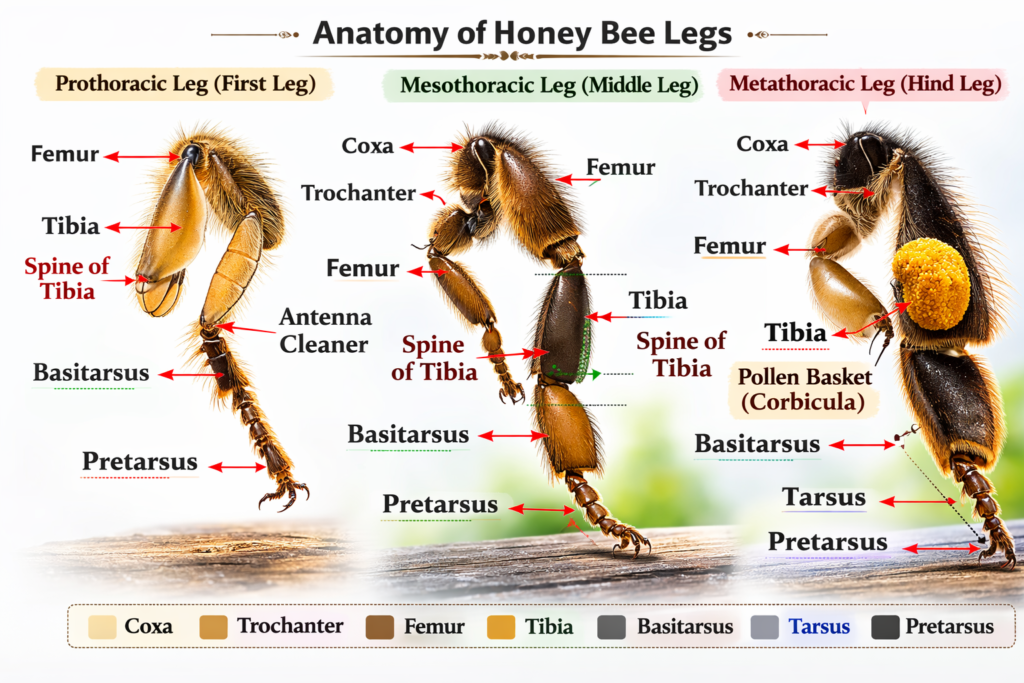
The foreleg of honey bee is more than just a limb for walking; it features a specialized C-shaped notch used as an antenna cleaner to remove debris. This maintenance tool is essential for Honey Bee Morphology because it ensures that the antennae stay sensitive to pheromones and environmental cues. By frequently swiping its antennae through this notch, the bee maintains the integrity of its primary communication and navigation sensors.
Mesothoracic and Metathoracic Legs
While the middle legs act as a conveyor belt to pass pollen backward and use specialized spurs to manipulate wax, the hind legs are the primary cargo tools of Honey Bee Morphology featuring the pollen basket and pollen press. The corbicula holds large pellets of pollen in place with curved hairs, while the press joint compacts loose dust into manageable loads for transport back to the hive. Together, these limbs turn the worker bee into an efficient gathering and building machine.
Wings of Honey Bees
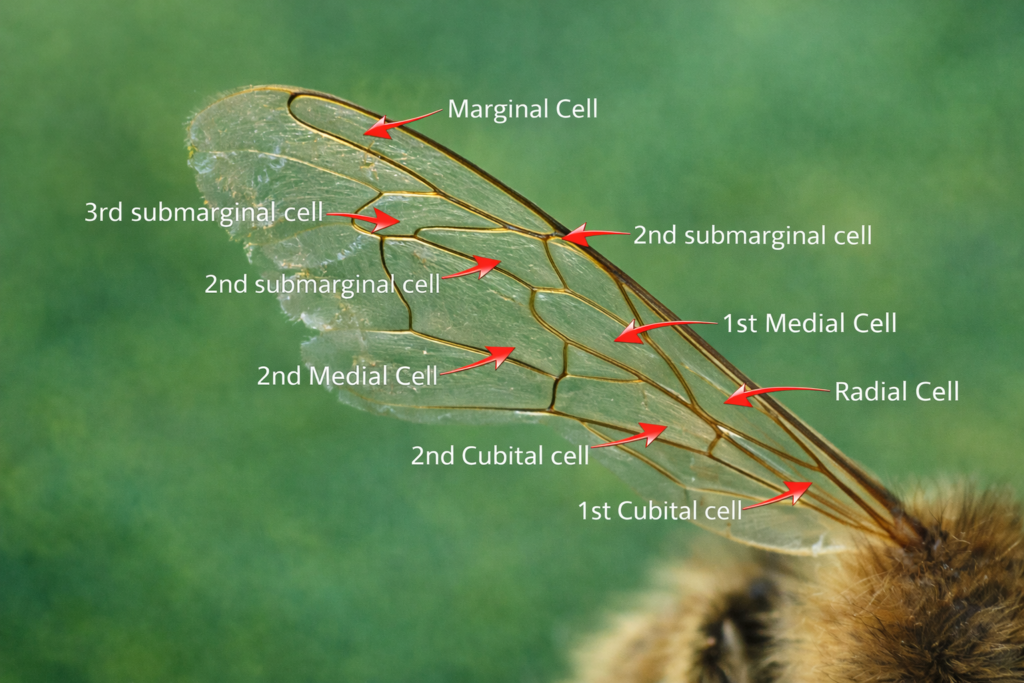
Honey bees possess four wings that function as a single pair thanks to the hamuli, which are tiny hooks that lock the forewings and hindwings together during flight. This Velcro-like mechanism creates a larger surface area for better lift and high-speed maneuvers, reaching frequencies of 200 beats per second. Upon landing, the wings uncouple and fold neatly away, protecting the delicate structures as the bee crawls through the tight spaces of the colony.
Abdomen of Honey Bees
As the largest and most flexible segment, the abdomen serves as the hive’s cargo hold, housing the honey stomach for nectar storage and wax glands for comb construction. It is also the site of the stinger, a modified egg-laying tube that provides a potent defense for the colony. The abdomen’s ability to pulse also facilitates breathing through spiracles, making it a central hub for storage, construction, and respiratory functions in Honey Bee Morphology.
Digestive and Reproductive System of Honey Bees
Internal Honey Bee Morphology includes a specialized honey stomach for transporting nectar and a true stomach for the bee’s own nutrition, separated by a one-way valve called the proventriculus. The reproductive system further defines the hive’s caste system, with the Queen possessing massive ovaries for constant egg production while the workers have shriveled, non-functional ovaries. This internal specialization ensures that every individual is biologically optimized for their specific role, whether it be reproduction or resource management.
Stinger and Defense Mechanisms
The worker bee’s barbed stinger is a defensive adaptation that, while fatal to the individual upon use, ensures a continuous pump of venom and alarm pheromones into a predator. This “one-time” weapon is replaced in the Queen by a smooth stinger, which she uses primarily to eliminate rival queens without endangering her own life. The released pheromones act as a chemical beacon, signaling other bees in the vicinity to join the defense of the hive.
Functional Adaptations of Honey Bees
Every aspect of Honey Bee Morphology is an evolutionary adaptation, from the plumose hairs that use static electricity to attract pollen to the UV-sensitive eyes that reveal nectar guides on flowers. These physical traits, combined with specialized leg tools and a high-speed wing mechanism, allow bees to pollinate millions of flowers with incredible efficiency. These adaptations transform the honey bee from a simple insect into a critical cornerstone of the global ecosystem.
Conclusion
The Honey Bee Morphology is a testament to evolutionary precision, where every feature from the mouth parts of honey bee to the grooming notch on the foreleg of honey bee serves a vital role. As seen in a worker bee diagram, these insects are complex biological machines whose form strictly follows function to ensure the survival of the colony. Understanding these structural details deepens our appreciation for the engineered wonders that sustain our world through pollination and hive production.
FAQs
- Why do honey bees have five eyes? They use two large compound eyes for motion and shape detection, while three small ocelli on top of the head detect light intensity to assist with flight stability.
- How does the foreleg of honey bee help with its senses? It contains a specialized notch that cleans the antennae, ensuring the bee’s primary chemical and vibration sensors stay free of dust and pollen.
- What is the dual purpose of the mouth parts of honey bee? They feature mandibles for solid work like chewing wax and a proboscis for lapping up liquid nectar.
- What is the most important feature in a worker bee diagram? The most critical labor-specific features are the pollen baskets on the hind legs and the wax glands on the abdomen.
- Why does a worker bee die after stinging? Because of the barbs on her stinger, it becomes lodged in the skin, causing her internal organs to be pulled out when she attempts to fly away.


