
H2: Introduction to the Bee Superorganism
Honey bees are recognized as fully social insects because they live in complex colonies where many generations overlap within a single nest, reflecting highly organized honey bee behavior. Among the millions of insect species, taxonomists identify only eight orders with communal life. Out of these, only Hymenoptera and Isoptera have well-developed social organizations. Within Hymenoptera, the families Apidae and Halictidae house fully social species, while most other bees live solitary lives, highlighting the unique evolutionary patterns of honey bees behavior in comparison to other insects.
The colony operates as a highly organized social group driven by a strict division of labor. Every individual has a specific behavioral role, ranging from the queen’s egg-laying to the workers’ responsibilities in nursing larvae, building wax combs, and guarding the hive. This cooperative structure ensures that the superorganism can efficiently manage food collection and storage.
A defining feature of this superorganism is its sophisticated biological communication system. Communication in this context is an action on the part of one organism that alters the probability pattern of behavior in another organism in an adaptive fashion. This specific honey bee behavior allows thousands of individuals to function as a singular, intelligent entity.
H2: Bee Biology and the Internal Social Structure
The internal social structure of a honey bee colony is a masterpiece of biological organization, characterized by a sophisticated division of labor where every individual contributes to the welfare of the collective. Within this well-developed social system, specific bees are assigned roles such as the queen, who focuses on laying eggs, and the workers, who handle nursing larvae, building wax combs, guarding the nest entrance, and managing food collection and storage. This honey bee behavior is maintained through a complex system of biological communication, where actions by one bee adaptively influence the behavior of others. Crucial to this organization is the use of pheromones, such as the queen substance (9-oxo-2-decenoic acid) from the queen bee, along with alarm pheromones and alarm odour from worker bees, which play an important role in the welfare of the colony. By ensuring that every member of the hive is synchronized through these chemical signals, the colony is able to maintain its hive temperature between 32°C and 35°C in the brood area.
H2: The Science of Recruitment: How Bees Communicate
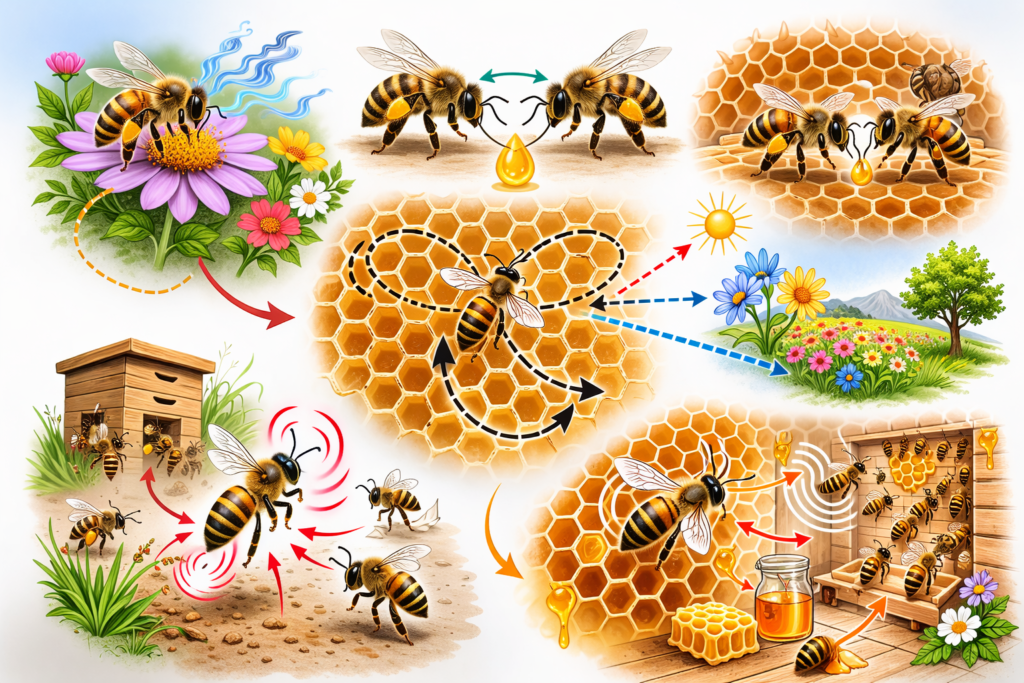
The science of recruitment in honey bees is a highly specialized form of biological communication, defined as a process that brings nest mates to some point in space where work is required. This recruitment system is essential for maximizing foraging efficiency, as it allows the colony to quickly direct its workforce to high-quality nectar and water sources discovered by scout bees. A fundamental component of this honey bee behavior is trophallaxis, the mutual exchange of regurgitated liquids between workers, the queen, and drones. Beyond simply sharing food, trophallaxis serves as a constant data stream regarding the hive’s nutritional status while acting as a critical medium for the transfer of pheromones. This chemical exchange is complemented by complex physical movements, most notably the recruitment dances first described by Father Spitzner in 1788 and later decoded by Karl von Frisch. By combining these tactile, chemical, and behavioral signals, the hive ensures that its foragers are always directed to the best available flowers.
H2: The Round Dance: Finding Resources Nearby
The Round Dance is a specific behavioral communication used when a scout bee discovers a food source in close proximity to the hive. This dance is performed if the source is within 100 meters for A. mellifera and 10 meters for A. cerana. During this performance, the scout bee takes quick, short steps and runs in narrow circles on the comb, once to the right and then left, repeating this for several seconds. This honey bee behavior excites the bees in the hive, who touch the performer with their antennae and then leave the nest in search of the food source. Unlike more complex dances, the Round Dance provides no indication of direction; instead, the foragers search within the 100-meter radius in all directions, using the floral odour clinging to the scout bee as a cue. Additionally, sips of nectar received from the dancing bee provide further evidence of the resource quality.

H2: The Wag-Tail Dance: Mapping Distance and Direction
The Wag-Tail Dance, or Waggle Dance, is a sophisticated honey bee behavior performed when a food source is located more than 100 metres from the hive. In this behavioral display, the bee makes a half-circle to one side, runs in a straight line back to the starting point, and then performs another half-circle in the opposite direction. During the straight run, the dancing bee makes a wiggling motion with her body. The direction of this straight run in relation to the line of gravity indicates the location of the food. If the food is in line with the sun, the bee wag-tails upwards; if it is away from the sun, she performs the dance downwards. Furthermore, if the food is to the left of the sun, the bee dances at a counterclockwise angle to the line of gravity, and if it is to the right, she dances to the right of the gravity line. Distance is communicated by the number of straight runs per 15 seconds: for example, 100 meters is indicated by 9–10 runs, while 6,000 meters is indicated by only 2 runs.
H2: Hive Maintenance and Colony Welfare
A honey bee colony operates as a single social unit to ensure the collective welfare and survival of the hive through precise environmental control and chemical regulation. One of the most critical aspects of hive maintenance is thermoregulation, where the bees work together to keep the temperature in the brood area consistently between 32°C and 35°C. This stable environment is essential for the healthy development of larvae and the overall stability of the nest. Beyond temperature control, the social organization of the colony is heavily dependent on chemical signals known as pheromones. Key elements of colony welfare include the Queen Substance (9-oxo-2-decenoic acid) from the queen bee, as well as alarm pheromones from worker bees. This integrated honey bee behavior ensures that every individual remains focused on their specific role, such as comb building or guarding, which is fundamental to the long-term success of the colony.
H2: Conclusion: Insights into Honey Bee Social Complexity
The complex honey bee behavior serves as a premier example of social organization within the insect world, highlighting a level of cooperation that allows the colony to function as a unified superorganism. From the rigid division of labor—where roles like egg-laying, nursing, and hive defense are strictly maintained—to the advanced thermoregulation that keeps the brood area between 32°C and 35°C, every action is dedicated to the welfare of the collective. This social stability is reinforced by a sophisticated chemical language involving pheromones like Queen Substance (9-ODA) and alarm odours, which synchronize the thousands of individuals within the nest. Ultimately, the success of the hive is rooted in its ability to communicate and recruit nest mates through both physical and chemical means. Whether it is the mutual exchange of liquids via trophallaxis or the intricate geometry of the round and wag-tail dances, these honey bee behavior patterns allow the colony to adaptively respond to the environment with incredible precision. Understanding these insights into the unique bee behavior reveals how a group of individual insects can achieve a level of survival and efficiency that far exceeds the capabilities of any solitary species.
H2: Frequently Asked Questions (FAQs)
What are the different types of bee dances? Honey bee scouts primarily perform two types of recruitment dances: the Round Dance for food sources within 10 to 100 meters and the Wag-tail Dance for distances exceeding 100 meters. This specific honey bee behavior is the foundation of their survival.
How is distance communicated in honey bee behavior? Distance is indicated by the number of straight runs performed during a 15-second interval of the Wag-tail Dance. For example, 100 meters is indicated by 9–10 runs, while 1,000 meters is indicated by 4 runs.
How do bees know the direction of flowers in relation to the sun? Bees use the line of gravity on the vertical honeycomb to represent the sun’s position. Dancing upward indicates food toward the sun, while dancing at a specific angle left or right of the gravity line indicates the direction relative to the sun.
What is trophallaxis and why is it important? Trophallaxis is the mutual exchange of regurgitated liquids between bees. This bee behavior is crucial because it transmits food and water throughout the colony and acts as a medium for the transfer of pheromones that regulate hive behavior.
How do honey bees keep their hive from getting too hot or cold? The colony maintains a steady temperature between 32°C and 35°C in the brood area through collective behavioral efforts as a social unit.
What is the “Queen Substance”? It is a specific pheromone (9-oxo-2-decenoic acid or 9-ODA) from the queen bee that is essential for maintaining the colony’s social organization and welfare. This chemical signal is a core part of documented bee behavior.


