
Accurately identifying Common Household Pests is the essential first step in managing an infestation and protecting your home’s structural integrity. Many pests leave behind distinct visual and behavioral clues: cockroaches are recognized by their flat, oval bodies and musty odors, while ants typically travel in long lines toward food sources. Rodents, such as mice and rats, are larger nocturnal invaders identified by rice-shaped droppings, gnaw marks on wiring, and scurrying noises in walls. More specialized Common Household Pests like termites often go unnoticed until significant damage occurs, leaving subtle signs like mud tubes or hollow-sounding wood.
The presence of these pests poses more than just a nuisance; they represent significant health risks and potential property damage. Rodents and cockroaches are notorious for contaminating food and surfaces with pathogens like Salmonella and E. coli, and their shed skins or droppings can trigger severe asthma and allergy attacks. Mosquitoes and ticks serve as vectors for dangerous diseases such as West Nile virus and Lyme disease, while bed bugs and fleas cause painful, itchy skin irritations. Furthermore, Common Household Pests like carpenter ants and termites can compromise the very foundation of a building by excavating galleries in structural wood.
Effective pest control relies on Integrated Pest Management (IPM), which prioritizes prevention and sanitation over the use of heavy chemicals. This “defense-first” approach involves sealing entry points—such as cracks in the foundation or gaps around pipes—and installing weather stripping on doors to exclude these Common Household Pests. Maintaining a clean home by promptly removing food crumbs, storing dry goods in airtight containers, and eliminating standing water is crucial to deprive pests of the resources they need to thrive. For persistent or severe infestations, specialized treatments like targeted baits, traps, or professional heat treatments may be necessary to ensure long-term eradication.
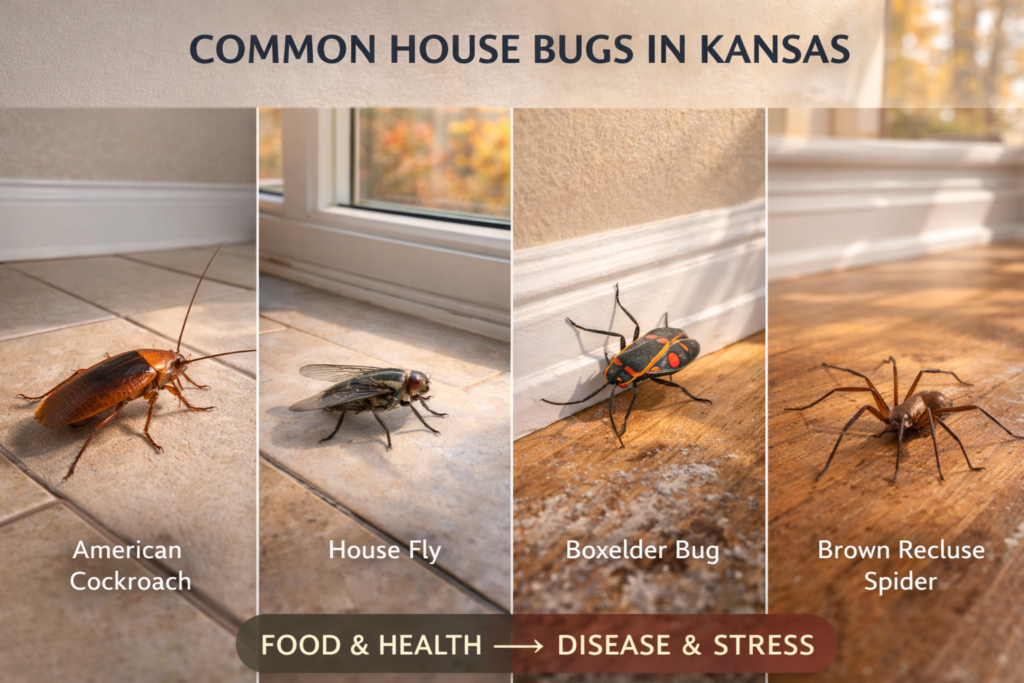
Identifying Common House Bugs in Kansas: A Seasonal Visual Guide
I honestly believe that a successful home defense strategy in the Midwest requires understanding the “seasonal rhythm” of your local environment. In the scientific study of life, we see that Kansas’s extreme temperature shifts act as a biological trigger, forcing different species to seek the shelter of your home at specific times of the year. By identifying these common house bugs in Kansas, you can implement proactive measures before an infestation takes root.
Spring & Summer Invaders: Ants, Spiders, and Mosquitoes
As the ground thaws and humidity rises, the common house bugs in Kansas become highly active. Ants, specifically odorous house ants and carpenter ants, emerge to forage for sweets and proteins, often establishing trails through kitchen windows or foundation gaps. This is also the peak season for mosquitoes, which utilize standing water from spring rains to breed near your home’s entry points. Spiders, such as the common house spider and wolf spider, also increase in visibility as they follow their insect prey indoors.
Fall & Winter Shelter-Seekers: Boxelder Bugs, Stink Bugs, and Rodents
When temperatures drop in the late fall, many common house bugs in Kansas seek “overwintering” sites inside wall voids and attics. Boxelder bugs and brown marmorated stink bugs are notorious for congregating on the sunny, south-facing sides of homes before squeezing into cracks. This season also brings a significant increase in rodent activity; as natural food sources dry up, mice and rats seek the warmth and steady food supply of your pantry, often signaling their presence with nocturnal scurrying and droppings.
The Dangerous “Brown” Pests: Identifying the Brown Recluse Spider
One of the most significant common house bugs in Kansas to watch for is the Brown Recluse spider. Unlike many other spiders, the Brown Recluse is medically significant and prefers dark, undisturbed areas like closets, cardboard boxes, and basements. You can identify them by the distinct dark “violin” shape on their cephalothorax. Because they are shy and reclusive, most bites occur when a spider is accidentally pressed against the skin in stored clothing or bedding, making visual inspections of storage areas a vital safety practice.
Small, Tiny, and Brown: Identifying the Mysterious “Little Brown Bugs”
When dealing with Common Household Pests, identification is difficult because many “little brown bugs” look nearly identical to the naked eye. From my experience, these pests fall into three distinct categories based on what they are targeting in your home: your food, your fabrics, or your furniture.
Pantry Prowlers: Drugstore Beetles and Indian Meal Moths
These Common Household Pests are typically introduced through infested food packages from the grocery store.
- Drugstore Beetles: These are tiny (about 1/8 inch), reddish-brown, oval beetles that look like miniature ladybugs without spots. A key identifier is the presence of longitudinal grooves on their wing covers.
- Indian Meal Moths: The most common pantry moth, they have distinct two-tone wings: whitish-gray near the body and coppery-red on the outer two-thirds.
- Signs of Infestation: Seeing small moths fluttering near the ceiling or finding silky webbing and “frass” (excrement mixed with food particles) inside packages of flour, cereal, or spices.
Fabric & Wood Destroyers: Carpet Beetles and Powderpost Beetles
These pests cause significant property damage by feeding on natural fibers or structural timber.
- Carpet Beetles: The larvae are “fuzzy” or hairy and feed on keratin found in wool, silk, and pet hair, often leaving bald spots in rugs or holes in sweaters. Adults are small (1/8 to 1/10 inch) and often have a mottled pattern of white, brown, and yellow scales.
- Powderpost Beetles: These small brown insects bore into hardwoods and furniture. The most obvious sign is numerous tiny, round exit holes (1/16 to 1/8 inch) accompanied by piles of fine, talcum-like sawdust known as frass.
Bed Bugs vs. Bat Bugs: How to Tell the Difference
Both of these Common Household Pests are flat, oval, and reddish-brown, resembling an apple seed. Because they belong to the same genus (Cimex), distinguishing them requires a close look at their physical features:
- Physical Difference: The most reliable way to tell them apart is the “fringe hairs” on the pronotum (the area just behind the head). Bat bugs have fringe hairs that are longer than the width of their eye, whereas bed bug hairs are shorter than the width of their eye.
- Habitat Clues: Bed bugs prefer lower ground areas like mattress folds and bed frames. Bat bugs typically originate from elevated spaces like attics or ceiling cracks where bat colonies are or were previously roosting.
The Hidden Dangers: Why “Common” Pests are a Serious Threat
While they are often dismissed as a mere nuisance, Common Household Pests represent a two-pronged threat to both your family’s well-being and your greatest financial investment. Understanding these hidden dangers is the first step in moving from reactive swatting to a proactive defense of your home’s environment against these invasive species.
Health Risks: From Asthma Triggers to Vector-Borne Diseases
The primary danger posed by household invaders is their ability to compromise indoor air quality and spread illness.
- Respiratory Issues: Cockroaches and dust mites leave behind shed skins, saliva, and droppings that contain potent proteins known to trigger severe asthma attacks and chronic allergies, especially in children.
- Food Contamination: Pests like flies, rodents, and ants crawl through unsanitary areas before landing on your counters, spreading pathogens such as Salmonella, E. coli, and Listeria.
- Vector-Borne Diseases: Blood-feeding pests like mosquitoes and ticks are more than an annoyance; they can transmit West Nile virus, Lyme disease, and Zika, while rodents are known carriers of Hantavirus and Leptospirosis.
Professional Home Defense: Integrated Pest Management (IPM) for Homes
I honestly believe that a successful home defense strategy in the Midwest requires moving away from the “spray and pray” mentality. In the scientific study of life, we see that Kansas’s extreme temperature shifts and diverse habitats create a constant influx of Common Household Pests seeking survival. By implementing Integrated Pest Management (IPM), you focus on the long-term environmental adaptation of insects rather than just temporary eradication. This proactive approach is the “gold standard” for keeping your home safe and pest-free year-round.
Sanitation First: Removing Food and Water Attraction Points
The foundation of any IPM strategy is “restriction”—making your home an inhospitable insect environment. Most Common Household Pests are driven by a primal need for moisture and energy.
- Eliminate Food Sources: Store all pantry goods, including pet food and birdseed, in airtight plastic or glass containers. Ensure that crumbs are swept daily and that garbage cans have tight-fitting lids to prevent “pantry prowlers” from nesting.
- Manage Moisture: In the dry Kansas climate, a leaky pipe or a dripping AC condenser becomes a magnet for pests. Fix dripping faucets immediately and ensure that gutters direct water at least 10 feet away from your foundation to disrupt the insect habitat interactions that lead to infestations.
Exclusion Tactics: Sealing Entry Points and Foundation Cracks
Exclusion is your home’s physical “armor” against Common Household Pests. Because many insects, such as cockroaches, can squeeze through gaps as thin as 2mm, a thorough exterior inspection is vital.
- Seal the Foundation: Use masonry caulk or hydraulic cement to fill cracks where the concrete meets the soil. For larger gaps around utility lines (gas, electric, or plumbing), use a combination of steel wool and expanding foam; rodents can chew through foam alone, but the steel wool provides a painful deterrent.
- Threshold Defense: Install heavy-duty door sweeps on all exterior doors and replace worn weather stripping around windows. In Kansas, pay special attention to south-facing walls, where pests like boxelder bugs congregate in the sun before seeking a way inside.

DIY vs. Professional Pest Control: When to Call the Experts
I honestly believe that choosing between DIY and professional services for Common Household Pests is a decision that balances immediate cost with long-term safety. In the scientific study of life, we see that pests have evolved remarkable survival mechanisms, making the insect environment of your home a difficult landscape to navigate without specialized training.
The Risks of DIY: Misidentification and Ineffective Chemicals
The most common mistake in home pest management is misidentification. Treating what you think are ants when they are actually termites can allow a structural infestation of Common Household Pests to grow unchecked for months. Furthermore, many off-the-shelf sprays only target the “symptoms”—the visible insects—while leaving the nest or colony’s root cause untouched in the hidden insect environment of your walls.
Relying on “more is better” with store-bought chemicals can also lead to chemical resistance in pests and significant health risks for your family. Improperly applied pesticides can linger on surfaces, affecting indoor air quality and posing accidental poisoning risks to children and pets who are more sensitive to these toxic substances.
When a Pro is Mandatory: Termites, Bed Bugs, and Persistent Infestations
Certain Common Household Pests are far too resilient for standard DIY methods and require professional-grade tools and biological knowledge to eradicate.
- Termites: Because they are “silent destroyers” that eat wood from the inside out, they require professional-grade baiting systems and deep-soil barriers that are unavailable to the general public.
- Bed Bugs: These pests are notoriously elusive, hiding in electrical outlets and behind wallpaper. Professional heat treatments or specialized chemical rotations are often the only way to ensure every life stage, including eggs, is eliminated.
- Persistent or Heavy Infestations: If pests return within weeks of a DIY treatment, it indicates a deep-seated colony or a structural entry point you have missed. A professional can conduct a thorough inspection to find these “strongholds” in the insect environment and provide a long-term, guaranteed solution.

H2: Conclusion: Maintaining a Pest-Free Sanctuary in the Insect Environment
I honestly believe that a successful home defense strategy requires moving away from the “spray and pray” mentality toward a more ecological approach. In the scientific study of life, we see that pests are opportunistic survivors, and our homes often provide the perfect insect environment—offering warmth, moisture, and consistent food sources that they have evolved to exploit. By implementing Integrated Pest Management (IPM) and focusing on long-term sanitation and exclusion, you can fundamentally shift the insect environment of your property from an inviting habitat to a secure fortress. Ultimately, the goal of identifying Common Household Pests is to move from reactive, chemical-heavy solutions toward a proactive, biological understanding of your living space, ensuring that you manage the insect environment in a way that protects both your home’s structure and your family’s health.
FAQs: Master the Basics of Kansas Household Pest Identification
- What is the most dangerous “Common Household Pest” in Kansas? While many insects are nuisances, the Brown Recluse spider is the most medically significant species native to the region. It is identifiable by the dark “violin” shape on its back and prefers dark, undisturbed areas like closets and cardboard boxes.
- How can I tell the difference between a reproductive termite and a flying ant? This is a critical distinction for your home’s structural safety. Termites have straight antennae, a broad waist, and four wings of equal length. Ants have “elbowed” antennae, a pinched “wasp-like” waist, and hind wings that are significantly smaller than their front wings.
- Why do I see more “Common Household Pests” during seasonal transitions? Pests are highly sensitive to the insect environment. In the spring, high moisture drives ants and mosquitoes to seek higher ground or breeding sites. In the fall, a drop in temperature triggers “overwintering” behavior, causing boxelder bugs, stink bugs, and rodents to seek the warmth of your wall voids.
- Are “small brown bugs” in my pantry always a sign of a dirty kitchen? Not necessarily. Many pantry pests, like drugstore beetles and Indian meal moths, are often brought into the home inside pre-packaged grain products from the store. The key is to store all dry goods in airtight glass or plastic containers to disrupt their life cycle in the insect environment.
- When is DIY pest control no longer enough? If you see Common Household Pests like cockroaches or bed bugs during the day, it often indicates a high-density infestation where the “hiding spots” are already full. Furthermore, if you find mud tubes (termites) or experience recurring sightings after a DIY treatment, it is time to call a professional to address the root cause for these Common Household Pests in the insect environment.


