
The study of Inter-specific Positive Interactions is a fundamental branch of entomology that examines the cooperative relationships where at least one species benefits without causing harm to the other. In the “sum total” of an insect’s environment, these “useful” factors—ranging from host plants that provide safe havens to animal partners that offer transportation—are critical for reducing environmental resistance and allowing a species to realize its biotic potential. By systematically classifying these synergistic relationships, researchers can identify the biological pillars that support biodiversity and ecosystem stability.
In 2026, the framework for analyzing Inter-specific Positive Interactions has expanded to include high-resolution modeling of mutualistic networks, such as the complex economic exchange between ants and aphids. These interactions are characterized by a “positive and useful effect” on insect life, often providing the two most vital resources for survival: food and shelter. For a professional ecologist or agricultural strategist, understanding these positive heterospecific dynamics is essential for creating integrated systems where beneficial organisms are nurtured to improve crop yield and environmental health.
Mastering the nuances of Inter-specific Positive Interactions is critical for navigating the evolutionary trade-offs that have allowed insects to conquer every corner of the globe. Whether we are analyzing the “Mutualism” of pollinators ensuring plant reproduction or the “Commensalism” of insects utilizing larger animals for protection, these interactions represent the cooperative side of natural selection. This article provides a comprehensive technical review of these classifications, exploring how useful plants and animals serve as the foundations for some of the most successful life strategies in the Class Insecta.
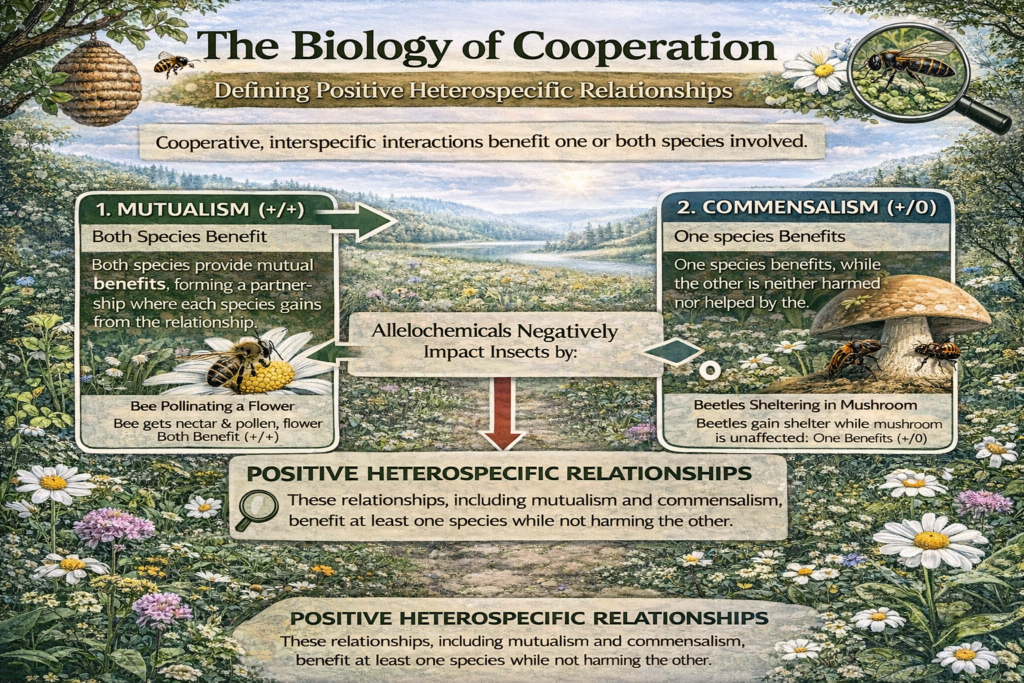
The Biology of Cooperation: Defining Positive Heterospecific Relationships
- Mutualism and Commensalism: When “Useful” Factors Benefit the Hexapod
- Positive interactions are classified as “useful” factors that have a positive and useful effect on the life of an insect.
- These relationships can be obligate, where the interaction is necessary for survival, or facultative, involving different species that benefit from proximity without a strict requirement.
- In the context of the insect environment, these interactions represent a significant portion of the biotic environment that supports growth and survival.
- Facilitation: How One Species Enhances the Niche of Another
- Facilitation occurs when one species improves the environmental conditions for another, effectively reducing abiotic stress.
- For example, the presence of certain plants may modify the microenvironment by regulating humidity or temperature, making it more hospitable for specific insect populations.
- This type of interaction is essential for insects living in harsh terrestrial or aquatic systems where physical constraints are high.
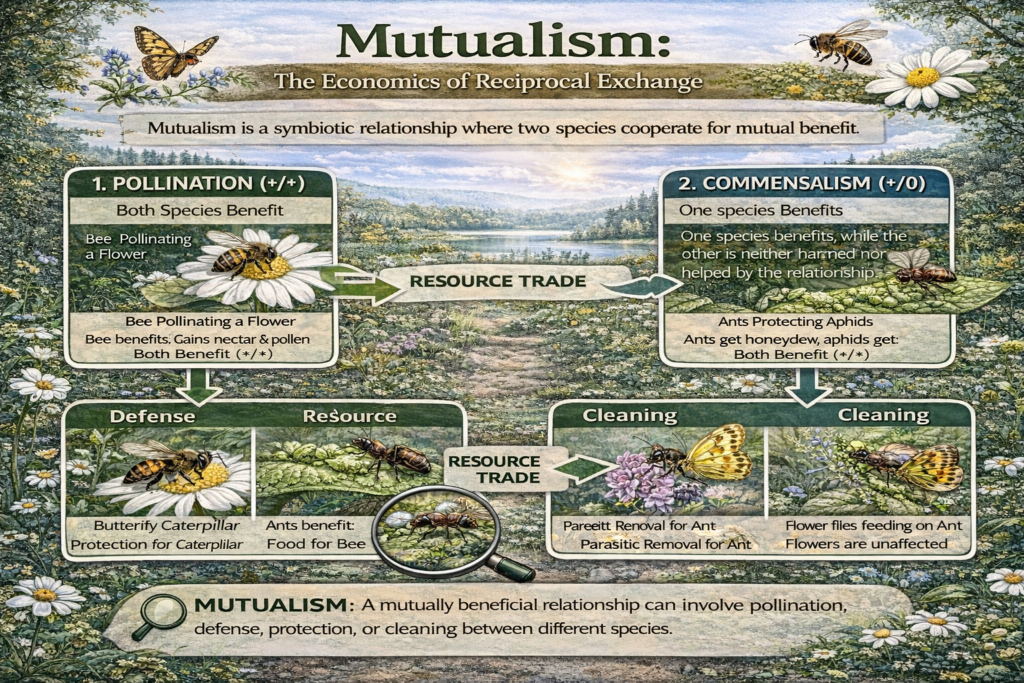
Mutualism: The Economics of Reciprocal Exchange
- Case Study: Ants and Aphids—Protection for Honeydew
- This represents a classic Inter-specific Positive Interaction where both species receive a reciprocal benefit.
- Aphids (different species from ants) provide a sugary excretory product known as honeydew, which serves as a vital energy source for the ants.
- In return, the ants provide a useful effect by protecting the aphids from harmful predators, effectively acting as a “security force” within the biotic environment.
- Insect-Plant Mutualism: The Essential Role of Pollinators
- Plants provide nectar and pollen as a primary food source, while insects provide the useful effect of cross-pollination.
- This relationship is central to Plant Ecology, particularly for Angiosperms, where the reproductive success of the plant is directly tied to insect activity.
- Without these positive interactions, many terrestrial ecosystems would collapse due to a lack of primary producer reproduction.
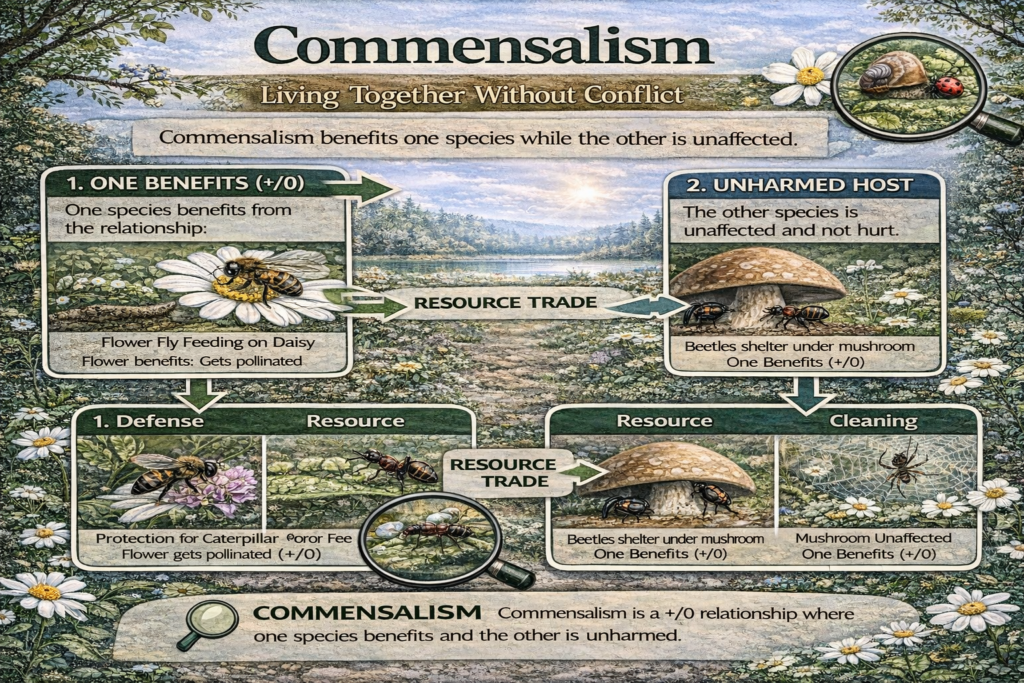
Commensalism: Living Together Without Conflict
- Shelter and Protection: Insects Utilizing Animal Habitats
- Commensalism involves a specific interaction where one species benefits (the insect) while the other animal factor is neither helped nor harmed.
- Many insects utilize the nests, burrows, or even the bodies of larger animals purely for shelter and protection from the macroenvironment.
- This provides the insect with a stable microenvironment that is buffered against extreme abiotic factors like temperature or wind.
- Phoresy: Non-Parasitic Transport and Migration Strategies
- Phoresy is a positive interaction where an insect (the phoretic) attaches to another animal for the sole purpose of transport.
- Unlike parasitism, the “host” animal is not harmed during this process, making it a non-antagonistic inter-specific relationship.
- This allows small insects to disperse over large distances to reach new fresh water or terrestrial habitats.
The Role of Useful Animals in Positive Interaction
- H3: Providing Food and Shelter: Domesticated and Wild Animal Hosts
- Useful animals provide the essential requirements of life, specifically food and shelter, to various insect species.
- These animal factors have a positive and useful effect on insect life by allowing them to live as ectosymbionts on the host’s body.
- This is a key component of Animal Ecology, where vertebrate and invertebrate interactions result in a net gain for the insect population.
- Case Study: Ectosymbionts on Buffaloes, Poultry, and Domestic Pets
- Domesticated animals like buffaloes, poultry, dogs, and cats serve as important sources of shelter and nutrition for specific insects.
- As parasites that do not always kill their hosts, these insects find a reliable habitat on the bodies of these animals.
Positive Plant-Insect Interactions: Beyond Simple Herbivory
- Useful Plants: Promoting Insect Growth and Fecundity
- Certain plants have a positive and useful effect on insect life by promoting their growth, development, and overall fecundity.
- These useful plants provide a rich nutritional base that supports the insect’s metabolism and metabolic flow.
- In Bioecology, these plant-insect links are studied to understand how biological factors interact to maintain energy flow in the environment.
- Shelter Provision: Sugarcane, Rice, and Maize as Safe Havens
- Strategic agricultural crops such as sugarcane, rice, maize, and citrus serve as critical host plants.
- These plants provide shelter to borers, leaf folders, and leaf miners, protecting them inside their tissues from external environmental factors.
- This internal microenvironment allows these insects to thrive even when the macroenvironment outside the field is unfavorable.
Conclusion: The Evolution of Synergy and the Balance of Nature
Inter-specific Positive Interactions demonstrate that the “Balance of Nature” is sustained not just by competition, but by deep-seated cooperation. By leveraging useful plants and animals, insects minimize environmental resistance and maximize their biological success. These cooperative classifications are the ultimate key to understanding how life persists in a state of ecological equilibrium across the globe.
FAQs: Understanding the Cooperative Side of Insect Ecology
- What defines a positive interaction in insect ecology? It is an interaction with “useful” factors (plants, animals, or other insects) that has a positive and useful effect on an insect’s life.
- How do ants and aphids exhibit inter-specific positive interaction? They engage in a mutualistic aggregate where aphids provide honeydew as food, and ants provide protection as a useful effect.
- Which crops are cited as “useful plants” for insect shelter? Sugarcane, rice, maize, and citrus are primary examples of host plants that provide food and shelter to borers and miners.
- Can animals act as useful factors for insects? Yes, useful animals such as buffaloes and poultry provide parasitic insects with both food and shelter on their bodies.
- Is commensalism different from mutualism? Yes; in mutualism, both species benefit, while in commensalism, the insect benefits from food or shelter without affecting the host animal.


