
Gemini said
To understand the insect environment, one must distinguish between the physical landscape and the complex “living” network that dictates an insect’s survival. This insect environment consists of all living organisms—from microscopic pathogens to giant host trees—that interact with an insect throughout its life cycle. In the scientific study of life, these biotic factors are classified based on how they influence population density and individual behavior. Whether it is a predator hunting for a meal or a plant developing chemical defenses, these living factors create a constant state of biological negotiation within the insect environment that defines the “balance of nature.”
A primary method of biotic classification is based on nutritional modes, which categorizes insects by their role in the food web. Producers, such as flowering plants, serve as the foundational energy source for phytophagous insects, while consumers—including predators, parasites, and parasitoids—act as a natural check on herbivore populations. Furthermore, the ecology of insect decomposers, or saprophagous species, plays a vital role in nutrient cycling by breaking down organic waste. These habitat interactions ensure that energy flows efficiently through the insect environment, preventing the accumulation of dead matter and maintaining soil health for future generations.
Beyond simple feeding, the biotic world is shaped by intricate species interactions that can be either competitive or cooperative. Intraspecific interactions involve members of the same species competing for mates or territory, whereas interspecific relationships include mutualism, such as the famous partnership between bees and flowers. Understanding these biotic components of the ecosystem is essential for an ecologist, as it allows for the prediction of population spikes and the development of integrated pest management strategies. By analyzing how competition and predation function, we gain a clearer picture of the living world that allows these “master builders” to thrive across the globe.
Defining the Insect Environment: Biotic vs. Abiotic Factors
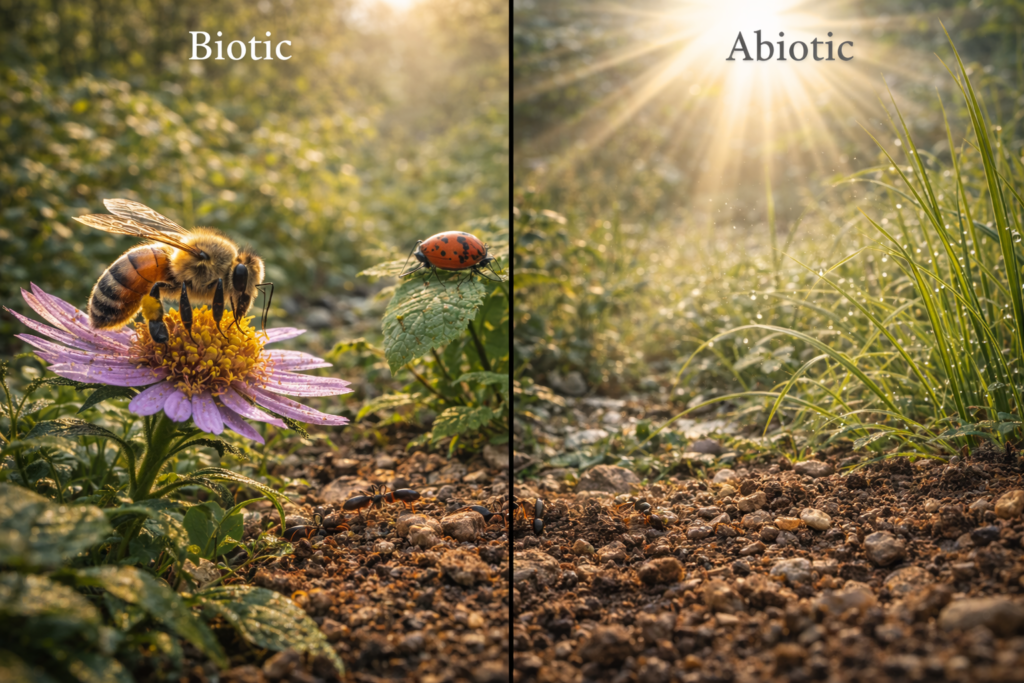
The insect environment is an intricate combination of every external force that influences an insect’s ability to survive, grow, and reproduce. In the scientific study of life, we categorize these influences into two distinct but inseparable categories: biotic vs abiotic insect environment factors. While the abiotic factors provide the physical “stage” or conditions for life, the biotic factors represent the “actors” or living interactions that drive the ecology of insect populations. Understanding the interplay between these two is essential for any ecologist attempting to map out insect habitat interactions.
The Abiotic Stage: Non-Living Influences on Survival
Abiotic factors are the non-living chemical and physical parts of the environment that affect living organisms. For insects, these factors act as the primary regulators of their metabolism and geographic distribution. Since insects are ectothermic (cold-blooded), their very pace of life is dictated by the environment. Key abiotic influences include:
- Temperature: Directly controls growth rates, heart rate, and activity levels.
- Moisture and Humidity: Essential for preventing desiccation, especially in delicate larvae and eggs.
- Light (Photoperiod): Acts as a biological clock, signaling when it is time to feed, mate, or enter dormancy (diapause).
- Soil and Wind: Physical structures that determine nesting sites and dispersal patterns.
The Biotic Players: Living Factors Affecting Insects
The biotic factors in insects include all the living components they encounter. These living factors affecting insects are often density-dependent, meaning their impact increases as the insect population grows. These interactions are the core of insect ecology biotic environment studies and include:
- Food Sources: The availability and quality of host plants or prey.
- Natural Enemies: The constant pressure from predators, parasites, and disease-causing pathogens.
- Competitors: Other organisms (of the same or different species) vying for the same limited resources.
- Symbionts: Beneficial microorganisms within the insect that assist with digestion or provide essential nutrients.
Comprehensive Biotic Classification of the Insect Environment
The biotic classification of the insect environment provides a systematic way to understand how living organisms influence an insect’s life cycle. By categorizing these biotic factors in insects, we can see how energy flows and how social structures form within a habitat. This classification is the cornerstone of insect ecology biotic environment studies, moving from what an insect eats to how it behaves with others.
Classification Based on Nutritional Modes (Food Sources)
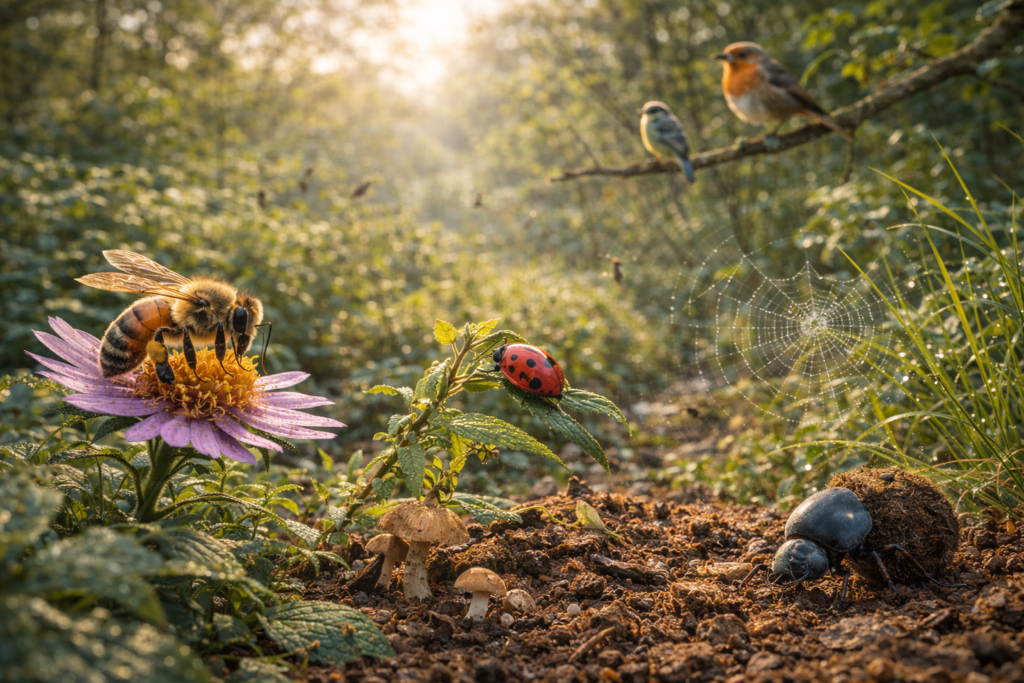
This classification focuses on the insect habitat interactions regarding energy acquisition. Every insect occupies a specific niche based on its primary food source:
- Producers (Autotrophs): While insects aren’t producers, their insect–plant interactions with autotrophs like green plants are foundational. Phytophagous insects (herbivores) rely on these producers for energy. This relationship is a constant battle of environmental adaptation of insects against plant defenses like toxins or thorns.
- Consumers (Heterotrophs): These are the zoophagous insects that survive by consuming other living animals. This group is further divided into predators (which kill and eat multiple prey), parasites (which live on or in a host without necessarily killing it), and parasitoids (which eventually kill their host as part of their development).
- Decomposers (Detritivores): Also known as saprophagous insects, these species are the recyclers of the insect environment. Beetles and fly larvae break down dead organic matter, returning essential nutrients to the soil and ensuring the biotic components of the insect ecosystem remain sustainable.
Classification Based on Species Interaction Types
In the scientific study of life, interactions are classified by whether they occur within a single species or between different ones. These “effects” determine the insect community structure and are deeply rooted in the biological pressures found within the insect environment.
- Homotypal Effects (Intraspecific): These are interactions between individuals of the same species. This includes intraspecific competition for limited resources like food or mates, but also includes positive interactions like the complex social structures found in bees, ants, and termites. These relationships dictate how a population organizes itself within the insect environment.
- Heterotypal Effects (Interspecific): These involve living factors affecting insects that belong to different species. These interactions can be antagonistic (like insect competition and predation) or beneficial (like mutualism between pollinators and plants). These effects are what define the overall stability and diversity of an ecosystem, directly shaping the insect community structure by managing the flow of energy and the density of various populations.
Biotic Factors in Insect Ecology: Competition and Predation
In the scientific study of life, the balance of an ecosystem is maintained through constant conflict and regulation. Biotic factors in insects act as the primary “brakes” on population growth, ensuring that no single species dominates to the point of destroying its own habitat. By analyzing insect competition and predation, we can see how the insect environment remains diverse and resilient.
The Battle for Resources: Analyzing Interspecific Competition
When different species within an insect community structure rely on the same limited resources—such as the same host plant or nesting site—interspecific competition occurs. This is a critical insect habitat interaction that often leads to “niche partitioning,” where species adapt to use different parts of a resource to avoid direct conflict. For example, two types of aphids might live on the same plant, but one prefers the upper leaves while the other stays near the roots. If competition is too intense, it can lead to the local extinction of the weaker species, proving that living factors affecting insects are just as influential as the physical climate.
Natural Enemies: The Regulatory Role of Predation and Parasitism
The ecology of insect populations is most visible through the lens of their “natural enemies.” These biological regulators prevent herbivore outbreaks that would otherwise devastate vegetation.
- Predators: Ladybugs, lacewings, and praying mantises act as the “lions” of the insect environment, actively hunting and consuming multiple prey individuals.
- Parasitoids: Unlike typical predators, parasitoids (like many small wasps) lay their eggs inside or on a host. As the larvae grow, they consume the host from the within, eventually killing it. This regulatory role is a cornerstone of insect ecology biotic environment studies, as it provides the foundation for “biological control”—using natural enemies instead of chemicals to manage agricultural pests.
Symbiotic and Mutualistic Insect–Biotic Interactions
While competition and predation define the struggle for survival, the ecology of insect life is equally supported by cooperation. These insect-biotic interactions represent some of the most sophisticated partnerships in the scientific study of life, where insects and other organisms exchange services to ensure mutual survival. These relationships are essential biotic components of the insect ecosystem, creating a foundation of stability across diverse insect habitat types.
Mutualism: Pollination and Defensive Partnerships
Mutualism is a “win-win” interaction where both species derive a clear benefit. The most globally significant example is the insect–plant interaction found in pollination. Plants provide nectar as a high-energy food source, while the ecology of insect pollinators like bees and butterflies ensures the plant’s reproduction by transporting pollen. Another fascinating example is “defensive mutualism,” such as the relationship between ants and aphids; ants protect the aphids from predators like ladybugs, and in return, the aphids provide the ants with a sugary secretion called honeydew.
Commensalism and Symbiosis: Hidden Beneficial Relationships
Beyond direct partnerships, the insect ecology biotic environment contains subtle, often hidden connections:
- Commensalism: This occurs when one species benefits while the other is unaffected. An example is “phoresy,” where smaller insects (like mites) hitch a ride on larger flying insects (like beetles) to reach new food sources without harming their “transport.”
- Symbiosis (Endosymbiosis): Many insects host beneficial microorganisms within their bodies. For instance, termites rely on specialized gut protozoa to digest the cellulose in wood. Without these microscopic living factors affecting insects, the termites would starve, and the insect ecosystem role of wood decomposition would come to a halt.
Case Studies: How Food Sources and Pathogens Shape Insect Populations
In the scientific study of life, theoretical models are proven through real-world observations of how living factors affecting insects dictate their success or failure. These case studies highlight the dramatic impact that biotic factors in insects can have, shifting a species from a rare inhabitant to a dominant force—or vice versa—within the insect environment.
The Impact of Food Sources: The Locust Swarm Phenomenon
One of the most powerful examples of insect habitat interactions is the transformation of the Desert Locust. Normally, these insects live solitary lives, but a sudden increase in food availability (triggered by unusual rainfall) leads to a biological shift. As they crowd together to feed, the ecology of insect behavior changes; they become gregarious, change color, and form massive swarms. This case study shows how the role of food sources can fundamentally alter the physiology and social structure of a population, leading to migrations that can devastate agricultural ecosystems across entire continents.
Pathogens as Population Regulators: The Gypsy Moth Collapse
The ecology of insect populations is often kept in check by microscopic “natural enemies” such as fungi and viruses. A classic case study involves the Gypsy Moth in North America. When their populations reach extreme densities, a lethal virus (NPV) and a specialized fungus (Entomophaga maimaiga) spread rapidly through the population. These biotic components of the insect ecosystem act as a biological “reset button,” causing a total population collapse. This illustrates how pathogens serve as critical living factors affecting insects, preventing any single species from permanently overwhelming its environment.
Conclusion: Why Biotic Classification is Essential for Integrated Pest Management
The scientific study of life proves that mastering the biotic classification of an environment is the most sustainable way to manage agricultural and urban pests. By identifying the specific biotic factors in insects—such as their natural predators, parasites, and host plant preferences—ecologists can implement Integrated Pest Management (IPM) strategies that reduce our reliance on harmful chemical pesticides. Understanding the insect ecology biotic environment allows us to manipulate the “balance of nature” by introducing beneficial natural enemies or planting resistant crops, effectively using the living factors affecting insects to protect our food security. Ultimately, viewing the insect environment as a complex web of interactions rather than a simple battlefield ensures that we manage populations in a way that preserves biodiversity while maintaining the resilience of the global biosphere.
FAQs: Master the Basics of Biotic Components and Insect Habitat Interactions
- What is the difference between biotic and abiotic factors in insect ecology? Abiotic factors are non-living physical conditions like temperature and humidity, while biotic factors in insects include all living interactions, such as food sources, predators, and competitors.
- How does biotic classification help an ecologist? It allows scientists to categorize insects based on their “job” or nutritional mode (e.g., producers, consumers, or decomposers), making it easier to predict how a species will impact its ecosystem.
- What is the “insect ecosystem role” of a parasitoid? Parasitoids act as high-precision regulators. By laying eggs in a host and eventually killing it, they prevent herbivore populations from growing out of control and destroying local vegetation.
- What are homotypal and heterotypal effects? Homotypal effects are interactions within the same species (like a swarm of bees), while heterotypal effects are interactions between different species (like a bird eating a caterpillar).
- Why is food specialization important in insect-biotic interactions? Whether an insect is “monophagous” (eats only one plant) or “polyphagous” (eats many) determines how sensitive it is to habitat changes and how much competition it faces for resources.
- Can biotic factors replace chemical pesticides? Yes, through Integrated Pest Management (IPM). By understanding insect habitat interactions, we can use natural enemies like ladybugs to control pests instead of relying solely on chemicals.


