
I honestly believe that to master the ecology of insect life, we must first look at how scientists organize this vast field into manageable divisions. From my experience, the general division of insect ecology is split into autecology—which focuses on the environmental adaptation of insects at a species level—and synecology, which examines complex insect community structures. In the scientific study of life, this distinction is vital because it allows an ecologist to choose between studying the specific survival traits of a single praying mantis or the broad interactions within an entire forest ecosystem.
When we categorize the ecology of insect populations based on environment, we see how habitat types dictate physical and behavioral traits. From my experience, the ecological classification of insects often starts with terrestrial insects that have adapted to land and aquatic insects that serve as essential indicators of water health. I’ve always felt that the most fascinating adaptations occur in specialized niches, such as soil-dwelling insects that engineer the earth or aerial insects that navigate the atmosphere, proving that the environmental adaptation of insects is a diverse response to the challenges of every corner of the biosphere.
Finally, understanding the ecology of insect life based on level of organization reveals the hierarchical “engine” of nature, moving from the individual to the global ecosystem. I honestly believe that by studying the individual level, we learn about behavioral ecology, while moving to the population and community levels allows us to analyze the vital insect ecosystem role and trophic levels. In the scientific study of life, these layers ensure that every interaction—from a beetle decomposing waste to a bee pollinating a crop—is recognized as a critical component of the larger ecological organization that sustains our modern world.
Introduction to the Ecology of Insect: Definition and Global Importance
The ecology of insect study is a foundational branch of biology that explores the intricate relationships between insects and their biological and physical environments. By examining the insect ecology definition, we see that these creatures serve as the core functional units of the biosphere, acting as biological sensors for environmental health. The global importance of the ecology of insect populations is reflected in several key areas:
- Nutrient Cycling and Soil Health: Insects accelerate the decomposition of organic matter and improve soil structure through constant tunneling.
- Food Web Stability: They represent a vital insect ecosystem role by serving as the primary protein source for a vast array of birds, reptiles, and mammals.
- Pollination Services: A significant portion of the world’s food crops and flowering plants depend entirely on the ecology of insect pollinators for reproduction.
- Environmental Bioindicators: Because they are highly sensitive to climate shifts, their distribution and abundance provide an ecologist with early warnings of ecosystem stress.

The Scope and Scientific Value of Insect Ecology
The scope of insect ecology is vast, covering everything from the internal physiological responses of a single beetle to the massive, multi-continental migrations of monarch butterflies. It examines the environmental adaptation of insects across every imaginable niche, providing the scientific study of life with a blueprint for how species survive under extreme pressure. By investigating the ecology of insect behaviors, scientists can decode the complex “language” of pheromones, the mechanics of social structures in hives, and the survival tactics that allow insects to thrive in both frozen tundras and scorching deserts.
The scientific value of these studies is immense, offering critical insights into the following areas:
- Evolutionary Insights: Studying the ecology of insect populations helps us understand how natural selection drives specialized traits, such as mimicry and camouflage.
- Agricultural Management: By analyzing the insect ecosystem role, researchers develop sustainable pest control methods that reduce reliance on chemicals while protecting pollinators.
- Climate Change Tracking: Insects serve as “early warning systems”; changes in their geographic range or life cycles provide immediate data on global warming impacts.
- Biodiversity Conservation: Mapping insect habitat types allows for the protection of “keystone” species that hold entire ecosystems together.
General Division of Insect Ecology: Autecology vs. Synecology
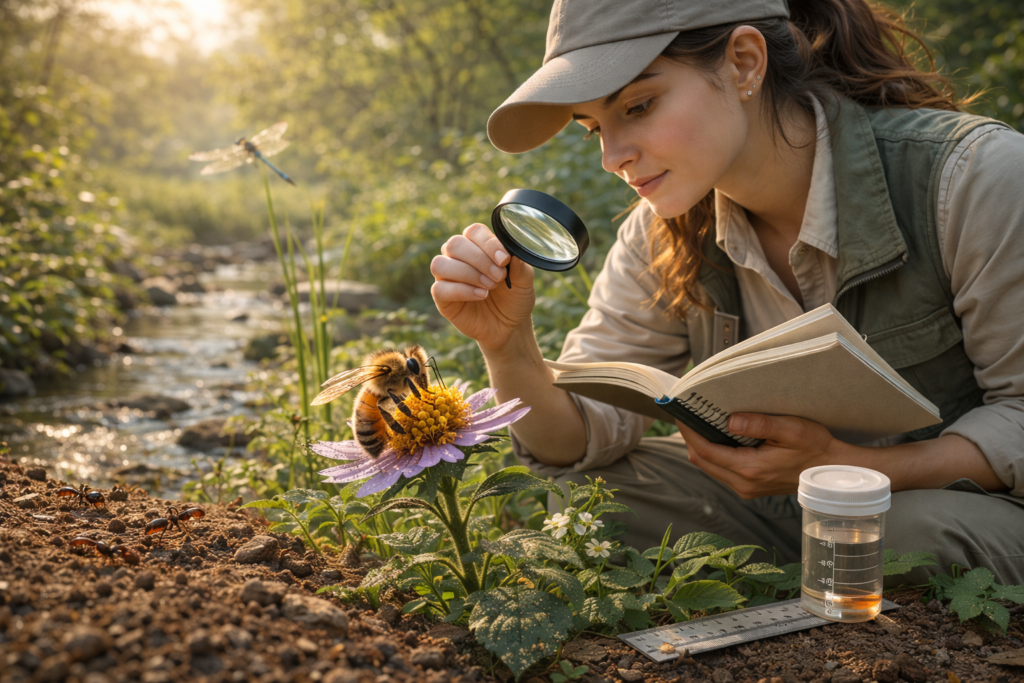
The general division of insect ecology is a fundamental framework used to organize the scientific study of life based on the complexity of the subjects involved. By splitting research into two primary branches, an ecologist can focus either on the specific survival mechanisms of a single species or the collective behavior of a diverse community. This division is essential for understanding the ecology of insect populations because it allows us to bridge the gap between individual behavioral traits and large-scale environmental patterns.
- Autecology (Individual Ecology): This branch focuses on the environmental adaptation of insects at the species level. It examines how a specific insect, such as a honeybee or a praying mantis, reacts to its physical environment, including its tolerance for temperature, moisture, and its unique life cycle. In the ecology of insect autecology, the goal is to understand the “niche” a species occupies and the physical limits of its survival.
- Synecology (Community Ecology): In contrast, synecology investigates the insect community structure by studying how different species interact within a shared habitat. This includes analyzing competition for resources, predator-prey dynamics, and mutualistic relationships like those between ants and aphids. Synecology provides a “big picture” view of the insect ecosystem role, showing how energy flows through various trophic levels within a defined space like a forest or a wetland.
Ecology of Insect Based on Environment: Habitat Adaptation Strategies
The ecology of insect populations is largely defined by the physical space they inhabit, which forces them to develop unique survival mechanisms. From my experience, the ecological classification of insects based on their environment reveals how physical constraints—like gravity on land or oxygen levels in water—drive the environmental adaptation of insects in fascinating ways.
Terrestrial Insects: Environmental Adaptation on Land
Living on land presents the greatest challenge of desiccation (drying out). To survive, terrestrial insects have developed a waxy exoskeleton that seals in moisture, a critical environmental adaptation of insects that allows them to thrive in arid deserts and tropical forests alike. Their insect habitat types on land vary from the forest floor to the high canopy, requiring specialized respiratory systems called tracheae to breathe air directly. Behavioral ecology plays a huge role here, as many species use complex camouflage to blend into foliage or soil to avoid predators.
Aquatic Insects: Life in Freshwater and Marine Ecosystems
The ecology of insect life in water requires mastering the art of underwater respiration and movement. Aquatic insects, such as dragonfly larvae or diving beetles, have evolved specialized gills or “physical gills” (air bubbles trapped against their bodies) to extract oxygen from water. These insects are essential to insect community structure in ponds and streams, often acting as primary consumers or fierce underwater predators. Their presence is so tied to water quality that they are the gold standard for an ecologist measuring the health of an aquatic ecosystem.
Aerial and Soil-Dwelling Insects: Exploring Specialized Habitats
Some of the most vital insect ecosystem roles are performed in the air and under the earth.
- Aerial Insects: Adaptation for flight allows for rapid dispersal and access to nectar sources, making these insects the world’s most effective pollinators.
- Soil-Dwelling Insects: These “ecosystem engineers,” such as termites and ants, spend their lives in the subterranean dark. Their environmental adaptation of insects includes reduced eyes and powerful digging limbs. By tunneling, they facilitate soil aeration and nutrient cycling, proving that the ecology of insect life beneath our feet is just as complex as that above it.
Ecology of Insect Based on Level of Organization
In the scientific study of life, organizing the ecology of insect life into hierarchical levels allows us to see how microscopic behaviors translate into global environmental changes. By breaking down the levels of ecological organization in insects, we can track how energy and information flow from a single organism upward to the entire biosphere.
Individual Level: Behavioral Ecology and Survival Traits
At the most basic level, the ecology of insect study focuses on the environmental adaptation of insects that allows a single organism to survive and reproduce. This includes behavioral ecology, where scientists observe how an insect’s “choices”—such as a moth’s flight pattern or a mantis’s camouflage—maximize its fitness. Survival traits at this level are often physiological, like the ability to produce antifreeze proteins or pheromones to signal mates, ensuring the individual can navigate its specific insect habitat types.
Population Level: Analyzing Insect Population Dynamics
When we shift to the population level, we examine a group of the same species living in a specific area. This branch of insect population ecology analyzes “dynamics”—the factors that cause numbers to rise or fall, such as birth rates, migration, and the impact of weather. Understanding these dynamics is crucial for predicting outbreaks, like locust swarms or seasonal butterfly migrations, and helps an ecologist determine the “carrying capacity” of a habitat for a particular species.
Community Level: Understanding Insect Community Structure
The insect community structure looks at how different populations—like bees, ants, and spiders—interact within the same environment. Here, the focus is on relationships such as competition for food, mutualism (where both species benefit), and predator-prey cycles. By studying this level, we gain insight into the ecology of insect diversity and how the presence of one species, like a predatory wasp, can prevent another, like a leaf-eating caterpillar, from destroying the local flora.
Ecosystem Level: Trophic Levels and Energy Flow
At the ecosystem level, the ecology of insect life is integrated with non-living elements like soil, water, and sunlight. Insects occupy various trophic levels, acting as primary consumers (herbivores), secondary consumers (predators), and decomposers. They are the essential link in the “energy flow” of the planet; they harvest energy from plants and transfer it to larger animals, while their role in nutrient cycling ensures that organic waste is turned back into life-sustaining soil.
Key Ecological Roles: Pollinators, Decomposers, and Predators
The ecology of insect functionality is best understood through the specific “jobs” they perform within a habitat. These roles are the backbone of the insect ecosystem role, ensuring that energy is captured, waste is removed, and populations remain balanced. Without these three primary pillars, most terrestrial ecosystems would lose their structural integrity.
- Pollinators (The Fertilizers): In the scientific study of life, pollination is perhaps the most famous insect ecology contribution. Insects like bees, butterflies, and hoverflies facilitate the reproduction of over 75% of the world’s flowering plants. By moving pollen from one flower to another, they ensure genetic diversity and the production of fruits and seeds that sustain other wildlife and human agriculture.
- Decomposers (The Recyclers): This often-overlooked ecology of insect role involves the breakdown of organic matter. Insects such as dung beetles, fly larvae, and termites are nature’s cleanup crew. They fragment dead plants and animals, allowing fungi and bacteria to finish the job of returning vital nutrients like nitrogen and carbon to the soil. This cycle is essential for maintaining the insect habitat types that support new plant growth.
- Predators and Parasites (The Regulators): To maintain a healthy insect community structure, natural “checks and balances” are required. Predatory insects, like praying mantises and ladybugs, along with parasitic wasps, control the populations of herbivores. By preventing any single species from overpopulating, these predators protect vegetation from being overgrazed and ensure that the trophic levels within an ecosystem remain stable.
Insect–Plant Interactions: The Foundation of Modern Biodiversity
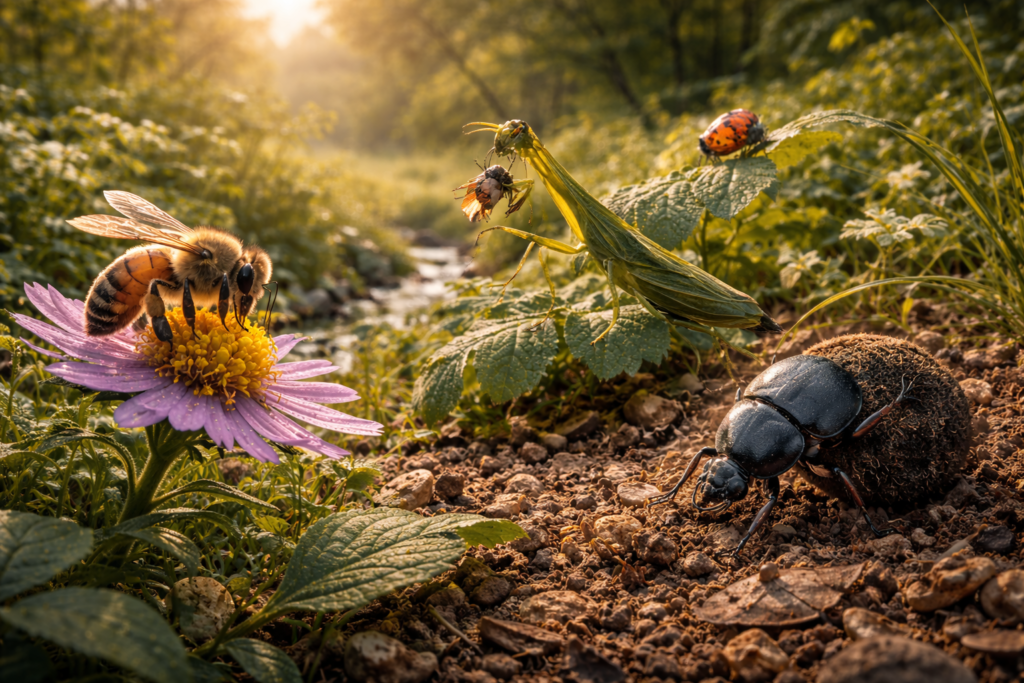
The ecology of insect and plant relationships is the primary engine driving global biodiversity, creating a complex web of co-evolution that has lasted for millions of years. This fundamental insect–plant interaction is not just about survival; it is a sophisticated biological partnership where plants provide food and shelter in exchange for reproduction and protection. In the scientific study of life, we see that the ecology of insect specialization allows different species to co-exist without competing for the same resources, which is why a single forest can support thousands of unique life forms.
These interactions within the ecology of insect communities can be categorized into three major types that define our natural landscapes:
- Mutualism (Pollination): This is the most vital insect–plant interaction, where flowering plants offer nectar as a high-energy reward. The ecology of insect pollinators like bees and butterflies ensures that pollen is transferred effectively, allowing for the genetic diversity we see in modern flora.
- Herbivory and Plant Defense: As part of the ecology of insect feeding habits, many insects consume plant tissue. In response, plants have evolved chemical and physical defenses (like thorns or toxins), which in turn forces insects to develop new environmental adaptation of insects to bypass these barriers.
- Protection and Myrmecophory: Some plants have evolved “extrafloral nectaries” to attract ants. This specific ecology of insect behavior creates a bodyguard system where the ants protect the plant from other herbivores in exchange for a steady food supply and nesting sites.
Conclusion: Why Understanding the Ecology of Insect Populations Matters
Ultimately, the scientific study of life reaches its most critical point when we recognize that the ecology of insect populations is the invisible thread holding our global biosphere together. Understanding these complex relationships is a vital necessity for modern society, as the ecology of insect adaptation provides the blueprints for sustainable agriculture, natural pest regulation, and the preservation of the world’s food security. By protecting the diverse insect habitat types and the intricate insect–plant interactions that have evolved over millennia, we are not just saving “bugs”—we are ensuring the resilience of the ecosystem services that provide us with clean air, fertile soil, and stable climates. Mastering the ecology of insect life is, therefore, our most effective tool for navigating the environmental challenges of the future and ensuring that the natural world remains productive for generations to come.
FAQs: Master the Basics of Insect Habitat Types and Ecological Classifications
What is the simplest definition of the ecology of insect life? It is the study of how insects interact with their physical environment and other living organisms to survive, grow, and reproduce.
What are the primary insect habitat types? Insects are found in almost every environment, categorized into terrestrial (land-based), aquatic (freshwater/marine), aerial (atmosphere-focused), and subterranean (soil-dwelling) habitats.
What is the difference between Autecology and Synecology? Autecology focuses on the environmental adaptation of insects at the individual species level, while Synecology studies the insect community structure and how different species interact within a shared space.
Why is the ecosystem level the most complex level of organization? At this level, the ecology of insect populations is integrated with non-living (abiotic) factors like sunlight, soil chemistry, and water, mapping the entire flow of energy through trophic levels.
How does the environmental adaptation of insects help them survive? Adaptations can be physical, like a waxy exoskeleton to prevent drying out on land, or behavioral, like a praying mantis using camouflage to ambush prey.
What is the “insect ecosystem role” of a decomposer? Decomposers like dung beetles and fly larvae perform a vital ecology of insect service by breaking down organic waste, which recycles nutrients back into the soil for plant growth.


