
I honestly believe that to truly understand the planet, you have to look at the world through the lens of its most numerous inhabitants. The ecology of insects is the scientific study of how these diverse creatures interact with their environment and other organisms. From my experience, this field is fascinating because it reveals how insects act as the “engine room” of nature, driving processes like pollination, decomposition, and nutrient cycling that keep entire ecosystems alive.
When we dive into the ecology of insects, we are looking at the intricate relationships that dictate survival and reproduction. I’ve always felt that the beauty of this study lies in its complexity; it examines how a single beetle’s behavior is influenced by temperature, soil quality, and the presence of predators. This scientific study of life on a micro-scale shows us that no insect exists in a vacuum; every movement is a response to the ecological pressures of their specific habitat.
Ultimately, mastering the concepts within the ecology of insects allows us to address global challenges like food security and biodiversity loss. I honestly believe that by understanding these interactions, we can better manage agricultural pests and protect the beneficial insects that sustain our food supply. From my experience, looking at insects not just as individual bugs, but as vital components of a larger ecological web, is the only way to appreciate the true meaning of biological balance.
What is Ecology? Understanding the Meaning and Scientific Definition
I honestly believe that is ecology a branch of biology is one of the most common questions for beginners, and the answer is a resounding yes. From my experience, while biology is the broad study of all living things, ecology is the specific “specialized lens” used to examine how those organisms function within their external environments. To understand how this scientific study of life operates, it helps to look at the different levels of biological organization an ecologist might investigate:
- Organismal Level: Studying how an individual, such as a single praying mantis, adapts to the challenges of its specific habitat.
- Population Level: Analyzing the distribution and abundance of a group of the same species living in a particular area.
- Community Level: Examining the interactions between different species, like the relationship between insects and the plants they pollinate.
- Ecosystem Level: Integrating the study of living organisms with non-living factors like climate, soil, and water.
Is Ecology a Branch of Biology? Exploring the Scientific Study of Life
I honestly believe that while general biology focuses on the internal mechanics of a living thing—like how a heart beats or how a cell divides—ecology is the study of how that life interacts with the external world. From my experience, you can think of biology as the study of the “machine” and ecology as the study of how that machine performs out in the field. When we look at ecology of insects , we are shifting our focus to the “big picture” of the natural world, analyzing how energy flows from the sun through plants and finally into the insects that consume them. This scientific study of life is essential because it bridges the gap between individual species and the health of the entire planet, providing the data needed to understand why certain populations thrive while others decline.
- Interdisciplinary Nature: Ecology often blends biology with chemistry and physics to explain how non-living elements like nitrogen or heat affect living communities.
- Scientific Study of Life: It specifically investigates the survival strategies that allow a species to fill its unique “niche” in an environment.
- Resource Distribution: It tracks how vital resources like food, water, and space are divided among competing organisms within a specific habitat.

What Does an Ecologist Study? The Role of Scientists in Nature
I honestly believe that many people picture an ecologist as someone who simply wanders through the woods, but the reality is that their work is a rigorous blend of data science and field observation. From my experience, what an ecologist studies is the complex “language” of nature—the invisible signals, chemical trails, and energy transfers that dictate how an ecosystem functions. In the context of the ecology of insects, this means they aren’t just counting bugs; they are investigating how a specific species of moth might be the only thing keeping a rare wildflower from going extinct or how a sudden rise in temperature might disrupt a beetle’s entire life cycle.
To understand the vital role these scientists play in nature, consider the diverse areas they investigate:
- Behavioral Dynamics: They observe how individual organisms interact, such as how ants organize complex social structures to maximize resource collection.
- Environmental Impact: They analyze how external factors like pollution or habitat loss ripple through the food chain, often using insects as “bio-indicators” of overall ecosystem health.
- Resource Tracking: They map the movement of nutrients and energy, studying how a dragonfly’s diet contributes to the control of mosquito populations.
- Conservation Strategy: They use their findings to create management plans that protect biodiversity, ensuring that the scientific study of life leads to actionable protection for endangered habitats.
Main Types of Ecology: From Individual Organisms to Global Biospheres
I honestly believe that to truly grasp the “big picture” of the natural world, you have to realize that ecology is organized like a giant puzzle, where each piece fits into a larger layer of complexity. From my experience, understanding the types of ecology of insects allows you to see how a single interaction—like a praying mantis catching its prey—ripples upward to affect the entire planet. By categorizing the scientific study of life into these distinct levels, an ecologist can pinpoint exactly where an ecosystem is thriving or where it might be breaking down.
To help you visualize how these layers stack up, here are the main branches that define the field:
- Organismal Ecology: This focuses on the individual, examining how a specific creature’s physiology and behavior allow it to meet the challenges of its environment.
- Population Ecology: This type analyzes groups of the same species, tracking how their numbers change over time and why they live in certain areas.
- Community Ecology: Here, the focus shifts to how different species interact with one another, such as the competition between two different types of beetles for the same food source.
- Ecosystem Ecology: This layer integrates living organisms with non-living components, studying how energy and nutrients flow through the air, water, and soil.
- Landscape and Global Ecology: These are the broadest types, looking at how multiple ecosystems interact across large regions and how the entire biosphere regulates the Earth’s climate and life-support systems.
Key Ecology Examples in the Insect World
I honestly believe that to truly understand the ecology definition, you have to look at the “jobs” insects perform every day. From my experience, the insect world provides the most vivid ecology examples because their interactions are so dramatic and essential for life. In the scientific study of life, we categorize these behaviors to see how they keep the environment in balance.
Consider these “case studies” of insect ecology in action:
- The Mutualists (Bees and Flowers): This is the gold standard of ecological interaction. The bee gets energy from nectar, while the flower gets a “genetic courier” to help it reproduce.
- The Recyclers (Dung Beetles): In ecosystem ecology, decomposition is vital. Dung beetles break down waste, returning nutrients to the soil and preventing pest outbreaks.
- The Predators (Praying Mantises): These masters of camouflage regulate the “distribution and abundance” of other insects. By keeping herbivore populations in check, they prevent plants from being overgrazed.
- The Engineers (Ants): Ants reshape the earth, aerating soil and dispersing seeds. Their social structure is a prime example of community ecology, where thousands of individuals work as a single unit to influence their habitat.
The Importance of Insect Ecology in Modern Ecosystems
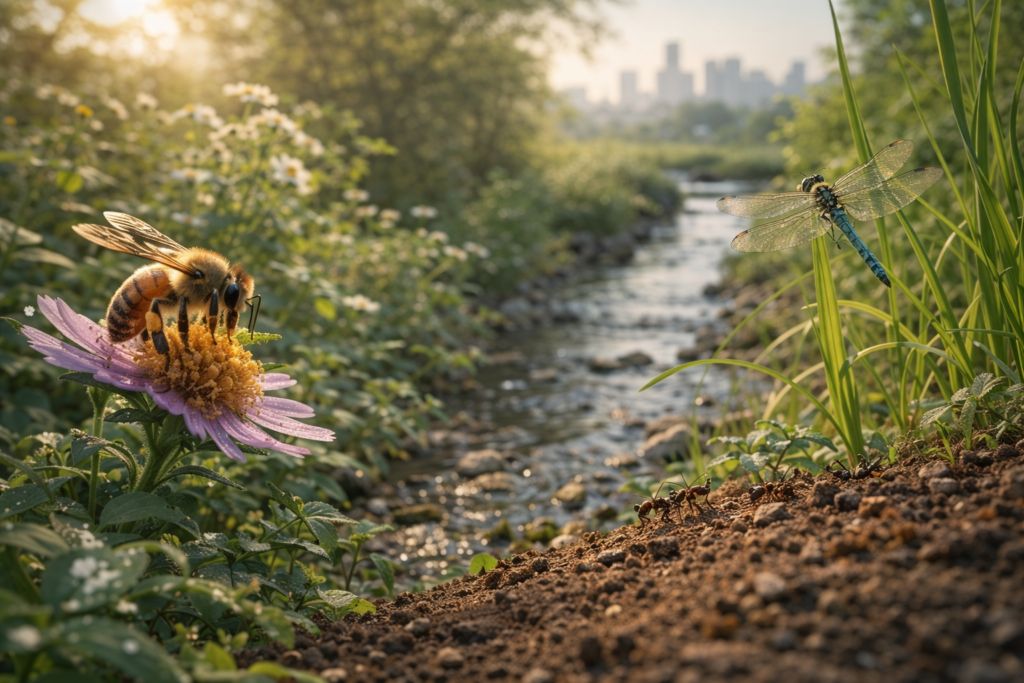
I honestly believe that insects are the true “master builders” of the natural world, functioning as biological engineers that physically and chemically transform their surroundings. From my experience, looking at the ecology of insects reveals that their roles go far beyond simple survival; they are responsible for aerating soil through tunneling, dispersing seeds to ensure plant diversity, and acting as a primary waste management system by breaking down dead matter. In the scientific study of life, these ecological roles are essential because they maintain the structural integrity of the habitat for all other species. Whether it is an ant colony moving tons of earth or a swarm of aquatic larvae purifying a stream, insects shape the environment in ways that allow the entire biosphere to remain productive and resilient.
How Insects Shape the Environment: A Look at Ecological Roles
I honestly believe that insects are the true “master builders” of the natural world, functioning as biological engineers that physically and chemically transform their surroundings. From my experience, looking at the ecology of insects reveals that their roles go far beyond simple survival; they are responsible for aerating soil through tunneling, dispersing seeds to ensure plant diversity, and acting as a primary waste management system by breaking down dead matter. In the scientific study of life, these ecological roles within the ecology of insects are essential because they maintain the structural integrity of the habitat for all other species. Whether it is an ant colony moving tons of earth or a swarm of aquatic larvae purifying a stream, the ecology of insects shapes the environment in ways that allow the entire biosphere to remain productive and resilient.
To better understand how these tiny creatures wield such massive influence, we can look at their specific ecological contributions through the lens of the ecology of insects:
- Nutrient Cycling: Beetles and fly larvae accelerate the breakdown of organic material, returning nitrogen and carbon to the soil.
- Soil Engineering: Ants and termites move more soil globally than earthworms, improving water infiltration and root growth.
- Trophic Links: Insects serve as the primary protein source for thousands of species of birds, reptiles, and mammals, acting as the vital bridge in the food web.
- Seed Dispersal (Myrmecochory): Many plants rely exclusively on ants to carry their seeds to nutrient-rich nesting sites, ensuring the next generation of flora.
Environmental Factors Influencing Insect Populations
I honestly believe that an insect’s life is a constant negotiation with the elements, where even a slight shift in the weather can trigger a population explosion or a total collapse. From my experience, the ecology of insects is uniquely sensitive to external pressures, as their cold-blooded nature means their growth rates and activity levels are directly dictated by environmental temperature. In the scientific study of life, we monitor these “abiotic factors” to predict how insect distributions will change, recognizing that variables like humidity can determine if a delicate egg survives, while the availability of specific host plants limits where a population can truly establish itself. By understanding these environmental influences, the ecology of insects becomes a roadmap for conservation, allowing an ecologist to better manage ecosystems. This proactive approach ensures that factors like habitat fragmentation or chemical changes don’t disrupt the vital ecology of insects or the roles these creatures perform.
- Temperature: Acts as a biological pacemaker, controlling how quickly an insect develops from a larva into an adult.
- Moisture and Humidity: Critical for preventing desiccation in eggs and larvae, especially for ground-dwelling species.
- Photoperiod: The length of daylight serves as a primary signal for insects to enter diapause (a state of dormancy) to survive the winter.
- Resource Availability: The presence of specific food sources or nesting sites determines the “carrying capacity” of a given habitat
Common Pitfalls in Understanding Ecological Relationships
I honestly believe that the biggest mistake people make in the scientific study of life is viewing nature as a static collection of individuals rather than a dynamic, moving web. From my experience, a common pitfall in understanding ecology of insects examples is the tendency to label certain insects as “good” or “bad” without considering their broader ecological role; for instance, a predatory wasp might be a nuisance at a picnic, but in community ecology, it is a vital check against caterpillar outbreaks that would otherwise destroy a forest. Another significant error is ignoring the “lag time” in nature, where the environmental factors affecting an insect population today—like a drought or habitat loss—might not show their full impact on the ecosystem for several seasons. By falling into these oversimplifications, we risk missing the delicate balance that an ecologist works to protect, ultimately leading to management decisions that inadvertently harm the very biodiversity we intend to save.
Common Pitfalls in Understanding Ecological Relationships
I honestly believe that the biggest mistake people make in the scientific study of life is viewing nature as a static collection of individuals rather than a dynamic, moving web. From my experience, a common pitfall in understanding ecology of insects examples is the tendency to label certain insects as “good” or “bad” without considering their broader ecological role; for instance, a predatory wasp might be a nuisance at a picnic, but in community ecology, it is a vital check against caterpillar outbreaks that would otherwise destroy a forest. Another significant error is ignoring the “lag time” in nature, where the environmental factors affecting an insect population today—like a drought or habitat loss—might not show their full impact on the ecosystem for several seasons. By falling into these oversimplifications, we risk missing the delicate balance that an ecologist works to protect, ultimately leading to management decisions that inadvertently harm the very biodiversity we intend to save.
FAQs: Master the Basics of What is Ecology and How it Works
- What is the simplest ecology definition? It is the study of how living things interact with each other and their physical environment to survive.
- What are some common ecology examples? Classic examples include the relationship between a predator and its prey, the way trees compete for sunlight in a forest, or how insects like bees provide pollination services to plants.
- Is ecology a branch of biology? Yes, it is the specific branch of biology that focuses on the external relationships and “big picture” connections of organisms rather than just their internal anatomy.
- What does an ecologist study daily? An ecologist studies data on population sizes, the flow of energy through food webs, and how changes in climate or habitat impact the survival of different species.
- How do you use “ecology” in a sentence? “The ecology of insects in this meadow is incredibly diverse, with dozens of species working together to maintain the health of the soil.”
- What are the main types of ecology of insects ? The field is divided into levels like organismal, population, community, and ecosystem ecology, each looking at a different scale of life.


