
In the scientific study of life, the growth and development of an insect are restricted by its rigid exoskeleton, making insect metamorphosis a biological necessity for survival. Since the cuticle can only undergo a limited amount of stretching, the organism must periodically cast off its old shell and develop a new, larger one to accommodate a marked increase in size. This profound transformation is not just a growth spurt but a total reprogramming of the insect’s form, allowing it to transition through distinct life stages such as the egg, larva, pupa, and the final adult form known as the imago.
The transformation process begins with moulting, a complex two-part operation consisting of apolysis and ecdysis. During apolysis, the old cuticle separates from the underlying epidermis , followed by the secretion of a specialized moulting fluid containing proteinase and chitinase to digest the old endocuticle. Once digestion is complete, the insect undergoes ecdysis, where it sheds the remnants of its old skin, called the exuvia. During this critical phase of insect metamorphosis, the new integument must be expanded by stretchin. Until the new integument is fully expanded and the tanning process (hardening) is complete, the insect remains in a soft, vulnerable “teneral” condition.
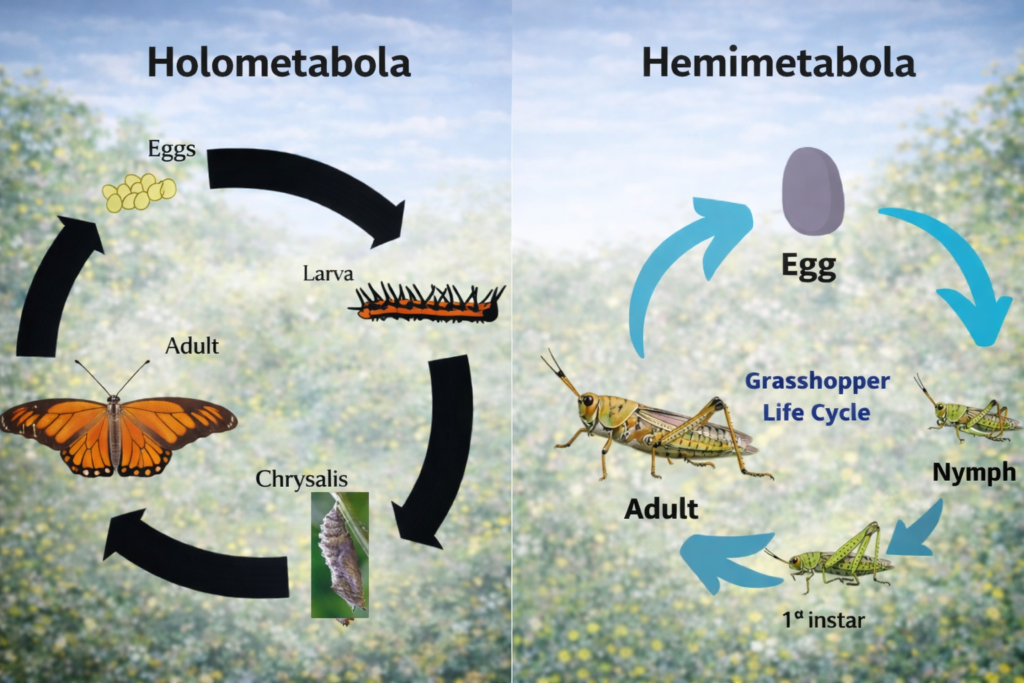
The diversity of this “biological reprogramming” is categorized into three primary modes: ametabolous, hemimetabolous, and holometabolous development. Primitive, wingless insects follow ametabola, where young nymphs look exactly like smaller versions of the adult. Many winged insects utilize hemimetabola, a simple or gradual metamorphosis where nymphs or aquatic “naids” slowly develop external wing pads. Finally, holometabola represents a complete, complex transformation where the larva enters a pupal stage to undergo radical internal and external reconstruction, eventually emerging as a winged adult that often occupies a completely different ecological niche than its younger self.
The Necessity of Change: Why Insects Must Undergo Metamorphosis
The primary reason for insect metamorphosis is the rigid nature of the exoskeleton. Unlike human skin, which expands as we grow, the insect’s nonliving cuticle can only undergo a very limited amount of stretching. For any marked increase in size to occur, the old, restrictive cuticle must be periodically shed and replaced with a larger one through the process of moulting.
Beyond simple growth, metamorphosis serves several vital evolutionary purposes:
- Size Increase: It provides the only opportunity for the insect to physically expand its body volume.
- Structural Renewal: The process allows for the development and hardening of a fresh, undamaged integument.
- Niche Differentiation: In complex metamorphosis (holometabola), it allows the young larvae and the adult imago to occupy different habitats and utilize different food sources.
- Reproductive Readiness: It facilitates the radical transition from a juvenile stage focused on feeding to a mature adult stage focused on reproduction and dispersal.
The Molting Protocol: The 9-Step Biomechanics of Ecdysis
In the scientific study of life, the transition between growth stages is a high-precision mechanical event. Insect metamorphosis relies on a strict sequence of biological “reprogramming” steps to ensure the new cuticle is properly formed before the old one is discarded.
Apolysis vs. Ecdysis: Understanding the Separation and Shedding
According to your lecture data, the molting protocol involves two distinct processes that are often separated in time:
- Apolysis: This is the initial stage where the living epidermis separates from the old, non-living cuticle. During this phase, the epidermal cells divide mitotically and become columnar, creating a tension that pulls them away from the existing shell.
- Ecdysis: This is the final act of shedding the remnants of the old cuticle, which now consists only of the epicuticle and exocuticle. The insect emerges by splitting the old shell along a “line of weakness” or ecdysial line.
The 9-Step Biomechanics of the Molting Cycle
Your PDF outlines the exact sequence required to successfully navigate this transformation:
- Apolysis: Separation of the old cuticle.
- Fluid Secretion: The epidermis secretes inactive moulting fluid.
- Cuticulin Production: The first layer of the new exoskeleton is formed.
- Activation: The moulting fluid is activated with enzymes (proteinase and chitinase).
- Digestion: The old endocuticle is digested and absorbed for recycling.
- New Secretion: The epidermis secretes the inner epicuticle and procuticle.
- Ecdysis: The actual shedding of the old skin.
- Expansion: The new, wrinkled integument is stretched to its full size.
- Tanning: The final hardening and coloring of the new armor.
Tanning and Hardening: Navigating the Vulnerable Teneral Condition
Immediately after ecdysis, the insect enters its most dangerous life stage. Known as the teneral condition, the insect’s new integument is soft, colorless, and wrinkled. To reach its next size during insect metamorphosis, the insect must swallow air or take in water to increase blood pressure and stretch the flexible new cuticle. This expansion is a vital step in insect metamorphosis before the hardening process begins. Once the wrinkled new integument is expanded by stretching, the process of tanning occurs, allowing the procuticle to differentiate into the rigid exocuticle.
Once expanded, the process of tanning (sclerotization) begins, where the procuticle differentiates into a rigid exocuticle. Only after this hardening is complete can the muscles relax and the insect return to its normal activities with its new, reinforced armor.
Developmental Stages: From Instar to Imago
The lifecycle of an insect is a series of discrete steps, each defined by the shedding of the insect integument. According to your lecture data, insect metamorphosis involves the following stages and temporal classifications:
- Instar: This refers to the particular form or shape of an insect between two successive moultings. For example, after hatching, the insect is in its first instar; after its first moult, it becomes a second instar.
- Stadium: This is the specific period of time or duration between two moultings. It represents the “growth phase” where the insect feeds heavily to prepare for the next physical transformation within the insect metamorphosis cycle.
- Pharate Instar: In some cases, the old cuticle may be retained for a time after the new one has formed but before ecdysis occurs. During this brief period, the insect is referred to as a pharate instar.
- Imago: This is the final, fully developed adult stage of the insect. The imago is typically characterized by the presence of functional wings and mature reproductive organs, marking the completion of insect metamorphosis.
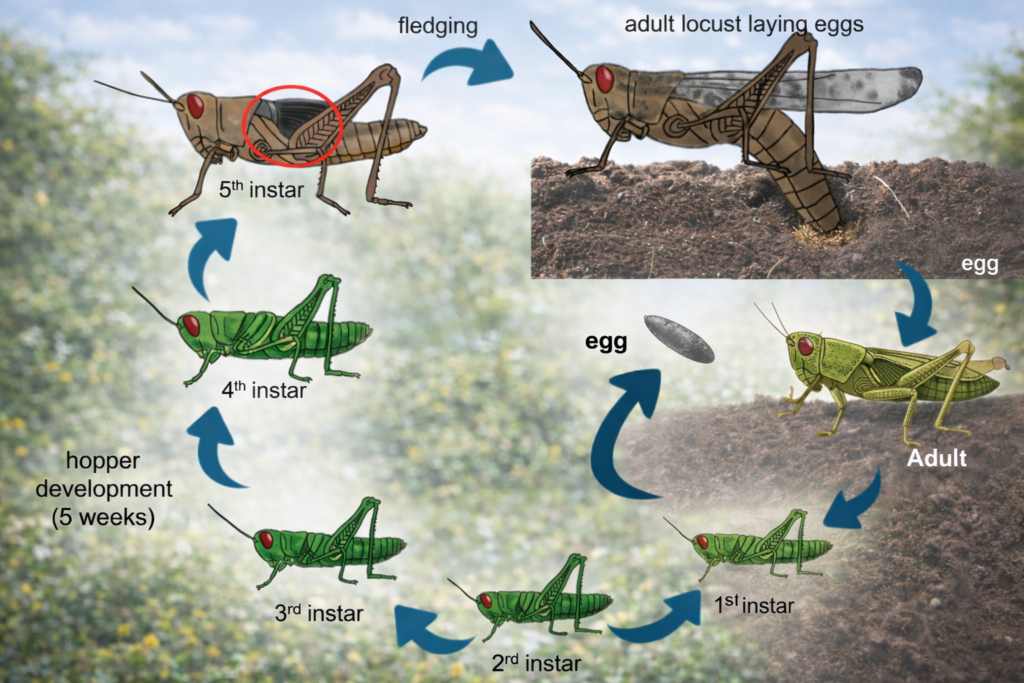
The Three Modes of Transformation: Types of Metamorphosis
In the scientific study of life, insect metamorphosis is categorized into three primary pathways based on the complexity of the physical changes the organism undergoes. These modes of development determine how an insect transitions from a juvenile to a sexually mature imago.
Ametabola: Primitive Development Without Structural Change
Insects following this pathway undergo little to no metamorphosis. The young ones, called nymphs, emerge from the egg looking essentially like smaller versions of the adult.
- Life Stages: These insects pass through only three life stages: egg, nymph, and adult.
- Key Characteristics: They are typically wingless (Apterygota).
- Examples: Common examples include silverfish, springtails, and telsontails.
Hemimetabola: The Simple Transition of Nymphs and Naids
This mode represents simple, direct, or incomplete insect metamorphosis. The young ones pass through gradual changes to reach maturity.
- Nymphs vs. Naids: The terrestrial young are called nymphs, while aquatic young are known as naids (or naiads).
- Development: These insects lack a pupal stage. Wings develop externally, a condition known as Exopterygota.
- Examples: This group includes grasshoppers, cockroaches, termites, and true bugs.
Holometabola: The Radical Rebirth of Complete Metamorphosis
This is a complex and indirect form of insect metamorphosis characterized by a total reconstruction of the body plan.
- Life Stages: The lifecycle consists of four distinct stages: egg, larva, pupa, and adult.
- Larval and Pupal Stages: The larva is typically specialized for feeding and does not resemble the adult. During the pupal stage, the insect is inactive as its tissues are “reprogrammed”.
- Wing Development: Wings develop internally (Endopterygota).
- Examples: Familiar examples include butterflies, beetles, flies, bees, and wasps
Advanced Variations: Hypermetamorphosis and Anamorphosis
Hypermetamorphosis: The Multi-Form Transformation
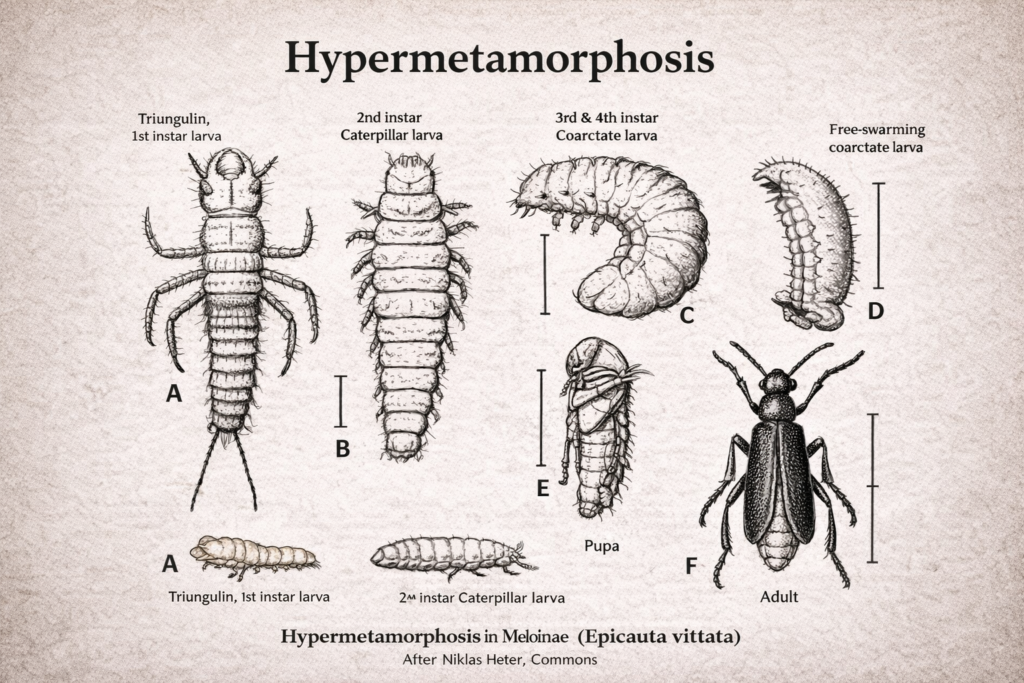
Hypermetamorphosis is a sophisticated version of complete metamorphosis where the various larval instars are not similar in shape or habit. Instead of a uniform larval stage, the insect’s form changes significantly as it progresses through different instars.
- Functional Diversity: Each larval stage is often specialized for a different task, such as searching for a host or intensive feeding.
- Example: The blister beetle is a primary example of this complex developmental strategy.
Anamorphosis: Postembryonic Segment Addition
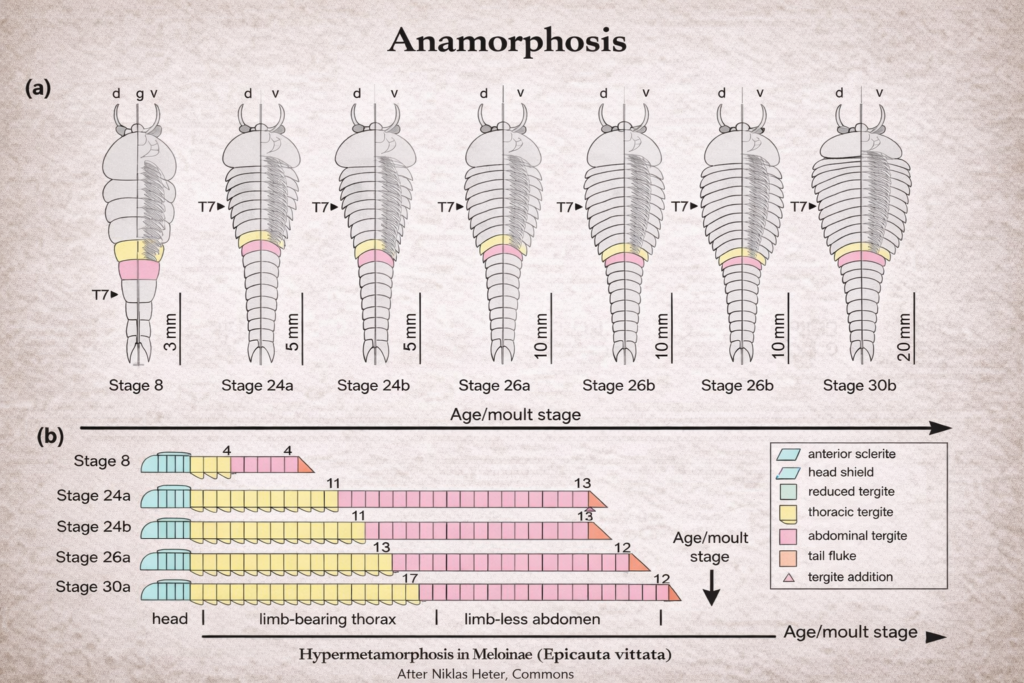
Anamorphosis is a unique growth pattern where the insect increases the number of its abdominal segments after hatching. Unlike typical insect metamorphosis, this process adds structural complexity without radically changing the insect’s overall appearance.
- Developmental Process: In species like telsontails, the nymphs hatch with only eight abdominal segments.
- Segment Addition: Three additional segments are added between the last segment and the rest of the body during postembryonic development.
- Visual Stability: Because the general form remains the same, anamorphosis is often considered a subtle but vital growth variation.
Hormonal Command: The Roles of Ecdysone and Juvenile Hormone
The transition between life stages is governed by two primary chemical messengers that work in tandem to manage the growth and development of the insect integument:
- Ecdysone (Moulting Hormone): Produced by the prothoracic glands, ecdysone is the primary trigger for the molting process. It initiates apolysis—the separation of the old cuticle—and stimulates the epidermal cells to begin secreting the new layers of the exoskeleton.
- Juvenile Hormone (JH): Secreted by the corpora allata, this hormone determines the “character” of the molt. As long as JH levels are high, the insect will remain in its current juvenile state (larva or nymph) after a molt.
- The Metamorphic Switch: For insect metamorphosis to progress toward maturity, JH levels must drop.
- Low JH + Ecdysone: Triggers a pupal molt in holometabolous insects.
- Absence of JH + Ecdysone: Results in the final imaginal molt, where the insect emerges as a fully developed adult or imago.
By balancing these two hormones, the insect’s body ensures it only transitions to the next stage when it has reached the appropriate size and nutritional status, preventing premature or malformed development.
Conclusion: Metamorphosis as an Evolutionary Masterclass
In the scientific study of life, insect metamorphosis stands as an evolutionary masterclass in biological efficiency and survival. By utilizing a periodic shedding process to overcome the physical constraints of a rigid insect integument, insects have developed a way to completely reprogram their bodies for different life stages. This transformation—ranging from the subtle changes in ametabola to the radical reconstruction seen in holometabola—allows a single species to exploit multiple ecological niches, reducing competition between the ravenous larva and the mobile, reproductive imago. Controlled by a precise hormonal command of ecdysone and juvenile hormone, this developmental flexibility is the primary reason insects remain the most diverse and successful group of organisms on the planet in 2026.
FAQs
Why is the moulting process necessary for insect growth? Growth is limited by the rigid cuticle, which only undergoes a limited amount of stretching; therefore, for any marked increase in size to occur, the cuticle must be shed and replaced.
What is the difference between an instar and a stadium? An instar refers to the particular form or shape of an insect between two successive moultings , while a stadium is the specific period of time between those two moultings.
What occurs during the “teneral” condition? Until the process of tanning (hardening) is complete, the insect is in a soft, wrinkled “teneral” state, where it must expand its new integument by stretching before the cuticle becomes rigid.
What are the four stages of complete (holometabolous) metamorphosis? The four distinct life stages are the egg, larva, pupa, and the adult imago.
How do nymphs and naids differ in hemimetabolous development? Both are immature forms similar to the adult; however, “nymph” typically refers to terrestrial young, while aquatic nymphs are specifically known as naids or naiads.
Which hormones control the metamorphic “reprogramming”? While your text focuses on the biological steps, the process is driven by the moulting gland secreting fluid to digest the old cuticle , which is enzymatically activated to break down protein and chitin.
What is hypermetamorphosis? It is a complex form of metamorphosis in which the different larval instars are not similar to one another, often changing shape significantly throughout development, such as in the blister beetle.


