
The study of Soil factors within the abiotic environment is a specialized branch of entomology that examines the non-living subterranean elements influencing an insect’s life cycle. For many insects, the soil is not just a substrate but a complex, sum total of external factors including mineral particles, moisture, and chemical nutrients that affect growth and survival. By classifying these edaphic variables, researchers can better predict the population dynamics of ground-dwelling pests and beneficial decomposers, providing a technical framework for sustainable agricultural management.
In 2026, the analysis of Soil factors has shifted toward high-resolution modeling of the pedosphere as a specialized microenvironment. For insects, the soil provides a sanctuary that orbits the “Organismal Center,” offering protection from the extreme temperature and humidity fluctuations found in the macroenvironment. This underground framework allows for a multidimensional understanding of how hexapods utilize soil structure and chemistry to successfully navigate their most vulnerable life stages, such as pupation and overwintering.
Mastering the nuances of Soil factors is essential for developing precise surveillance strategies for subterranean insects like termites and root-feeders. Whether we are analyzing the mechanical barriers of soil compaction or the nutritional value of organic humus, these non-living drivers sustain the diverse biological processes occurring beneath the surface. This article provides a technical breakdown of these abiotic classifications, exploring the physical, chemical, and biological layers that define the subterranean insect environment.
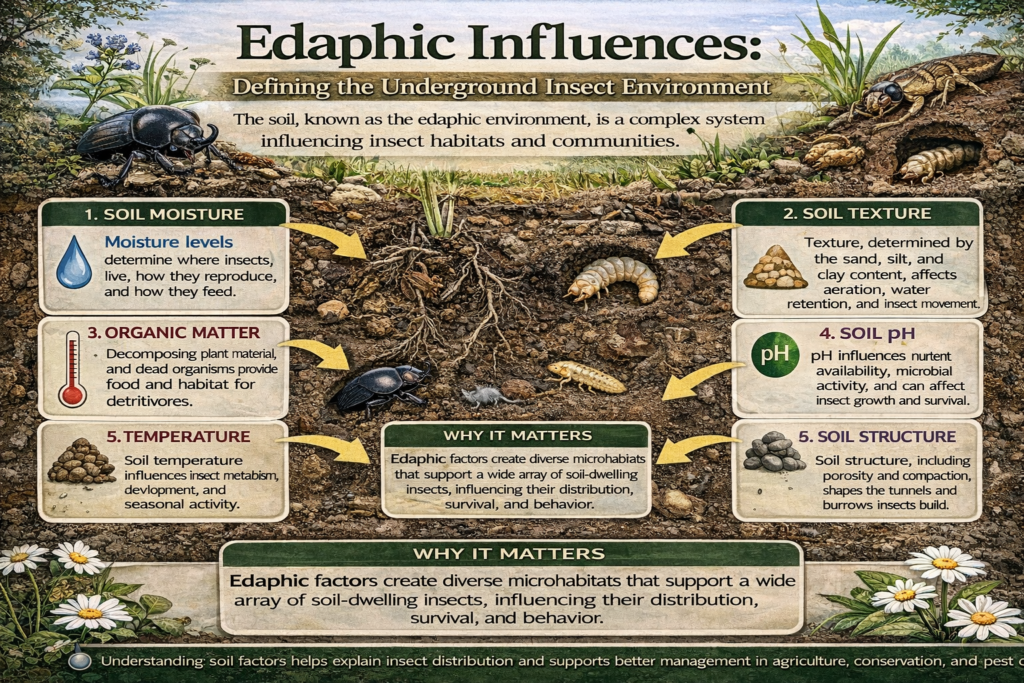
Edaphic Influences: Defining the Underground Insect Environment
- Soil as the Sum Total of Subterranean External Factors
- The soil is defined as a complex abiotic system consisting of non-living factors like minerals, nutrients, and physical space that surround subterranean organisms.
- These factors directly influence an insect’s metabolism, movement, and ability to perceive environmental signals.
- As part of the insect environment, soil provides the physical medium for many terrestrial life cycles.
- The Pedosphere: A Critical Microenvironment for Hexapod Life
- The pedosphere (soil layer) acts as a limited, immediate microenvironment where specific Soil factors operate at a very close range to the insect.
- This layer buffers insects from the harsh, distant conditions of the macroenvironment prevailing above ground, such as extreme winds or rapid temperature shifts.
- For a ground-dwelling organism, the microenvironment of the soil is its entire world for the duration of its subterranean life stage.
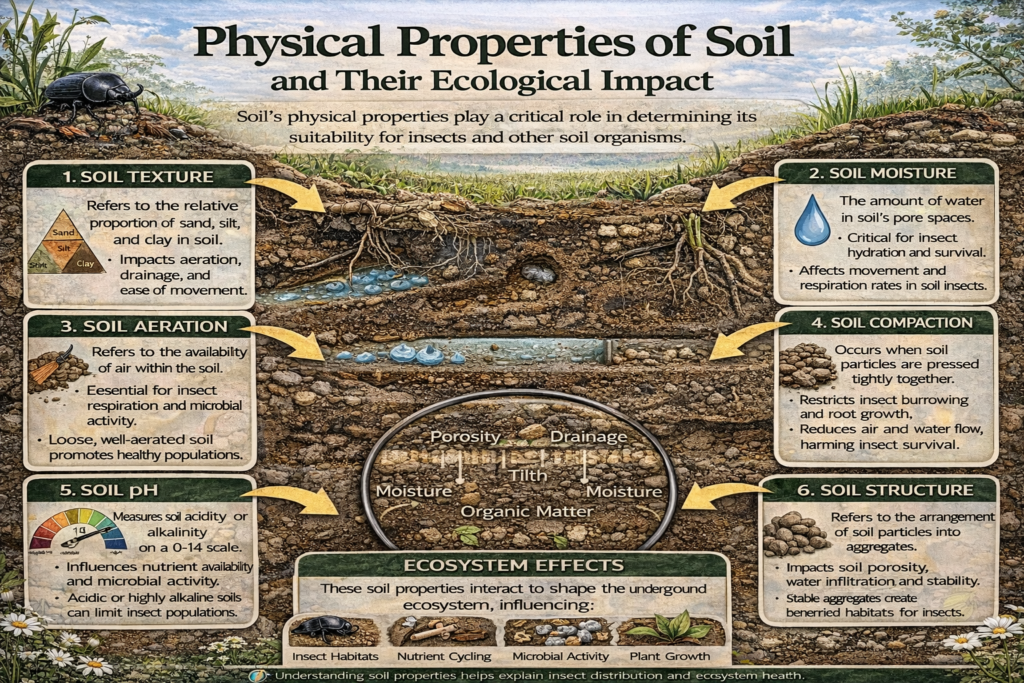
Physical Properties of Soil and Their Ecological Impact
- Soil Texture and Structure: Navigating the Mineral Matrix
- Texture refers to the proportion of sand, silt, and clay, which determines the physical space available for insect movement and burrowing.
- Structure dictates how these soil particles aggregate, creating pore spaces that are essential for the survival and oxygen access of burrowing hexapods.
- Compacted or heavy clay soils can act as mechanical barriers, significantly increasing environmental resistance.
- Soil Moisture and Humidity: The Hydrological Needs of Subterranean Larvae
- Water and humidity are critical Soil factors that prevent desiccation in soft-bodied larvae and eggs.
- The moisture content within the soil microenvironment is often much higher and more stable than in the open air, providing a safe haven for moisture-sensitive species.
- Water also acts as a medium for transporting dissolved chemicals and nutrients that affect the insect’s state.
- Thermal Conductivity: Temperature Regulation within Soil Layers
- Soil temperature is a key abiotic factor that governs the rate of development and overwintering success.
- Different soil depths provide different thermal constants; as the macroenvironment changes, insects can migrate vertically to find optimal heat levels.
- This physical factor is the primary driver for seasonal emergence patterns in many beetles and moths.
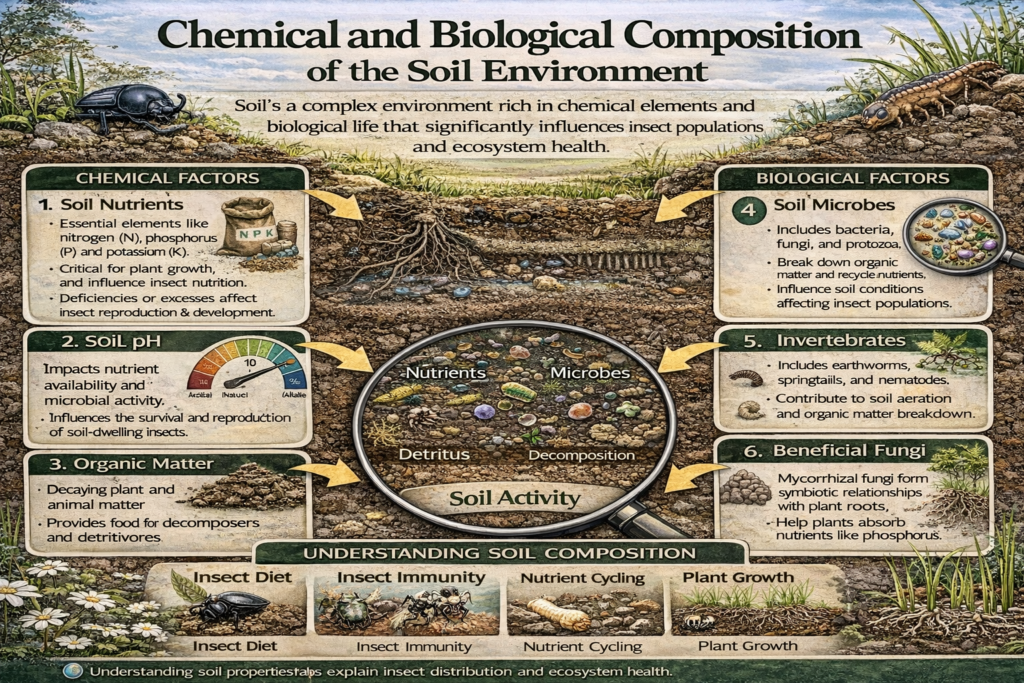
Chemical and Biological Composition of the Soil Environment
- Soil pH and Mineral Nutrients: The Chemical Drivers of Development
- Chemical factors, including soil pH and mineral availability, affect the physiological health and shell development of ground-dwelling insects.
- High salinity or chemical toxicity in the soil can act as a lethal environmental resistance factor, causing osmotic stress.
- These chemical influences are part of the non-living drivers that orbit the organismal center.
- Organic Matter and Humus: Food Sources for Decomposers and Detritivores
- Humus and organic matter provide a biotic bridge within the abiotic soil matrix, serving as primary food for decomposers like certain beetles.
- Rich organic soils support higher biodiversity by providing both energy and improved soil structure for habitat creation.
- This organic layer is the most biologically active portion of the subterranean insect environment.
- Soil Aeration: Oxygen Access for Root-Feeding and Burrowing Insects
- Air and gas exchange within the soil are essential for the respiration of subterranean insects through their tracheal systems.
- Poorly aerated or waterlogged soils can suffocate larvae, acting as a major limiting factor in the underground environment.
- The composition of atmospheric gases in soil pores is a critical abiotic driver of survival.
The Role of Soil in Life Cycle Stages
- Subterranean Habitats: Permanent Soil Dwellers (Collembola and Termites)
- Many insects spend their entire lives within the soil, adapted specifically to subterranean pressures like darkness and high pressure.
- These organisms rely on the “sum total” of soil variables to meet all their nutritional and reproductive needs.
- The Soil as a Sanctuary: Pupation and Overwintering Strategies
- For many terrestrial insects, the soil serves as a temporary shelter or microenvironment for pupation or survival during cold months.
- It provides mechanical protection and thermal stability that the macroenvironment cannot offer.
- Case Study: Termite Mounds and Soil Engineering
- Social insects actively manipulate Soil factors to construct mounds that stabilize their internal microenvironment against outside weather.
- These structures represent the ultimate interaction between an organism and its abiotic environment.
Soil Factors as Environmental Resistance
- Mechanical Barriers: Soil Compaction and Movement Constraints
- High soil density or compaction can prevent insects from burrowing or emerging, acting as a major physical barrier to survival.
- Gravity and soil pressure are miscellaneous factors that subterranean insects must overcome to move through the pedosphere.
- Soil Salinity and Toxicity: Chemical Barriers to Survival
- Excessive chemicals, salts, or pollutants in the soil can disrupt an insect’s internal chemistry, leading to high mortality rates.
- These negative chemical factors represent the “harmful” side of the abiotic environment.
Conclusion: Soil as the Foundation of Terrestrial Insect Success
In conclusion, Soil factors represent the foundational abiotic drivers that define the terrestrial insect environment. By integrating the physical properties of moisture and temperature with the chemical complexity of nutrients and pH, the soil creates a stable sanctuary for a vast array of hexapod species. Understanding these underground variables is essential for modern entomological research and the maintenance of ecosystem balance.
FAQs: Understanding Edaphic Factors in Entomology
- What are edaphic factors? They are the specific Soil factors, such as texture, moisture, and pH, that influence the organisms living within the pedosphere.
- How does soil moisture affect insects? It provides essential hydration for larvae and prevents the drying out (desiccation) of delicate eggs and pupae.
- Why is soil temperature important? It acts as a non-living driver for the speed of an insect’s life cycle and determines when they emerge or overwinter.
- Do all insects live in the soil? No, but many utilize the soil as a microenvironment for specific stages of their life, such as pupation or protection from predators.
- How do termites affect soil? They are “soil engineers” that move mineral and organic particles to create complex, ventilated mounds that stabilize their microenvironment.
