
The Respiratory System in Insects represents one of the most remarkable evolutionary diversifications in the animal kingdom, providing a decentralized solution to the problem of cellular oxygenation. Unlike the respiratory systems of vertebrates, which utilize lungs to oxygenate blood and a circulatory system to transport that oxygen, the Respiratory System in Insects delivers air directly to the internal tissues. This architecture allows insects to maintain exceptionally high metabolic rates, especially during flight, without the physiological “bottleneck” of a heart-driven oxygen delivery loop. In the scientific study of life, this system is recognized as the primary factor limiting the maximum physical size of insects, as it relies heavily on the physics of gas diffusion through a network of internal tubes.
The fundamental structural unit of this system is the tracheal network, an intricate web of branching tubes that originates at the body wall and terminates deep within individual muscle fibers and organ tissues. This network is divided into three functional zones: the external spiracles that act as regulated gateways, the primary tracheae that serve as transport highways, and the microscopic tracheoles where the actual exchange of oxygen and carbon dioxide occurs. Each component is specifically adapted to balance two conflicting biological needs: the continuous intake of oxygen and the strict prevention of internal water loss, which is the greatest threat to terrestrial invertebrates.
By examining the Respiratory System in Insects in 2026, we see a system that scales in complexity with the activity level of the species. While small, sedentary insects may rely entirely on passive diffusion, larger and more active species like bees, locusts, and dragonflies have evolved supplemental structures such as air sacs and mechanical pumping behaviors to facilitate active ventilation. This article provides an exhaustive technical analysis of these components, exploring the histological support of the tracheae, the biomechanics of spiracular valves, and the specialized modifications that allow insects to breathe in diverse environments, including underwater habitats.
The Tracheal Blueprint: How Insects Breathe Without Lungs
Terrestrial Adaptation: The Evolution of the Tracheal Network
- Insects possess a highly efficient respiratory system that is specifically adapted for a terrestrial existence, where oxygen is abundant but moisture is easily lost.
- The system is built upon a complex internal network of air-filled tubes called tracheae that branch throughout the entire body cavity.
- This branching ensures that gas exchange occurs directly between the air and the body tissues, essentially bringing the atmosphere into contact with every cell.
Vertebrate vs. Insect Respiration: The Absence of Blood-Based Transport
- A defining characteristic of the Respiratory System in Insects is that, unlike vertebrates, there is no involvement of the blood (hemolymph) in the transport of oxygen.
- Vertebrates use a centralized respiratory organ (lungs) to transfer oxygen to the blood, which then carries it to the tissues.
- Insects bypass this step, allowing for a much more direct and rapid supply of oxygen to high-demand areas like the flight muscles.
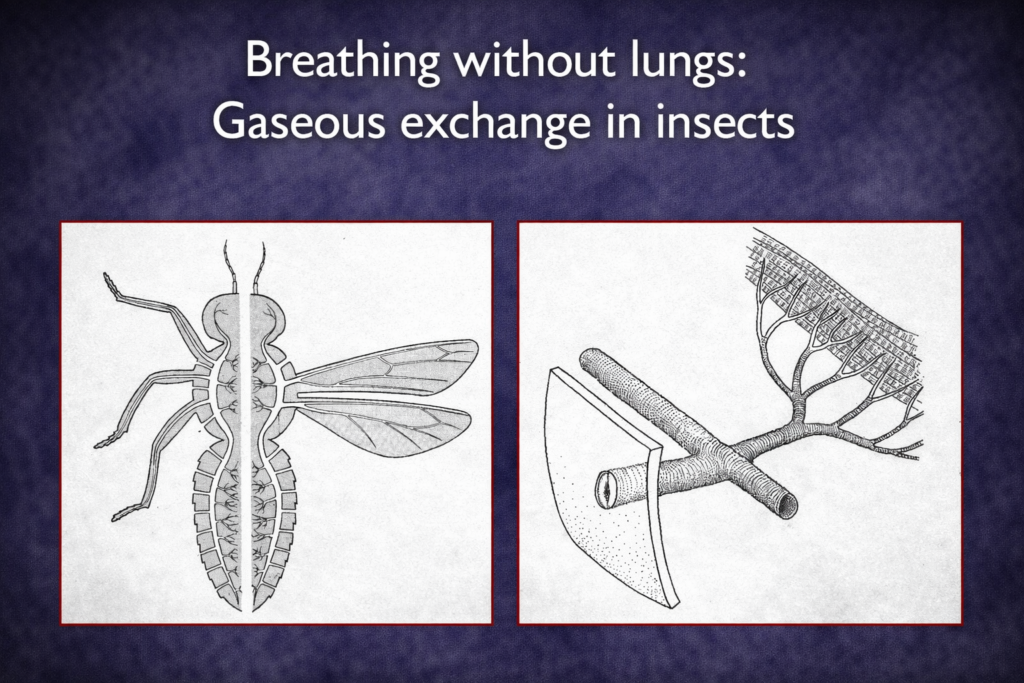
The External Gateways: Anatomy and Function of Spiracles
Segmental Distribution: Thoracic and Abdominal Positioning
- Spiracles are the external openings of the tracheal system, appearing as small pores on the insect’s exoskeleton.
- These openings are typically arranged in pairs and located laterally along the thoracic and abdominal segments.
- The distribution of spiracles ensures that air can enter the tracheal trunks at multiple points, providing a redundant and reliable oxygen supply.
Spiracular Valves: The Critical Mechanism for Preventing Water Loss
- Every spiracle is equipped with a specialized valve or closing apparatus that can be opened or closed by muscular action.
- These valves are the insect’s primary defense against desiccation, as they remain closed during periods of inactivity to prevent water vapor from escaping.
- When oxygen demand increases, the valves open to allow air entry, but they are carefully regulated to balance respiratory needs with hydration.
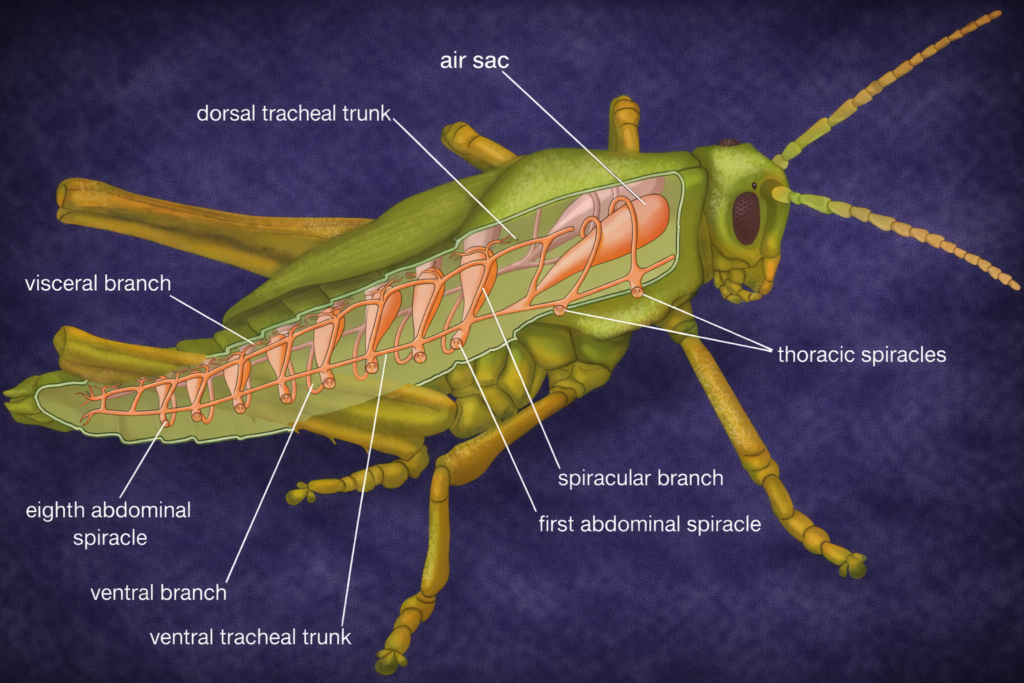
The Internal Conduit System: Tracheae and Tracheoles
Structural Integrity: The Role of Spiral Taenidia in Tube Support
- The tracheae are the large primary air tubes that extend inward from the spiracles into the body.
- These tubes are composed of a cuticular lining that is continuous with the insect’s outer skeleton.
- To prevent the tubes from collapsing under the weight of internal organs or changing body pressure, they are reinforced with spiral thickenings of the cuticle known as taenidia.
Tracheoles: The Fluid-Filled Micro-Branches of Gas Exchange
- As the tracheae branch deeper into the body, they become progressively smaller until they reach the tracheoles.
- Tracheoles are the finest branches of the system, often less than one micrometer in diameter, and they end blindly within the tissues.
- These tiny tubes are filled with fluid at their tips, providing a moist surface where oxygen can dissolve and diffuse directly into the adjacent cells.
Advanced Ventilation: Air Sacs in Active Insect Species
Facilitating Flight: The Function of Thin-Walled Expansions
- In many large or highly active insects, such as bees and locusts, certain parts of the tracheae are modified into thin-walled expansions called air sacs.
- Unlike standard tracheae, air sacs lack the reinforcing taenidia, which makes them highly flexible and capable of collapsing or expanding.
- These sacs act as bellows, increasing the volume of air that can be stored and moved through the system during intense physical activity.
Air Storage and Body Weight Reduction
- Air sacs provide a critical reservoir of oxygen that can be accessed when the insect is under high metabolic stress, such as during takeoff.
- Additionally, the presence of these air-filled cavities lightens the overall body weight of the insect, which is a major mechanical advantage for flight.
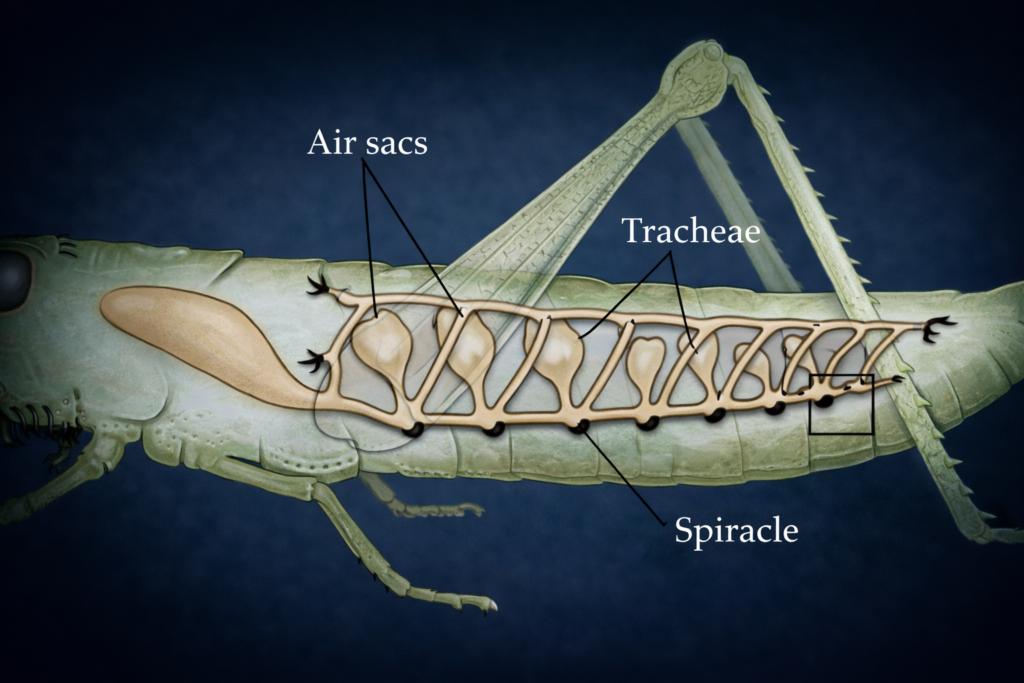
The Mechanics of Breathing: From Passive Diffusion to Active Pumping
Passive Diffusion: Gas Exchange in Small Insect Morphologies
- Small insects generally rely on the simple passive movement of gases, known as diffusion, to meet their oxygen needs.
- Because the distance between the external spiracles and the internal cells is very short in small species, oxygen naturally flows down its concentration gradient into the body.
- This system requires no energy expenditure for breathing, making it highly efficient for low-metabolism species.
Active Ventilation: Rhythmic Abdominal Contractions
- Large insects cannot rely on diffusion alone and must use active ventilation to move air through their larger tracheal networks.
- This is achieved through rhythmic contractions of the abdomen, which compress the internal air sacs and tracheae to force “old” air out.
- When the muscles relax, the tubes spring back into shape, drawing fresh, oxygen-rich air deep into the body through the spiracles.
Ecological Adaptations: Respiration in Aquatic Insects
Physical Gills and Plastron Respiration
- Aquatic insects have evolved ingenious methods to utilize the tracheal system while submerged in water.
- Some species carry a physical gill, which is a bubble of air trapped against the body that acts as an underwater oxygen reservoir.
- Others utilize plastron respiration, where a permanent, thin film of air is held in place by a dense carpet of microscopic, water-repellent hairs.
Tracheal Gills: Specialized Structures for Underwater Gas Exchange
- Many immature aquatic insects, such as dragonfly or mayfly nymphs, possess tracheal gills.
- These are leaf-like or filamentous outgrowths of the body wall that are heavily supplied with tracheae.
- Oxygen from the water diffuses across the thin skin of the gill and directly into the internal tracheal system, allowing the insect to breathe without surfacing.
Conclusion: The Importance of Respiratory Efficiency in Insect Survival
The Respiratory System in Insects is a fundamental organ system that ensures the continuous supply of oxygen for cellular metabolism and the efficient removal of carbon dioxide. By evolving a decentralized network of reinforced tubes and specialized sensory gateways, insects have mastered a form of respiration that is perfectly suited to their small size and high-energy lifestyles. From the reinforcing taenidia that keep air passages open to the complex air sacs that facilitate the energy demands of flight, every structural detail is a testament to the evolutionary success of the Class Insecta.
FAQs: Understanding the Insect Respiratory System
- Do insects have lungs like humans? No, insects lack lungs and instead use a network of tubes called tracheae to deliver oxygen directly to their tissues.
- What is the function of taenidia? Taenidia are spiral thickenings in the walls of the tracheae that provide structural support and prevent the tubes from collapsing.
- How do insects prevent water loss through their breathing holes? Insects have valves in their spiracles that can be closed tightly to prevent moisture from evaporating from the internal system.
- How do very large insects get enough air? Large or active insects use abdominal pumping and air sacs to actively move air through their bodies, rather than relying on diffusion alone.
- How do insects breathe underwater? Aquatic insects use various adaptations such as tracheal gills, air bubbles (physical gills), or permanent air films called plastrons.
