
The Insect Abdomen represents the final and often most physiologically significant tagma of the insect body. While the head is specialized for sensory input and feeding, and the thorax is dedicated to locomotion, the Insect Abdomen serves as the primary hub for metabolic, respiratory, and reproductive functions. In the scientific study of life, the Insects Abdomen is noted for its relative simplicity in external segmentation compared to the other tagmata, yet it possesses an extraordinary array of internal systems and specialized external appendages. Understanding the Insects Abdomen is essential for entomologists, as it provides the most reliable morphological characters for species identification, particularly regarding the complex genitalia used in taxonomic classification.
In 2026, research into the comparative morphology of the Insects Abdomen has highlighted the incredible diversity of abdominal modifications that allow insects to thrive in environments ranging from deep freshwater to arid deserts. The Insects Abdomen is not a rigid box but a flexible, telescoping cylinder composed of a series of ring-like segments. This flexibility is vital for activities such as respiration, where abdominal pumping moves air through the tracheal system, and for reproduction, where the Insects Abdomen must expand significantly to accommodate developing eggs or to maneuver an ovipositor during egg-laying. For a graphic designer or biological illustrator, the Insect Abdomen offers a rich tapestry of textures and forms, from the leathery tergites of a grasshopper to the microscopic, hair-like styli of primitive silverfish.
By analyzing the Insects Abdomen across different orders, we can trace the evolutionary history of the Class Insecta. Primitive insects often retain a higher number of visible segments and non-reproductive appendages, whereas more “advanced” orders, such as Hymenoptera (bees and wasps) or Diptera (flies), show significant reduction, fusion, or modification of these segments. This article provides a comprehensive look at the Insects Abdomen, exploring the external sclerites, the respiratory portals known as spiracles, and the diverse terminal appendages like cerci and ovipositors that define the comparative morphology of the Insect Abdomen.
The Bauplan of the Insect Abdomen: Segmentation and Tagmosis
Primary Segmentation: The 11-Segment Archetype
The ancestral structure of the Insects Abdomen is widely considered to have consisted of 11 distinct segments plus a terminal non-segmental region called the telson. In modern insects, this Insects Abdomen segmentation is rarely fully visible in its primitive form.
- Embryonic Development: During the embryonic stage, most insects clearly display 11 abdominal segments, reflecting their metameric ancestry.
- Adult Reduction and Fusion: As the insect matures, the 11th segment is often reduced to small plates (epiprocts and paraprocts) surrounding the anus. In many advanced orders, segments 9 and 10 are also fused or internalized to support the reproductive machinery. This process, known as abdominal tagmosis, varies significantly between orders; for instance, many Hymenoptera appear to have fewer segments because the first segment is physically incorporated into the thorax.
Sclerotization: Tergum, Sternum, and the Pleural Membrane
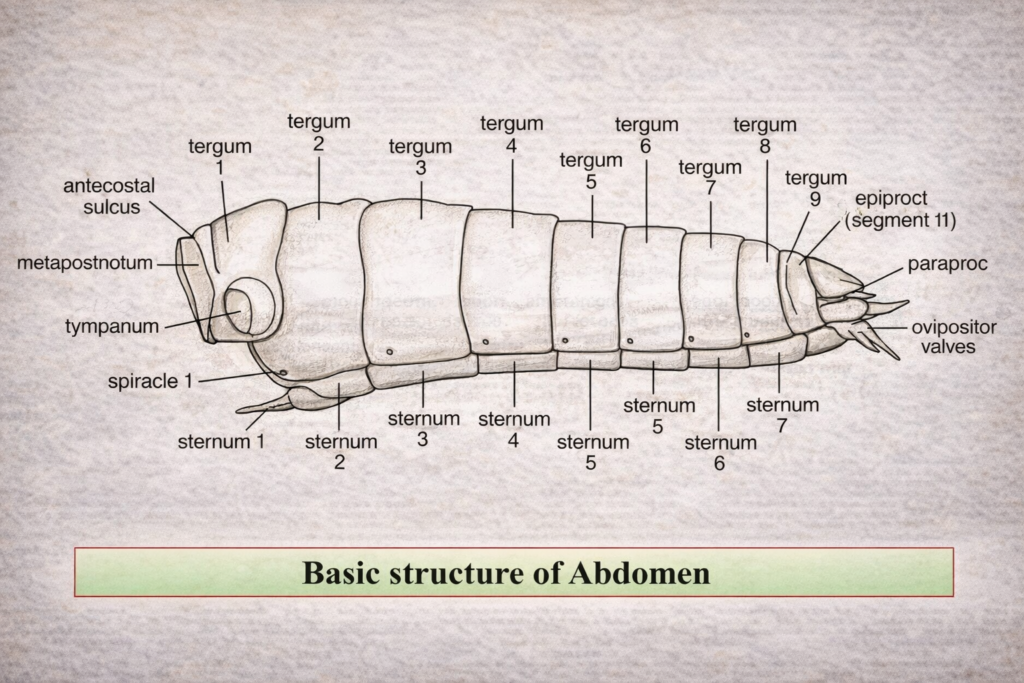
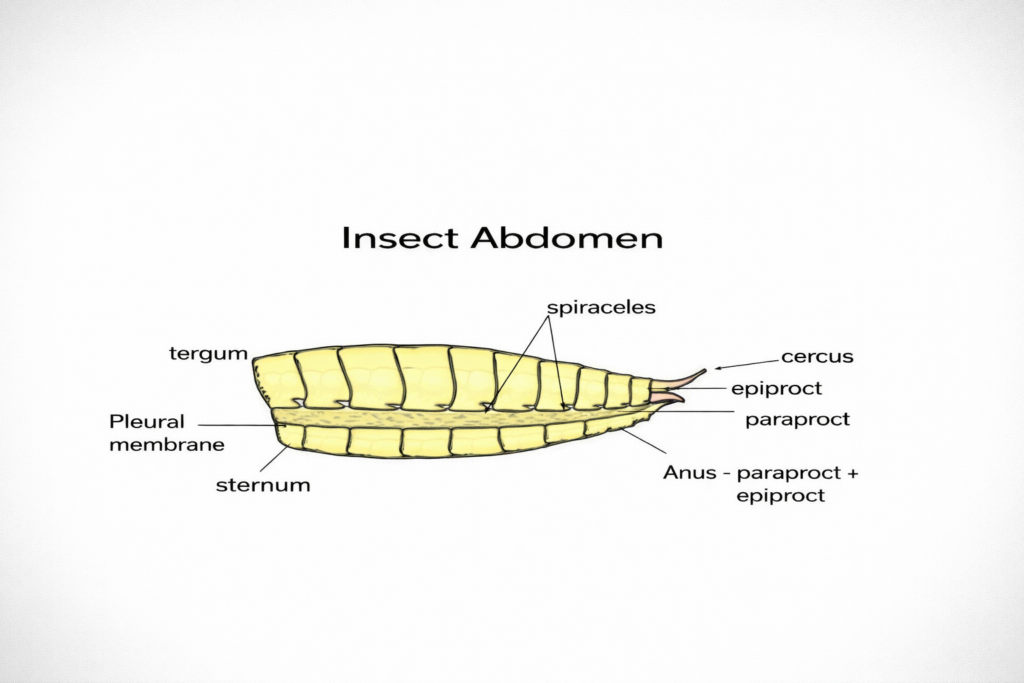
Each segment in the Insects Abdomen is typically protected by two major hardened plates:
- Tergum (Tergite): The dorsal (top) plate that protects the dorsal vessel (heart) and provides an anchor for the longitudinal muscles.
- Sternum (Sternite): The ventral (bottom) plate that protects the ventral nerve cord and the primary digestive tract. These plates are not fused into a solid ring. Instead, they are connected laterally by a flexible, unsclerotized pleural membrane. This arrangement is functionally critical; it allows the Insects Abdomen to expand and contract—a process essential for gas exchange (abdominal pumping) and for female insects during the “gravid” (egg-heavy) stage.
External Anatomy: Plates, Membranes, and Articulations
The Dorsal Tergites and Ventral Sternites: Protective Armor
The Insects Abdomen relies on the arrangement of these sclerites for protection. The tergites often overlap like shingles on a roof, providing armor while maintaining flexibility. In some beetles (Coleoptera), the abdominal tergites are soft because they are protected by the hardened forewings (elytra), whereas the sternites of the Insects Abdomen are heavily armored to protect the insect from ground-based threats and friction. In aquatic species, these sclerites may be streamlined to reduce drag during swimming.
Telescoping Mechanisms and Biomechanical Flexibility
The “telescoping” nature of the Insects Abdomen is a key evolutionary feature. By sliding the segments over one another (using intersegmental membranes), insects can dramatically change abdominal volume. This is used for:
- Active Respiration: Forcing air through the tracheal system via rhythmic contractions.
- Defense: Some insects “telescope” their abdomen to mimic the stinging motion of a wasp, even if they lack a sting.
- Reproductive Reach: Allowing the insect to reach deep into crevices, soil, or host organisms to deposit eggs with precision.
Comparative Analysis of Abdominal Appendages in Insects
Pre-Genital Appendages: Styli, Prolegs, and Gills
While most adult insects lack legs on the Insects Abdomen, primitive groups and larvae retain specialized appendages.
- Styli: Small, leg-like structures found in Archaeognatha (bristletails) and Zygentoma (silverfish). They provide sensory feedback and stability.
- Prolegs: Fleshy, temporary “legs” found on the Insects Abdomen of caterpillars. Unlike thoracic legs, they are hydraulic and use hooks called crochets to grip surfaces.
- Abdominal Gills: In aquatic nymphs (e.g., mayflies), the Insect Abdomen features leaf-like or filamentous gills that extract oxygen from water.
Sensory Appendages: The Functional Diversity of Cerci
Cerci are paired appendages located on the 11th segment of the Insects Abdomen. Their morphology is highly variable depending on the ecological niche:
- Filamentous: Long and thread-like (e.g., crickets) for detecting subtle air currents from approaching predators.
- Forceps-like: Modified into powerful pincers (e.g., earwigs) for defense, prey capture, and folding wings.
- Short and Stout: Found in many grasshoppers, acting as tactile sensors during mating.
Terminalia: The Complex Morphology of the Ovipositor
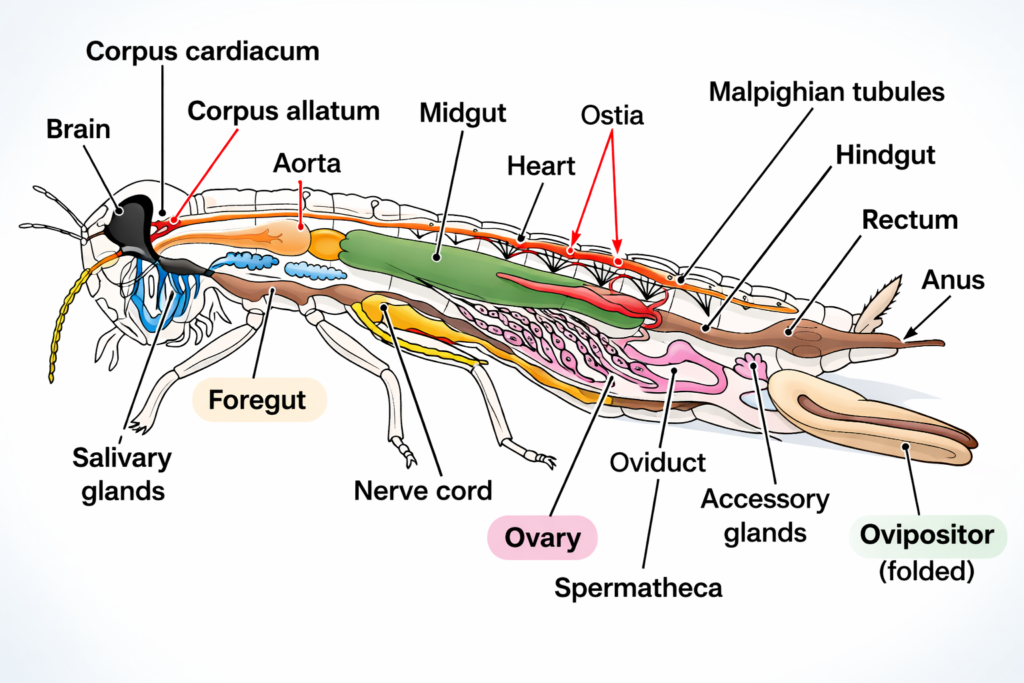
The Insect Abdomen terminalia include the reproductive organs.
- The Ovipositor: In females, segments 8 and 9 are modified into an organ for laying eggs. It can be needle-like for piercing plant tissue, saw-like for wood, or even modified into a venom-injecting sting in bees and wasps.
- The Aedeagus: In males, this structure on the Insects Abdomen is the intromittent organ. Because these structures must fit like a “lock and key” with the female, they are the most important diagnostic features for species identification in modern entomology.
Respiratory and Sensory Specializations of the Abdomen
The Spiracular System: Lateral Portals for Gas Exchange
The Insect Abdomen is the primary site for respiration. Typically, one pair of spiracles is located on each of the first eight segments within the pleural membrane. These openings are the gateway to the tracheal system. In 2026, researchers are focusing on the “valvular” mechanics of these spiracles to understand how insects survive in low-oxygen or highly polluted environments by regulating water loss.
The Tympanum: Comparative Hearing Organ Placement
In several insect groups, the Insects Abdomen houses the primary hearing organ. In grasshoppers (Acrididae), a large tympanum is located on the first segment of the Insects Abdomen. This placement allows the insect to detect the high-pitched calls of mates or the ultrasound of bats through the resonance of the abdominal cavity.
Modifications of the Insect Abdomen Across Major Orders
The “Wasp Waist” (Petiole and Propodeum)
One of the most famous modifications is the “wasp waist” found in the Hymenoptera suborder Apocrita.
- Propodeum: The first abdominal segment is fused to the thorax.
- Petiole: The second (and sometimes third) segment is narrowed into a stalk. This modification gives the Insects Abdomen extreme mobility, allowing a wasp to point its sting in almost any direction with surgical precision.
Defense Mechanisms: Glands and Chemical Warfare
Many insects have developed abdominal glands that spray caustic chemicals for defense. The bombardier beetle is a prime example, using a combustion chamber within the Insects Abdomen to spray boiling, noxious fluids. Other insects, like aphids, use cornicles on the abdomen to secrete pheromones or defensive waxes.
Conclusion: The Abdomen as an Evolutionary Masterpiece
The Insect Abdomen is far more than a simple container for guts; it is a highly specialized, adaptable, and flexible tagma that has allowed insects to dominate every terrestrial and freshwater environment. From the segments that facilitate breathing to the complex terminalia that ensure reproductive success, the Insects Abdomen is a testament to evolutionary efficiency. For students and researchers in 2026, the Insects Abdomen remains a critical area of study for understanding biodiversity, physiology, and species-specific behavior.
FAQs: Understanding the Insect Abdomen
- How many segments are in the Insect Abdomen? Usually 11 in embryos, though often reduced to 9 or 10 in adults due to fusion or internalization.
- What is the function of abdominal spiracles? They are the external openings used for gas exchange and respiration within the Insect Abdomen.
- Where is the hearing organ in grasshoppers? It is the tympanum, located on the first segment of the Insects Abdomen.
- What are cerci? Sensory appendages found at the posterior tip of the Insect Abdomen, used for detecting tactile stimuli.
- Why is the Insect Abdomen flexible? To allow for respiratory pumping, egg-laying, and extreme maneuverability.


