
The study of intraspecific and interspecific interactions is a cornerstone of modern entomological ecology, providing a critical framework for understanding how hexapods conquer diverse habitats and maintain ecosystem balance. At its core, this discipline categorizes the multi-directional factors that orbit the individual insect, separating the relationships within a single species (Intraspecific) from the complex web of interactions between different, multi-species assemblages (Interspecific). By systematically analyzing these specific interactions, researchers in 2026 can develop highly accurate population dynamic models, which are essential for predicting pest outbreaks and designing sustainable conservation strategies. This integrated approach moves beyond simple observation, allowing for a deep understanding of the physiological, behavioral, and chemical mechanisms that drive both cooperation and competition within and between species.
For a professional graphic designer, data analyst, or precision agriculture strategist, the conceptualization of these specific interactions as a “social landscape” offers a logical way to visualize the ecological constraints and opportunities that define an insect’s state. The intraspecific classification focuses on internal group dynamics, such as social hierarchy, mate selection, and the aggregation of whiteflies, which can be modeled using principles of swarm intelligence and pheromone signaling. In contrast, the interspecific classification explores the “struggle and synergy” between divergent taxa, from the useful mutualism of ants and aphids to the lethal mechanics of parasitism and predation, providing a technical blueprint of the functional pillars—pollination, parasitism, and decomposition—that sustain nutrient and energy flow.
Mastering the nuances of these specific interactions is essential for navigating the complex ecological and evolutionary trade-offs that insects face across terrestrial and aquatic systems. Whether we are analyzing the specific interspecific signaling of alarm pheromones (like E-farnesene), which can alert both heterospecific predators and conspecific rivals, or modeling the competitive pressures of matched niche space in intraspecific sibling rivalry, this framework provides the definitive technical vocabulary needed for modern research. This article provides a comprehensive technical review of these classifications, exploring the immediate social drivers and the broader trophic dynamics that sustain the most diverse group of animals on our planet.
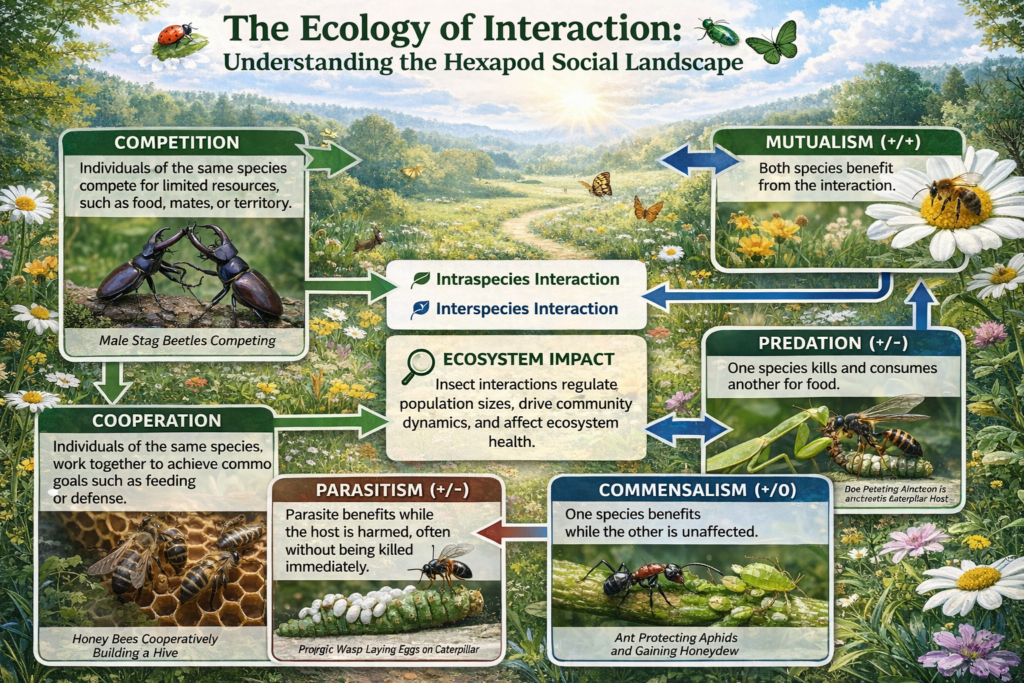
The Ecology of Interaction: Understanding the Hexapod Social Landscape
Defining the Organismal Center: How Multi-Directional Factors Orbit the Insect
- This perspective views the individual insect as the “center” of a web of radiating environmental variables. Both biotic (living) and abiotic (non-living) factors are multi-directional, constantly interacting with this center to determine survival.
- The insect’s state (e.g., metabolic rate, behavioral response) is a direct result of these forces, allowing for the isolation of specific drivers, such as a chemical cue or temperature shift, in population modeling.
Biological Constraints vs. Environmental Resistance: Intraspecific & Interspecific Friction
- Specific interactions often create a form of friction, known as environmental resistance, which opposes an insect’s innate biological constraints, such as its maximum reproductive rate (biotic potential).
- Understanding this friction is essential for precise surveillance and precision pest management, as it dictates how populations fluctuate within a given habitat.
Intraspecific Interactions: Dynamics and Relationships within a Single Species
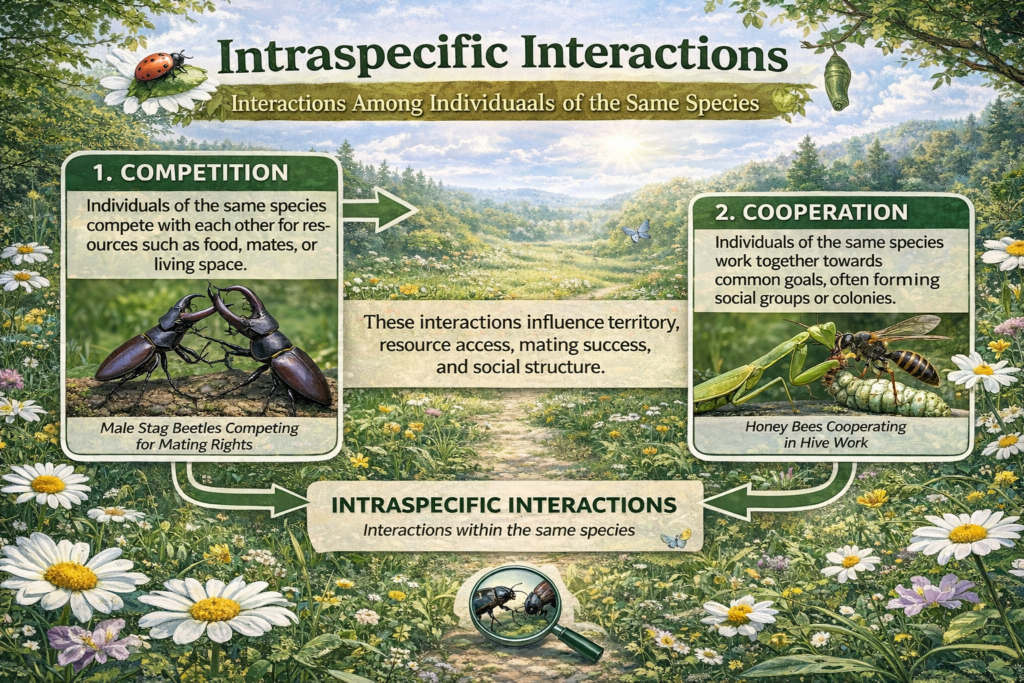
Intraspecific interactions are the relationships, communication, and resource-sharing strategies that occur among the individuals of the same insect species.
Intraspecific Competition: Sibling Rivalry and the Struggle for Matched Niche Space
- This occurs when individuals of the same species compete for identical resources, a concept known as matched niche space.
- The competition can be modeled through growth patterns, such as J-shaped exponential curves, which are typically found in situations of high intraspecific friction.
Social Cooperation and Intraspecific Communication: Pheromones, Sound, and Whitefly Aggregation
- Social cooperation involves collective behaviors that enhance group survival, such as defense, foraging, and offspring care.
- This is mediated through intraspecific communication, utilizing chemical signals (pheromones like E-farnesene) and sound to coordinate specific aggregate behaviors, a key example being the whitefly.
Interspecific Interactions: The Complexity of Multi-Species Assemblages
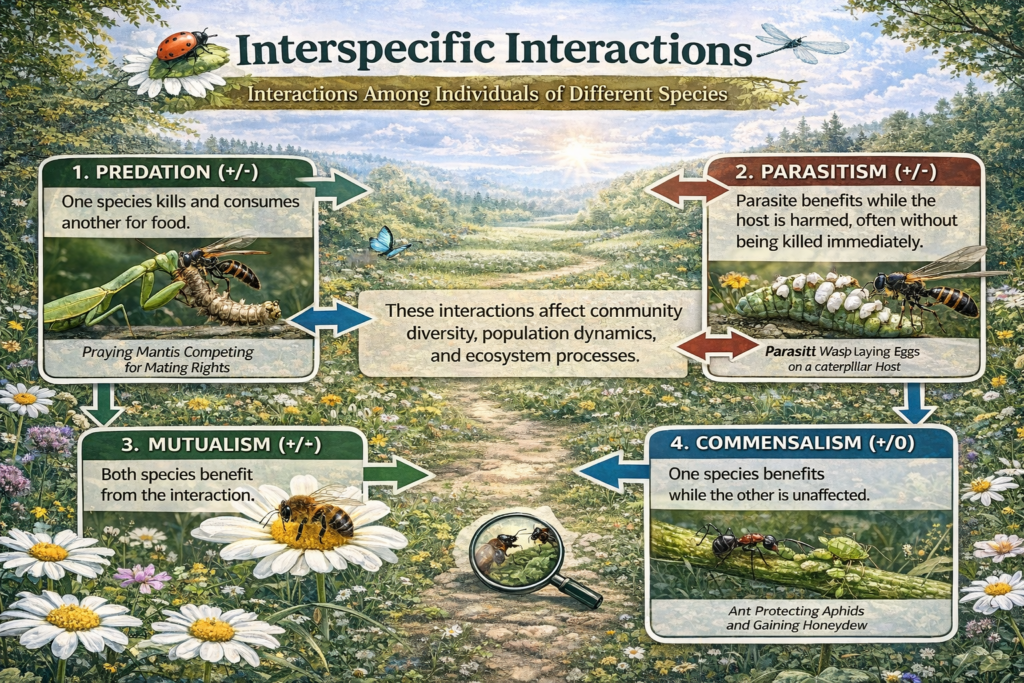
Interspecific interactions are the complexity of multi-species assemblages and relationships, including predation, symbiosis, and competition, that occur among individuals of different species.
Symbiosis and Mutualism: Ants, Aphids, and the Economics of Honeydew
- This is a type of symbiotic specific interaction where both species benefit, often driven by the transfer of energy or resources.
- A classic case is the mutualism between ants and aphids, where the ants provide protection in exchange for a sugary excretory product called honeydew, a technical term found in the lecture context.
Allelochemical Defenses: How Secondary Metabolites Mediate Interspecific Repellence
- Many interspecific interactions are mediated through chemical ecology, where organisms produce secondary metabolites (allelochemicals) for defense.
- These compounds can act as repellents, preventing predation by insects of different species.
Trophic Cascades and Predatory Dynamics in Managed Ecosystems
This section explores the flow of energy and the specific interactions involving secondary consumers, such as predators and parasites.
Case Study in Agroecosystems: Ladybird Beetles vs. Jassids and Whiteflies
- The relationship between a predator (ladybird beetle) and its prey (jassids and whiteflies) is a foundational interspecific specific interaction studied in agroecosystems.
- Understanding these dynamics is critical for developing sustainable, biologically-based pest control methods in modern 2026 agriculture.
Parasitism and Hyperparasitism: Complex Secondary Consumer Interactions
- These are specialized interspecific specific interactions where one species (the parasite) benefits at the expense of another (the host).
- When a parasite itself is parasitized by another distinct species, it is known as hyperparasitism, a key concept for modeling nutrient and energy flow.
2026 Frontiers in Behavioral Ecology and Social Modeling
This section discusses how modern technology and data are being integrated into the classification of specific interactions.
Molecular and Chemical Ecology: The Role of E-Farnesene in Interspecific Signaling
- Chemical ecology in 2026 is moving toward molecular-level understandings of pheromones, with a specific focus on signals that bridge classifications.
- E-farnesene, the universal alarm pheromone, is an intraspecific specific interaction cue (cooperating with conspecifics) that simultaneously acts as an interspecific specific interaction signal (alerting heterospecific predators).
Real-Time Precision Surveillance and Precision Pest Management
- Precision agriculture utilizes real-time precision surveillance drones to monitor specific interactions and environmental resistance in agricultural fields, allowing for precision pest management.
Conclusion: Integrating Social Dynamics into Sustainable Conservation and Pest Control
The classification of intraspecific and interspecific interactions provides the definitive roadmap for navigating the “web of radiating factors” that dictates an insect’s ecological success. By balancing the social cooperation of the conspecific world against the complex predatory and symbiotic pressures of the heterospecific world, insects maintain a state of ecological equilibrium. Integrating this technical understanding into sustainable conservation and biologically-based pest control is the defining challenge for entomologists in 2026, allowing us to utilize precision surveillance to manage ecosystem balance.
FAQs: Understanding Specific Interactions in Insect Ecology
- What is the fundamental difference between intraspecific and interspecific interactions? Intraspecific interactions refer to the specific interactions and relationships occurring among individuals of the same species. In contrast, interspecific interactions occur among individuals belonging to different species.
- Can you give a common example of an interspecific interaction in agriculture? A primary example is the relationship between a ladybird beetle and a whitefly. In this specific interaction, the ladybird beetle acts as a predator, feeding on the whitefly to regulate its population.
- What is “matched niche space” in the context of intraspecific competition? Matched niche space refers to a situation where individuals of the same species require the exact same resources (food, shelter, mates) at the same time. Because their needs are identical, the intraspecific competition for these resources is often more intense than competition between different species.
- How do insects use chemical signaling for both types of interactions? Insects utilize chemicals called allelochemicals or pheromones to communicate. For example, a whitefly may use pheromones for intraspecific aggregation (grouping together), while a plant might release secondary metabolites to repel insects of a different species, which is an interspecific defense.
- Why is understanding these interactions important for modern pest management? By analyzing specific interactions, researchers can identify natural enemies (predators or parasites) that can be used in precision pest management. This allows for the control of pest populations through biological means rather than relying solely on chemical pesticides.
