
The study of insect environment classification is a vital discipline within entomology that seeks to categorize the diverse external factors influencing an insect’s life cycle, behavior, and reproductive success. An insect does not exist in a vacuum; rather, it is at the center of a complex web of sum total external factors that affect its growth and survival. By systematically classifying these factors into biotic and abiotic categories, researchers can better predict population dynamics and the impact of environmental changes on both beneficial insects and agricultural pests.
In 2026, the framework for insect environment classification has moved beyond simple observation to include high-resolution modeling of microenvironments. For a professional graphic designer or marketing strategist, this scientific structure offers a logical way to visualize the “Organismal Center,” where every variable—from the humidity of a single leaf to the temperature of an entire orchard—orbits the insect. This framework allows for a multidimensional understanding of how hexapods adapt to terrestrial and aquatic constraints, ensuring their ecological success across nearly every biome on Earth.
Mastering the nuances of insect environment classification is essential for developing sustainable pest management and conservation strategies. Whether we are analyzing the useful versus harmful effects of host plants or the competitive pressures of intraspecific interactions, this framework provides the precise terminology needed for academic and professional excellence. This article provides a technical breakdown of these classifications, exploring the immediate micro-habitats and the broader abiotic drivers that sustain the most diverse group of animals on our planet.
Defining the Insect Environment: The Sum of External Influences
The Holistic View: Biological and Physical Surrounding Factors
- The insect environment is defined as the sum total of all the external factors lying around an organism which affect its life.
- These factors include a diverse range of variables such as humidity, soil, water, air, plants, animals, and temperature.
- Every biological process, from metabolism to movement, is a response to these surrounding influences.
The Organismal Center: How Environmental Variables Orbit the Insect
- In ecological modeling, the insect is viewed as the central point influenced by multiple radiating factors.
- Biotic factors (living) and abiotic factors (non-living) constantly interact with this center to determine survival.
- This perspective helps entomologists isolate which specific factor—such as a chemical signal or a sudden temperature shift—is driving a change in the insect’s state.
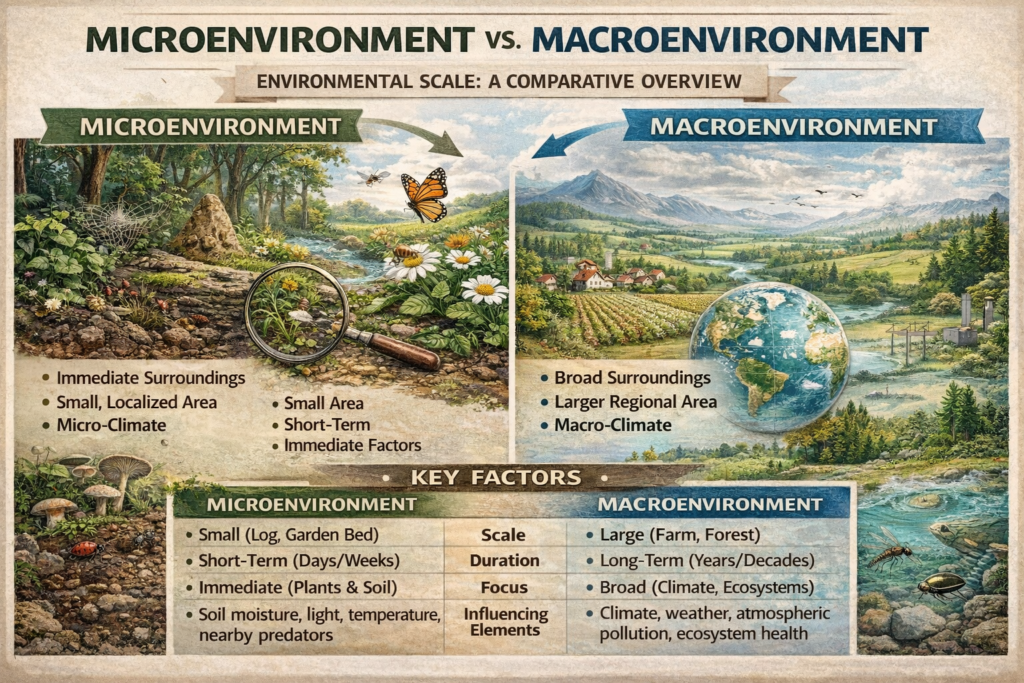
Ecological Perspectives: Microenvironment vs. Macroenvironment
Microenvironment: The Immediate and Limited Living Space
- The microenvironment is the small, limited, very close, and immediate insect environment in which an organism lives.
- For an insect, this is often a very restricted space, such as the underside of a specific leaf or a small patch of soil.
Macroenvironment: The Distant and General Prevailing Conditions
- The macroenvironment refers to the large, distant environment or general environment prevailing outside the microenvironment.
- It encompasses broader climate patterns and regional ecological conditions that indirectly influence the organism.
Case Study: The Cotton Field as a Specialized Micro-Habitat
- An insect sitting in a cotton field exists within the microenvironment of that specific field.
- The general environmental conditions prevailing outside that cotton field constitute its macroenvironment.
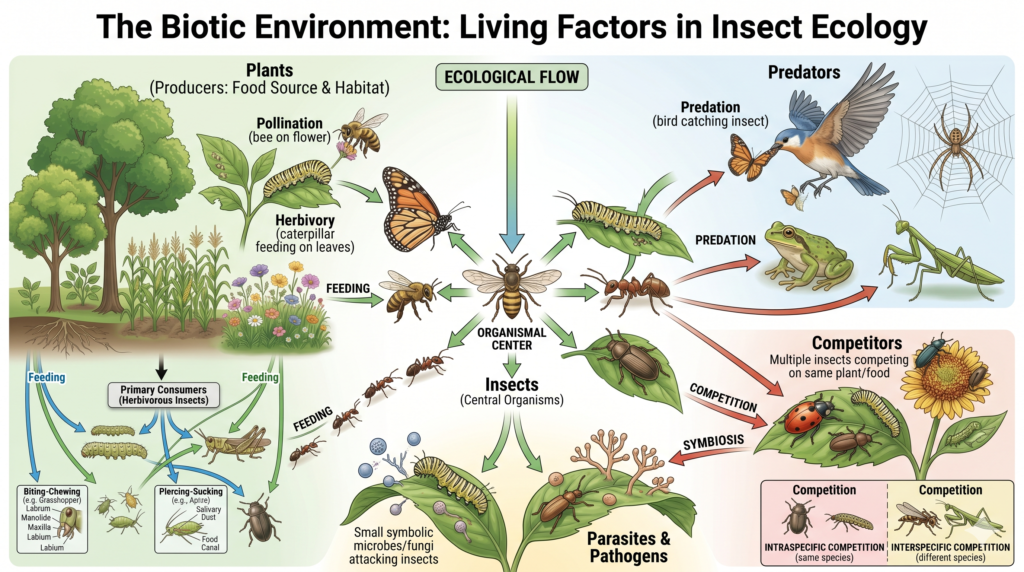
The Biotic Environment: Living Factors in Insect Ecology
The biotic insect environment includes all living factors, such as plants, animals, and other insects, that affect the organism.
Useful vs. Harmful Plants: Food, Shelter, and Allelochemical Defense
- Useful Plants: Have a positive effect on insect life by providing essential food and shelter. For example, sugarcane, rice, and maize borers get food and shelter from their host plants.
- Harmful Plants: Have a negative effect through repelling or killing insects.
- Repelling Effect: Some plants produce toxic substances called allelochemicals, secondary plant metabolites, or plant byproducts that repel insects. Examples include neem leaf, tobacco leaf, and chrysanthemum flowers.
Insectivorous Plants: The Lethal Mechanics of Traps and Pitchers
- Some plants act as predators, trapping and killing insects to meet their nutritional deficiencies.
- Key examples include the Pitcher plant, Venus flytrap, and Sundew plant.
Animal Interactions: Parasitic Success and Predatory Pressure
- Useful Animals: Have a positive effect by providing food and shelter for parasitic insects. Examples include buffaloes, poultry, birds, dogs, and cats.
- Harmful Animals: Have a negative effect by feeding on insects as predators. This includes small mammals (shrews, moles, hedgehogs, anteaters), birds (sparrows, starlings, mynahs), frogs, toads, and lizards.
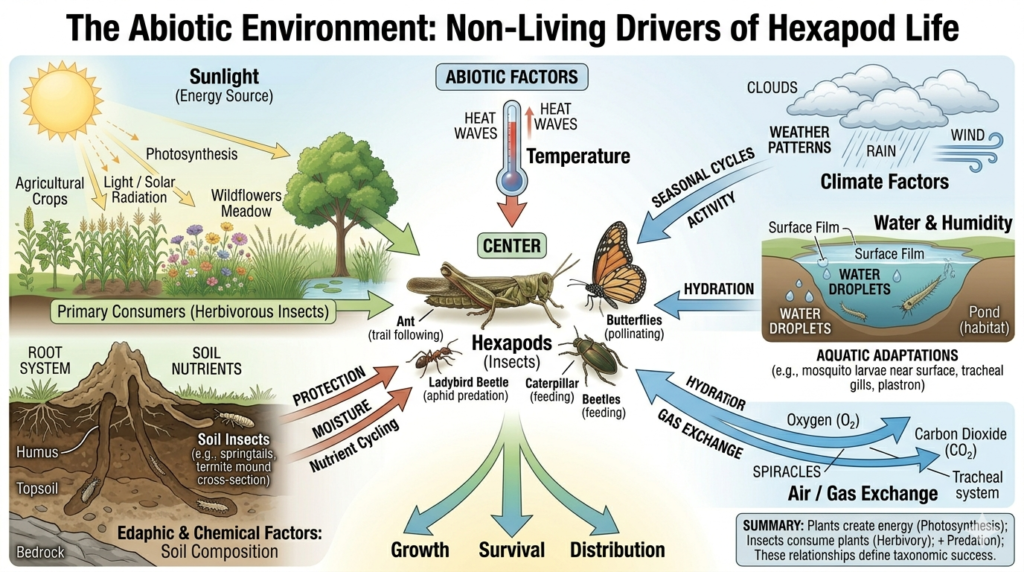
The Abiotic Environment: Non-Living Drivers of Hexapod Life
The abiotic insect environment encompasses all non-living factors like soil, water, air, temperature, and humidity.
Physical and Atmospheric Factors: Temperature, Humidity, and Light
- Temperature and relative humidity are critical physical factors that dictate metabolic rates and activity levels.
- Light influences biological cycles, while atmospheric factors like wind and gases affect dispersal and respiration.
Edaphic and Chemical Factors: Soil Composition and Water Quality
- Soil factors are vital for ground-dwelling insects and larvae, influencing their protection and moisture access.
- Aquatic factors and various environmental chemicals play significant roles in the development of aquatic and semi-aquatic species.
Miscellaneous Constraints: Gravity, Sound, and Atmospheric Pressure
- Insects must also navigate miscellaneous factors like gravity, sound, and changes in atmospheric pressure.
Intraspecific and Interspecific Dynamics: Social vs. Competitive Interaction
The biotic insect environment is further defined by interactions with other insects.
Intraspecific Interactions: Relationships Within the Same Species
- These are interactions among the individuals of the same species of insect.
- For example, whitefly individuals interacting with other whiteflies.
Interspecific Interactions: The Struggle and Synergy Between Different Species
- These occur among individuals of different species.
- For example, a ladybird beetle interacting with or preying on a whitefly or jassid.
Conclusion: Integrating Biotic and Abiotic Factors for Ecosystem Balance
The insect environment classification provides the essential roadmap for understanding how hexapods conquer diverse habitats. By balancing the useful resources of their biotic surroundings against the rigid constraints of the abiotic world, insects maintain a state of ecological equilibrium. This integrated view is the key to modern entomology, allowing us to see the insect not just as an individual, but as a central player in a vast, interactive environmental theater.
FAQs: Understanding Insect Environmental Classifications
- What is the difference between a microenvironment and a macroenvironment? A microenvironment is the small, immediate space (like a single field), while a macroenvironment is the general prevailing condition outside that space.
- Are all plants beneficial to insects? No; while useful plants provide food and shelter, harmful plants produce repelling toxic substances or actively trap and kill insects.
- What are abiotic factors? They are all the non-living factors like soil, water, air, temperature, humidity, and light that affect an insect’s life.
- What is an interspecific interaction? It is an interaction between individuals of different species, such as a predator and its prey.
- How do animals help insects? Useful animals can provide a habitat (as hosts) and food source for parasitic insects.
