
Exocrine Glands represent a specialized class of organs in the insect body designed to discharge their secretions either directly to the exterior of the body or into cuticle-lined ducts. Unlike the endocrine system, which regulates internal physiological processes through hormones released directly into the blood (hemolymph), Exocrine Glands are focused on external interactions and environmental manipulation. These secretions are the primary drivers of an insect’s ability to communicate with its peers, defend itself against predators, and protect its delicate cuticle from desiccation.
In the scientific study of life, the Exocrine Glands are recognized as being epithelial in origin, essentially derived from the epidermis or integument. This evolutionary connection to the outer body wall allows these glands to be distributed across almost every region of the insect, including the antennae, mouthparts, legs, and genital segments. Because their secretions are destined for the outside world, they are uniquely equipped with cuticular ducts that are continuous with the insect’s external skeleton, ensuring a safe and directed passage for often volatile or caustic chemicals.
By analyzing the Exocrine Glands through the lens of modern entomology, we see an incredible range of structural complexity, from simple unicellular pores to massive, multicellular glandular units. Whether they are producing the beeswax used to construct a hive, the trail pheromones that guide an ant colony, or the repellent “stink” that deters a bird, these glands are fundamental to the ecological success of the Class Insecta. This article provides a comprehensive technical breakdown of their anatomy, distribution, and the advanced cellular mechanisms that power their daily operation.
Defining the Exocrine System: Secretion to the Exterior
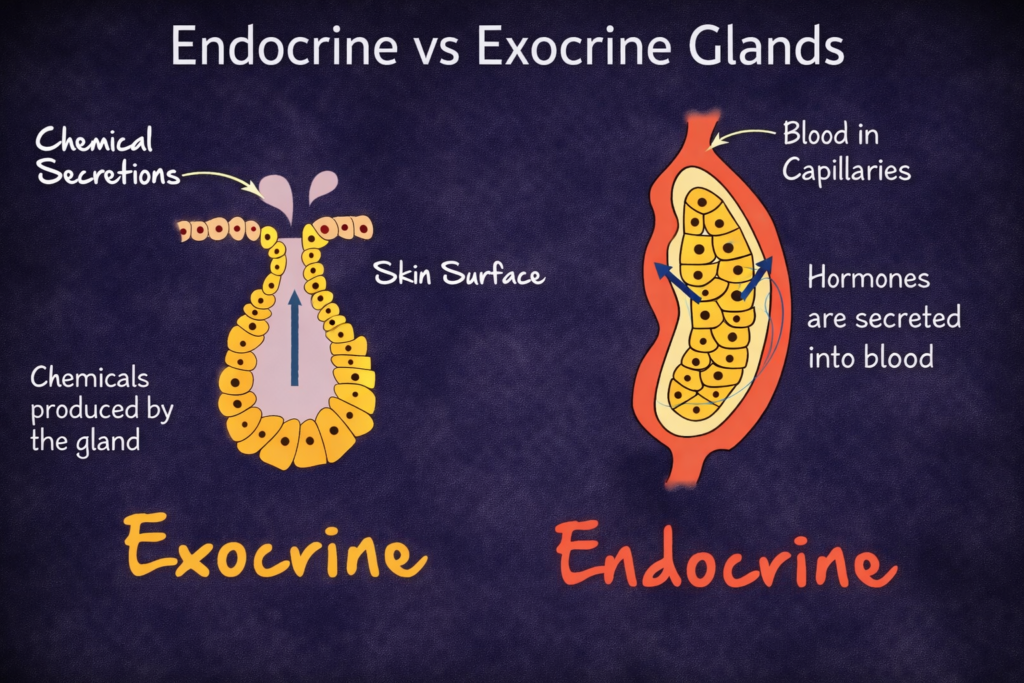
Exocrine vs. Endocrine: Internal Hormones vs. External Discharge
- Exocrine Glands are defined by their ability to discharge secretions to the exterior of the body.
- These glands utilize cuticle-lined ducts to transport materials, whereas endocrine glands are typically ductless in their release to the hemolymph.
- Endocrine glands release hormones internally into the blood for physiological regulation.
- Exocrine Glands release chemical secretions for communication, defense, and protection against environmental stressors.
Evolutionary Origin: The Epidermal and Integumentary Derivatives
- These organs are epithelial in origin and are structurally derived from the epidermis or integument.
- Their development as epidermal derivatives allows them to be seamlessly integrated into the body wall.
- The evolution of these glands reflects a profound adaptation to the ecological and behavioral needs of various insect species.
Primary Biological Roles: Communication, Defence, and Protection
- Secretions play critical roles in inter-species and intra-species communication.
- Exocrine Glands are vital for protection through the production of repellents and deterrents.
- They ensure mating success through pheromone release and facilitate social coordination in colonial insects.
Anatomical Architecture of Insect Exocrine Glands
The Secretory Unit: Cells, Vesicles, and Large Nuclei
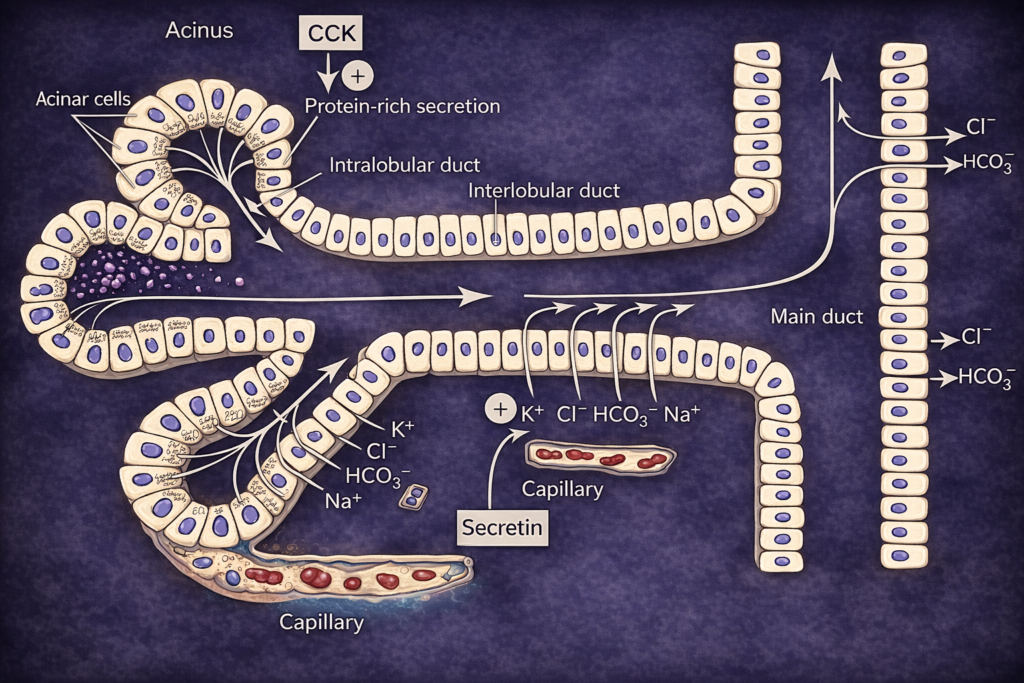
- Each gland generally consists of a secretory cell or a specialized group of cells.
- Gland cells are characterized by dense cytoplasm, numerous secretory vesicles, and large nuclei to support intense metabolic activity.
- Materials are actively transported from the cell cytoplasm into a central lumen or cuticular reservoir.
Cuticular Duct Systems: Transporting Secretions to the Surface
- Secretions pass through cuticular ducts that open to the exterior through the cuticle.
- These ducts are lined with cuticular material that is continuous with the external skeleton.
- This structure prevents caustic or volatile secretions from damaging the insect’s internal soft tissues.
Structural Complexity: Unicellular Pores vs. Multicellular Units
- Unicellular Exocrine Glands are single-celled and scattered among normal epidermal cells.
- Each unicellular gland produces and secretes its product directly through a specific pore.
- Multicellular glands are more complex, composed of multiple cells forming a glandular unit with shared ducts.
- These units are often grouped in specialized areas of the body to maximize secretion efficiency.
Distribution and Regional Specialization of Glands
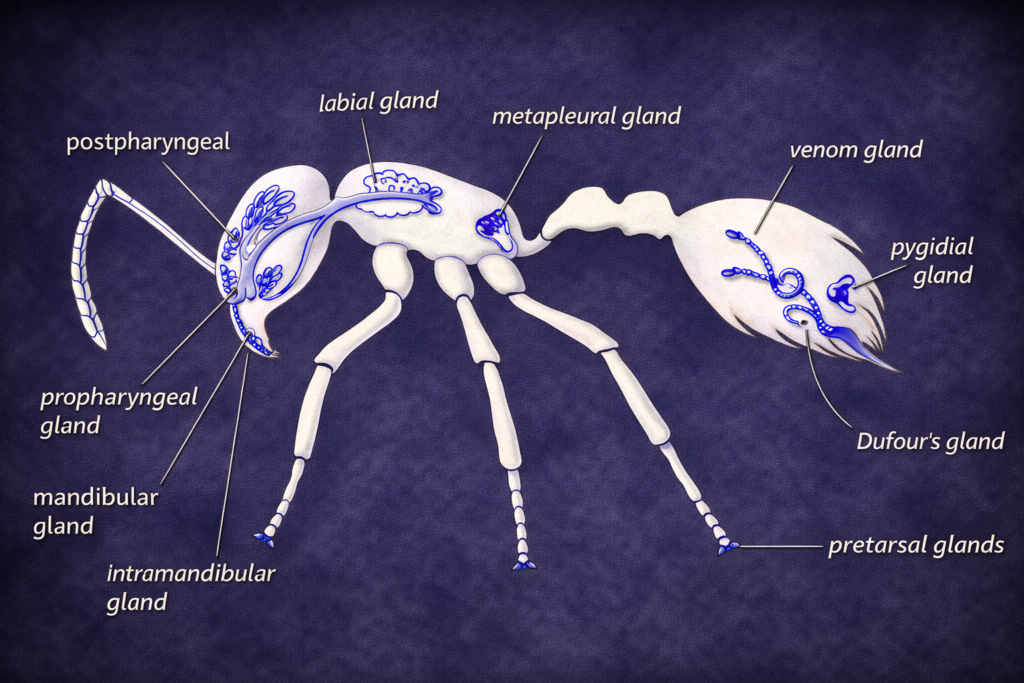
Exocrine Glands are found in many body regions, especially within the cuticle of the body wall. Their location is often modified for specific functions:
- Antennae and Mouthparts: Used for sensory signaling, trail following, and digestive fluid discharge.
- Legs: Often feature specialized glands like tenant hairs or pretarsal glands for adhesion and lubrication.
- Genital Regions: Specialized for the release of reproductive attractants and sex pheromones.
Functional Classification and Secretory Products
Dermal and Wax Glands: Waterproofing and Building
- Dermal glands produce waxes and lubricants that provide essential waterproofing for the insect.
- Wax glands are common in scale insects and bees, where they secrete wax used for building hives or protective coverings.
- These secretions also assist in cuticular maintenance and lubrication.
Odoriferous, Stink, and Repugnatorial Glands
- Odoriferous glands release chemicals that can be either defensive or attractive.
- Stink glands produce repellent substances to deter predators.
- Repugnatorial glands are specialized for defensive secretions and are particularly common in beetles and bugs.
Salivary Glands: Internal Exocrine Structures
- Although located internally, salivary glands are considered Exocrine Glands because they discharge digestive fluids through ducts.
- They are involved in the initial stages of the alimentary canal’s digestive process.
The Pheromonal System: Exocrine Glands as Communication Tools
Sex Pheromones: Volatile Attractants for Mating
- Pheromone glands are often located in the abdomen or cuticle.
- They release attractants that allow mates to locate each other over long distances.
- The flight path of many male insects, such as moths, is dictated by the pheromone plume released by the female.
Trail and Alarm Pheromones: Coordinating Social Insects
- Many pheromonal signals, including alarm and trail markers, rely on exocrine activity.
- These glands are vital for social coordination in colonies of ants, bees, and termites.
The Cellular Secretory Mechanism: From Cytoplasm to Lumen
The movement of materials through Exocrine Glands is a multi-step active process:
- Active Transport: Materials move from the cell cytoplasm into the lumen via active transport.
- Vesicle Fusion: Secretory vesicles fuse with the cell membrane to release the product into the duct.
- Duct Transport: Secretions pass through cuticular ducts to reach the outside environment.
- Cellular Support: Large nuclei and dense cytoplasm facilitate the high-energy demands of this secretory cycle.
Conclusion: Exocrine Evolution and Ecological Adaptation
Exocrine Glands are a testament to the evolutionary ingenuity of insects. By deriving complex chemical factories from simple epidermal cells, insects have gained the ability to manipulate their environment, communicate across distances, and defend themselves against much larger threats. From the protective waxes of a bee to the defensive sprays of a beetle, these glands remain central to the survival and social coordination of the most successful group of animals on Earth.
FAQs: Common Questions on Insect Exocrine Anatomy
- What is an exocrine gland in an insect? It is an epidermal derivative that releases secretions externally or into cuticle-lined ducts.
- How do they differ from endocrine glands? Exocrine glands have ducts and release secretions externally, while endocrine glands are ductless and release hormones into the blood.
- What are wax glands used for? They secrete wax for building hives (bees) or providing a protective, waterproof covering (scale insects).
- Where are pheromone glands usually located? They are often found in the abdomen or integrated into the cuticle of various body regions like the antennae or mouthparts.
- Why are salivary glands considered exocrine? Because they discharge their digestive fluids through a specific duct system to reach the mouth.
