
The study of Water factors within the abiotic environment is a critical pillar of entomology that examines how liquid moisture and atmospheric humidity influence an insect’s life cycle. For both terrestrial and aquatic species, water is the sum total of external liquid and vapor factors that affect vital biological processes, from respiration to thermal regulation. By systematically classifying these hydrological variables, researchers in 2026 can better predict the population dynamics of moisture-sensitive pests and identify the environmental resistance that limits their reproductive success.
In 2026, the analysis of Water factors has moved toward high-resolution modeling of fluid environments and relative humidity gradients. For insects, moisture represents a multidimensional constraint that orbits the “Organismal Center,” where even slight fluctuations in humidity can dictate the survival of eggs and soft-bodied larvae. This framework allows for a deep understanding of how hexapods adapt to aquatic systems or maintain internal water balance in arid terrestrial microenvironments, ensuring their ecological success across diverse biomes.
Mastering the nuances of Water factors is essential for developing sustainable pest management and conservation strategies. Whether we are analyzing the dissolved oxygen requirements of aquatic nymphs or the desiccation resistance of desert beetles, these non-living drivers sustain the most diverse group of animals on our planet. This article provides a technical breakdown of these abiotic classifications, exploring the immediate micro-habitats and the broader hydrological cycles that define the terrestrial and aquatic insect environment.
The Hydrological Influence: Defining Water in the Insect Environment
In the specialized field of insect ecology, the insect environment is defined as the sum total of all external liquid and vapor factors that surround and influence an organism. This definition encompasses a wide array of variables, ranging from the localized moisture found in soil to the large-scale precipitation patterns of the macroenvironment. These factors are fundamental because they directly influence an insect’s metabolism, its ability to move, and its overall physiological homeostasis. Without proper hydrological balance, the internal biological systems of an insect would rapidly fail, making water one of the most significant non-living drivers of life.
Insects are primarily classified by the medium they occupy: the fluid environment or the air-filled microenvironment. Aquatic insects are those that spend at least a portion of their life cycle submerged in water, requiring specialized morphological adaptations such as gills or siphons to extract oxygen. Conversely, terrestrial insects occupy air-filled spaces and must navigate the challenges of atmospheric humidity and potential water loss. The physical properties of these two environments—density, buoyancy, and oxygen availability—require drastically different survival strategies for hexapods to thrive.
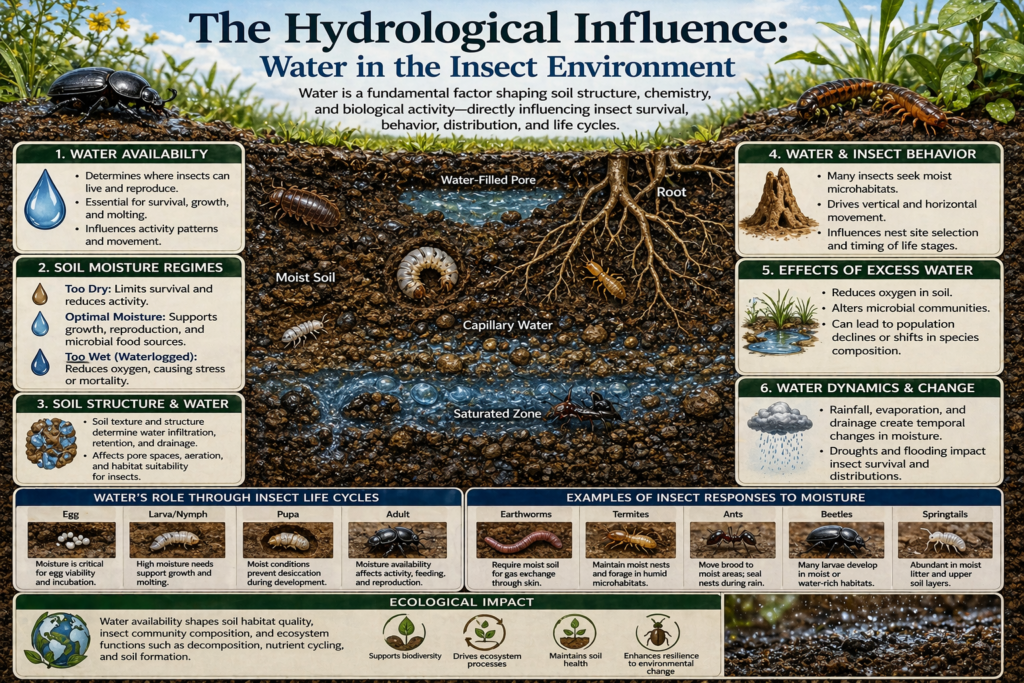
Humidity and Atmospheric Moisture: The Terrestrial Constraint
- Relative Humidity (RH) and its Impact on Metabolic Rates
- Relative humidity is a critical physical factor that dictates the rate of water loss from an insect’s body through the cuticle and spiracles.
- High humidity levels generally support faster growth and higher reproductive success, while low RH acts as a severe limiting factor or “environmental resistance”.
- For many species, the metabolic constant is strictly tied to the moisture levels of their immediate microenvironment.
- Desiccation Resistance: How Insects Manage Internal Water Balance
- Terrestrial hexapods have evolved waxy, waterproof exoskeletons and specialized behavioral patterns to resist drying out in low-moisture environments.
- This internal balance is vital for survival in the macroenvironment, where atmospheric conditions like wind and solar radiation can accelerate water loss.
- Managing this “water budget” is the primary challenge for insects inhabiting arid regions or high-canopy forest layers.
- Case Study: Humidity Requirements for Soft-Bodied Larvae and Pupae
- Many larvae, such as those of flies and beetles, possess thin cuticles and require a highly humid microenvironment to prevent lethal desiccation.
- Pupae are particularly vulnerable as they are immobile; they often rely on being buried in soil or hidden in plant tissues to maintain a stable moisture level.
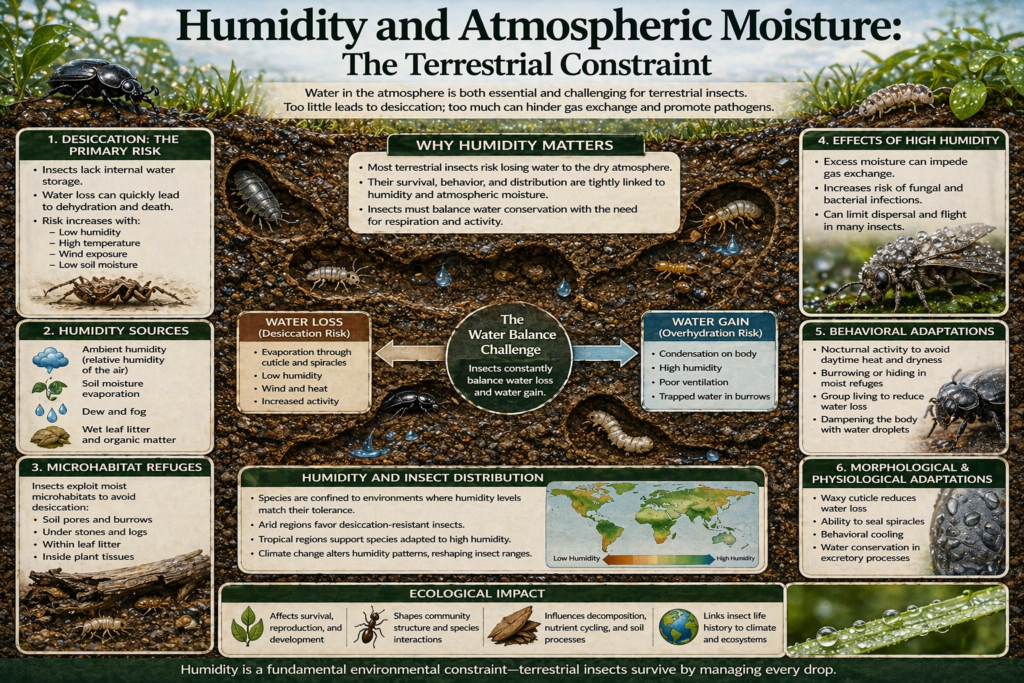
Aquatic Systems: Life in the Fluid Medium
Living in a fluid medium presents a unique set of abiotic challenges and opportunities that differ significantly from life on land. Water provides a dense, buoyant medium that allows for specialized modes of insect locomotion, such as jet propulsion in dragonfly nymphs or surface skating in water striders. However, the viscosity of water also creates higher resistance to movement compared to air, requiring insects to develop streamlined body shapes and powerful, fringed appendages for swimming. These physical properties of the aquatic habitat act as non-living drivers that shape the very morphology of the species residing within them.
Gas exchange remains the most critical hurdle for insects in the aquatic environment. Because water contains much less oxygen than air, aquatic hexapods have evolved ingenious structures such as tracheal gills to absorb dissolved oxygen directly from the water, or breathing siphons that allow them to pierce the surface film and breathe atmospheric air. Some diving beetles even carry a physical gill, known as a plastron or air bubble, which they use as an underwater oxygen tank. These chemical and physical factors are essential components of the abiotic environment that determine which species can survive in specific aquatic niches.
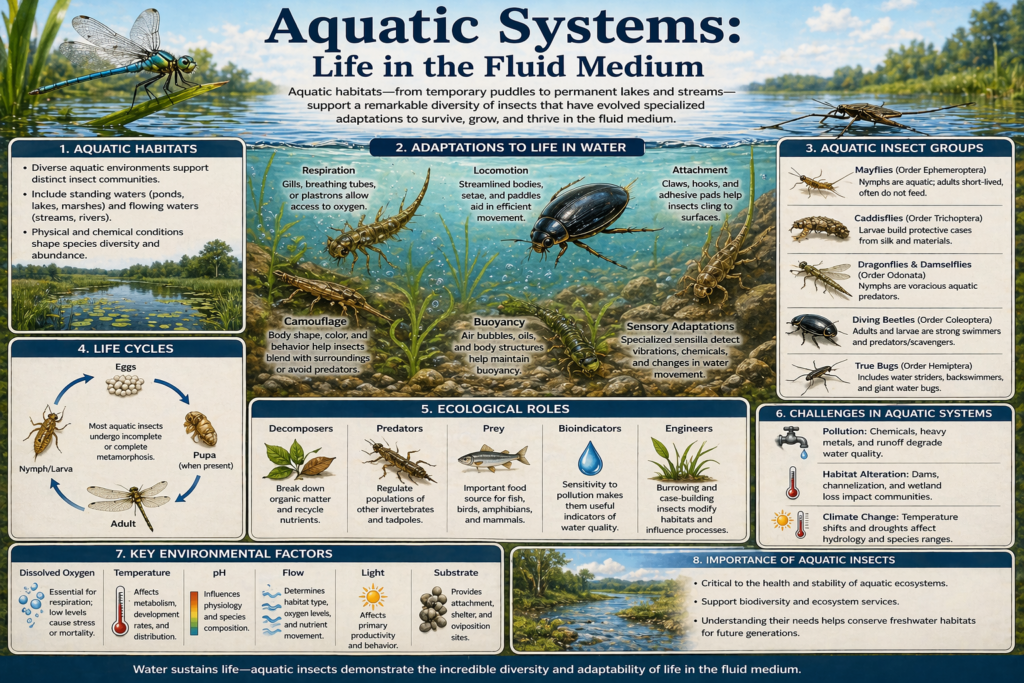
Water as a Medium for Habitat and Development
- Permanent Aquatic Dwellers: Diving Beetles and Water Striders
- These species spend their entire life cycle—from egg to adult—within or on the surface of the fluid environment.
- They have highly specialized adaptations for hunting, mating, and respiring without ever needing to leave the water.
- The Semiaquatic Bridge: Mosquito Larvae and Dragonfly Nymphs
- Many insects are considered “amphibious,” meaning their immature stages (larvae or nymphs) are strictly aquatic, while the adults are terrestrial or aerial.
- This transition requires a massive biological shift in respiration and movement as the insect moves from a fluid to an air-filled microenvironment.
- Precipitation and Seasonal Cycles: The Role of Rainfall in Emergence
- Rainfall and atmospheric moisture serve as the primary signals in the macroenvironment that trigger mass emergence and reproduction.
- Seasonal cycles of water availability dictate the phenology of many insect species, ensuring that larvae hatch during periods of high resource availability.
Water Factors as Environmental Resistance
While water is essential for life, it can also act as a powerful form of environmental resistance when present in extreme amounts or during periods of scarcity. Flooding and waterlogging are physical barriers that can saturate soil pores, effectively cutting off oxygen to subterranean insects and causing mass mortality among burrowing larvae. In these instances, the chemical and physical changes in the soil microenvironment create a lethal pressure that limits the biotic potential of the population.
Conversely, drought stress represents a significant abiotic constraint that can cause entire populations to crash. A lack of available Water factors limits an insect’s ability to feed, especially for sap-sucking insects that rely on plant turgor pressure, or for those that require standing water for breeding. This absence of moisture acts as a negative environmental factor that prevents a species from thriving, illustrating the delicate balance required between the insect and its hydrological surroundings.
Conclusion: Integrating Hydrological Dynamics for Ecosystem Balance
In conclusion, Water factors serve as the essential fluid and atmospheric pillars of the insect environment. From the specific humidity found on the underside of a cotton leaf to the complex dissolved oxygen levels in a pond, water dictates exactly where and how hexapods can survive. By understanding these hydrological dynamics, entomologists can gain a holistic view of the biotic and abiotic interactions that maintain the balance of nature in our global ecosystems.
FAQs: Understanding Aquatic and Humidity Factors in Entomology
- What exactly are aquatic factors? They are the specific non-living drivers associated with water-based environments, such as dissolved oxygen levels, water density, and liquid nutrients.
- How does low humidity impact insect survival? Low relative humidity causes rapid water loss, which can be lethal to eggs and soft-bodied larvae that lack thick waxy cuticles.
- What is the purpose of a breathing siphon? It is a specialized tube used by some aquatic insects to reach the surface and breathe atmospheric air while remaining submerged.
- Can water ever be considered a “harmful” factor? Yes; excessive water from flooding can act as a mechanical barrier that suffocates soil-dwelling insects.
- Why do some insects only live in water during their larval stage? This “amphibious” strategy allows them to utilize the nutrient-rich fluid environment for growth while using the terrestrial environment for dispersal and mating as adults.
